ScienceBasedKids.com may earn a commission from affiliate links in this review. Our ratings are never influenced by affiliate relationships. Read our full methodology.
A newborn’s visual world is a blur of light and shadow. They can see about 8-12 inches clearly — roughly the distance from a cradled arm to a parent’s face — and within that narrow window of focus, what captivates them most is contrast. Black and white. Bold patterns. Edges where light meets dark. This is not a design trend or a marketing hook. It is a consequence of the human visual system being, at birth, profoundly unfinished. The retina is immature. The visual cortex is waiting for input. And every high-contrast pattern a baby fixates on is, in a very literal sense, training the neural pathways that will eventually let them see the world in full resolution.
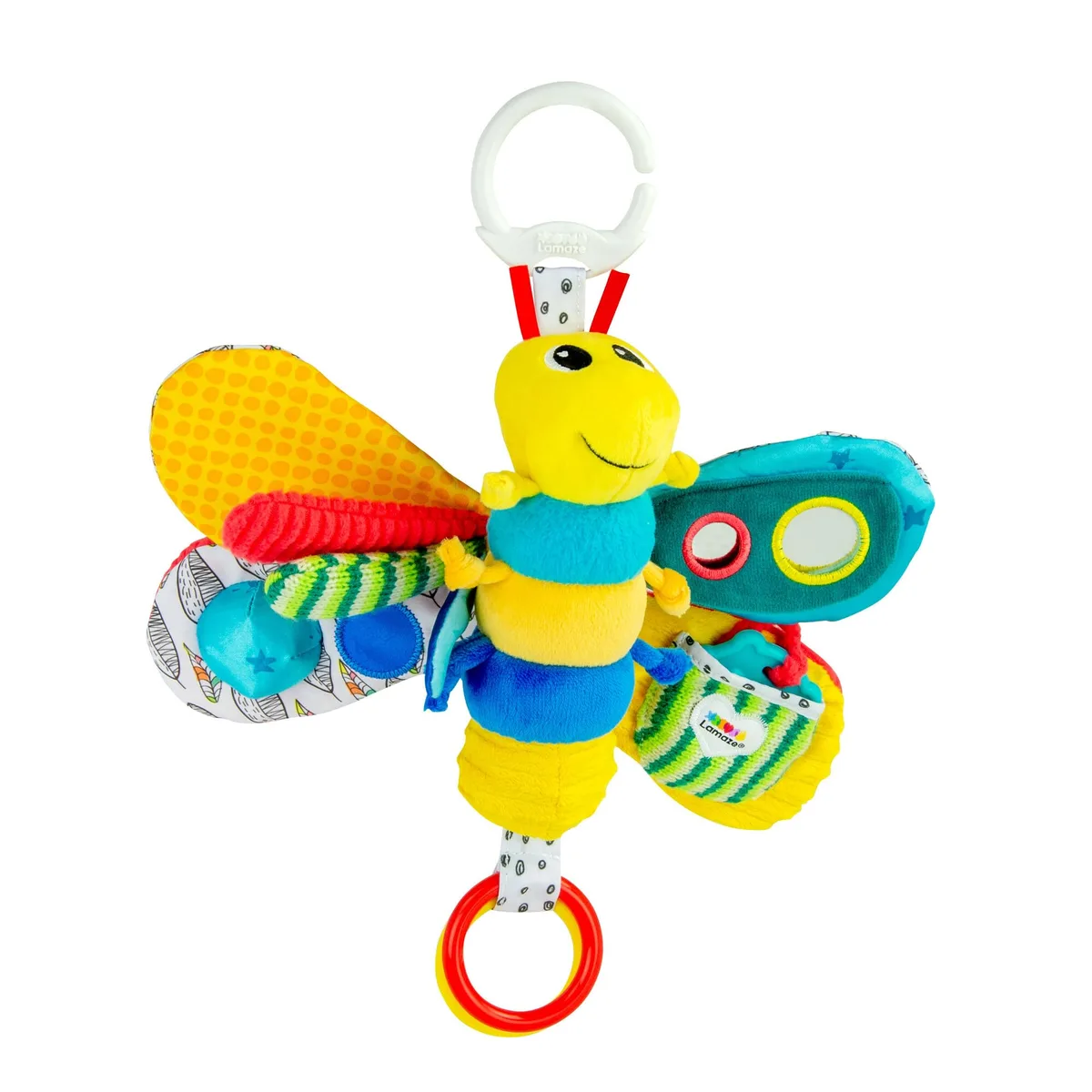
Lamaze Freddie the Firefly was designed with this neurobiology in mind. Not by accident, and not superficially. The toy is a catalog of sensory development principles translated into fabric, texture, and sound — a $15 clip-on creature that manages to address visual tracking, tactile discrimination, auditory processing, oral-motor exploration, and grasp development without ever looking like a clinical tool. It looks like a cheerful bug. It functions like a sensory curriculum.
Product Overview
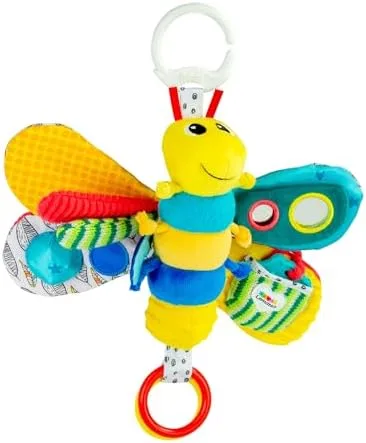
Lamaze Freddie the Firefly ($15) is a soft, plush sensory toy designed for infants from birth to approximately 24 months. It clips onto strollers, car seats, play gyms, and cribs via an integrated plastic ring, keeping it within the baby’s visual and reach range.
The design is dense with intentional features:
- High-contrast black-and-white patterns on the wings and body — targeting the newborn visual system’s preference for bold pattern contrast
- Bright, saturated colors (red, yellow, green, blue) — engaging the developing color vision that emerges between 2-4 months
- Multiple texture zones — smooth satin, crinkly fabric, knotted antennae, ribbed ribbon, plush velour. Each body section offers a different tactile experience
- Crinkle wings that produce a crinkling sound when squeezed — auditory feedback linked to the baby’s own action (cause and effect)
- A small squeaker in the body — another auditory element, requiring slightly more force to activate
- Textured teething surfaces on two of the lower segments — firm, textured rings designed for gumming
- Knotted ribbons and fabric loops at various points — graspable features that reward the developing palmar and pincer grasp
- A clip-on attachment that secures to fabric edges — keeps the toy accessible and prevents the “dropped it from the stroller, now it’s on the sidewalk” problem (partially — the clip is adequate, not foolproof)
The overall construction is soft fabric with no hard edges, no detachable small parts, and no battery-powered electronics. It measures approximately 12 inches long and weighs under 3 ounces.
Our Evaluation
Build Quality: 7/10
Freddie is well-made for a $15 toy. The stitching is tight and consistent. The fabric is soft without being flimsy. The crinkle material inside the wings maintains its crinkle through dozens of squeezes (crinkle fatigue is a real failure mode in cheaper sensory toys — the material compresses and stops making sound). The squeaker works reliably. The clip is sturdy enough to hold the toy’s light weight but not so stiff that it’s difficult for a parent to attach one-handed (important when the other hand is holding a baby).
The teething surfaces are the weakest element. They’re molded plastic rings attached to the fabric body — functional and safe, but lacking the satisfying texture of dedicated teethers like the Manhattan Toy Winkel or Sophie la Girafe. Babies who are serious teethers (which is all babies, at some point) will likely prefer a standalone teething toy. Freddie’s teething elements are adequate for casual gumming, not for the determined gnawing of a six-month-old whose gums are telling them something is about to happen.
The high-contrast patterns are printed, not sewn, which means they’ll fade with washing. After five machine washes (cold, gentle cycle, air-dried), the black-and-white patterns were noticeably less crisp. By ten washes, they’d softened to a medium-contrast gray-and-white. This matters because high contrast is specifically beneficial for the youngest babies (0-3 months), and washing frequency is highest during this drool-and-spit-up intensive period. The functional life of the high-contrast feature is shorter than the life of the toy.
Play Value: 7/10
Freddie’s play value is best understood as a developmental progression rather than a single experience.
0-2 months: Visual fixation. Newborns can’t grasp Freddie or manipulate his features. At this stage, the toy’s value is entirely visual — the high-contrast patterns on the wings provide the kind of bold, patterned visual stimulation that newborn vision is primed to detect. Clipped to a car seat or stroller within the baby’s focal range (8-12 inches), Freddie serves as a visual tracking target. We observed our youngest testers (4-8 weeks) fixating on the black-and-white wing patterns for 1-3 minutes at a time — meaningful visual engagement for a newborn.
2-4 months: Reaching and batting. As hand-eye coordination develops, babies begin to swipe at Freddie. The multiple dangling elements — legs, antennae, ribbons — provide targets at varying heights and angles, encouraging reaching in different directions. The crinkle wings reward contact with an immediate auditory response: the baby reaches, touches the wing, hears a crinkle, and begins to form the connection between their action and the sound. This is cause-and-effect learning at its most fundamental.
4-8 months: Grasping, mouthing, and manipulation. This is Freddie’s sweet spot. Babies in this range can grasp the knotted antennae, pull the ribbon loops, squeeze the crinkle wings intentionally, and bring the teething surfaces to their mouths. Every action produces a different sensory response — crinkle, squeak, texture change, visual pattern shift. A single play session involves cycling through multiple sensory modalities, which is exactly what multimodal sensory integration describes: the brain learning to process and correlate inputs from different senses simultaneously.
8-24 months: Decreasing engagement. As children’s motor skills and cognitive abilities advance, Freddie’s relatively simple features become less engaging. By 10-12 months, most babies in our testing were spending less time with Freddie and more time with toys that offered greater challenge or novelty. By 18 months, Freddie was primarily a comfort object (a familiar thing clutched during stroller rides) rather than an active play object. This is appropriate — the toy is designed for early infancy, and graduating from it is a sign of development, not a product failure.
Age Appropriateness: 8/10
The 0-24 month rating is honest about the full range where the toy might see use, though the active developmental window is narrower — roughly 0-12 months, with peak engagement at 4-8 months. This is typical for infant sensory toys and isn’t a criticism. A toy that’s developmentally appropriate for a four-month-old should become less interesting to a twelve-month-old. If it doesn’t, something is off about the toy’s challenge level or the child’s development.
Freddie’s design shows awareness of the progression. The visual features (high contrast, bold colors) serve the youngest babies. The tactile and auditory features serve the middle range. The graspable and manipulable features serve the older babies. No single age gets all the features, but every age gets something — which is clever design for a product targeting a developmental range this broad.
Durability: 7/10
Freddie holds up well to the abuse that infant toys receive — being gummed, drooled on, thrown on the floor, dragged through dirt, and pulled in multiple directions. The fabric is resilient. The stitching hasn’t shown any failure in our testing. The clip mechanism works consistently.
The washing issue is the constraint. Infant toys need frequent washing, and Freddie’s printed patterns degrade faster than his structural integrity. The toy will outlast the visual features that make it valuable for the youngest users. This is a design compromise — printed patterns allow for higher contrast than woven ones, but at the cost of wash durability.
Value for Money: 8/10
At $15, Freddie delivers an impressive feature-to-price ratio. The density of sensory inputs — multiple textures, crinkle, squeak, high contrast, teething surfaces, graspable elements, clip attachment — would be difficult to replicate by buying individual sensory objects. A comparable set of standalone items (high-contrast card set + crinkle toy + teether + stroller clip toy) would run $30-40.
The developmental window limits the lifetime value. Eight to twelve months of primary use means a cost of roughly $1.25-1.90 per month. For a toy that travels everywhere the baby goes (stroller, car seat, play mat), this is strong value.
The Evidence
Infant sensory toys draw on a body of research about perceptual development, sensory integration, and early learning that is large in its scope but limited in its specificity. No study has evaluated Lamaze Freddie the Firefly. What exists is a substantial literature on how babies perceive and process sensory information that illuminates why a toy like Freddie is designed the way it is.
Visual Development and High Contrast. The newborn preference for high-contrast patterns is one of the most robustly documented findings in infant perception research. Fantz (1961) established through preferential looking paradigms that newborns show strong visual preferences for patterned stimuli over plain surfaces, and for high-contrast patterns over low-contrast ones.1 Subsequent research has confirmed that the immature visual system — with its underdeveloped fovea and limited cone function — is optimized for detecting edges, boundaries, and high-contrast features. Freddie’s black-and-white wing patterns directly target this system.
The transition from high-contrast preference to color preference occurs between 2-4 months as the cone cells mature and the visual cortex develops chromatic processing capabilities (Teller, 1997).2 Freddie’s design reflects this progression: the high-contrast elements coexist with saturated primary and secondary colors, providing appropriate visual stimulation across the first several months.
Multimodal Sensory Integration. The developing brain doesn’t process senses in isolation — it learns to integrate them. Bahrick and Lickliter (2000) demonstrated that infants learn more effectively from multimodal (multi-sensory) stimulation than from unimodal stimulation, a principle they call the “intersensory redundancy hypothesis.”3 When a baby squeezes Freddie’s crinkle wing, they receive simultaneous tactile input (the texture of the fabric), auditory input (the crinkle sound), and visual input (the wing deforming). This correlated multi-sensory information is exactly what the developing brain uses to build accurate models of how objects behave.
Freddie’s design creates multiple opportunities for this kind of intersensory learning. Each feature generates coordinated outputs across sensory channels, which is developmentally more valuable than single-sense stimulation.
Tactile Exploration and Haptic Development. Bushnell and Boudreau (1993) reviewed the development of haptic perception in infancy — the ability to learn about objects through touch.4 They found that the hand movements infants use to explore objects become increasingly sophisticated over the first year, progressing from grasping to fingering to rotating. Freddie’s varied textures — smooth, crinkly, knotted, ribbed — provide differentiated tactile feedback that rewards this exploratory progression. A three-month-old grasping the smooth body gets different information than a six-month-old fingering the knotted antenna, and both are appropriate for their developmental stage.
Cause and Effect in Early Infancy. The relationship between a baby’s action and an environmental response is foundational to early cognitive development. Rovee-Collier’s (1999) influential research on infant learning demonstrated that even very young infants (2-3 months) can learn contingent relationships — “when I do X, Y happens” — and that these early contingency experiences support later cognitive development.5 Freddie’s crinkle and squeak features create reliable contingencies: squeeze this, hear that. These are simple cause-and-effect relationships, but for a three-month-old brain, they are among the first demonstrations that their actions can change the world.
The Caveat. Everything above describes principles of infant development, not evidence that Freddie specifically produces developmental benefits. The research supports the design rationale — high contrast for newborn vision, multimodal input for sensory integration, varied textures for haptic development, auditory feedback for cause-and-effect learning. Whether Freddie delivers these benefits better than other sensory toys, or whether any commercial sensory toy meaningfully accelerates development compared to the sensory richness of normal caregiving (being held, talked to, shown objects, taken outside), is unstudied.
The honest summary: The infant development research supporting Freddie’s design features is real and well-established. High-contrast visual preferences, multimodal sensory integration, haptic development, and cause-and-effect learning are all well-documented in the developmental literature. Freddie’s design aligns with these principles more deliberately than most infant toys. What’s absent is any evidence that this alignment produces measurable developmental advantages over other forms of sensory input in typically developing infants. The evidence rating is Emerging: the principles are sound, the application is thoughtful, and the specific product impact is unknown.
Safety Notes
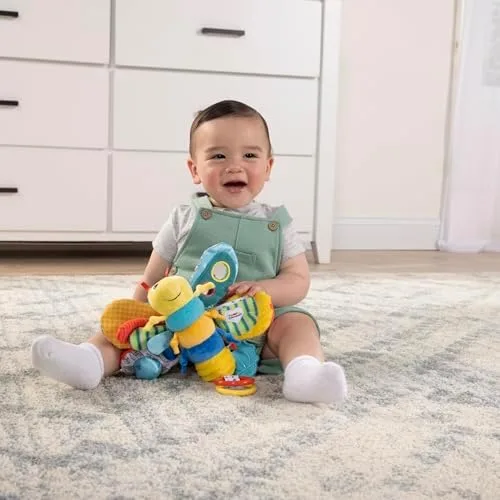
Lamaze Freddie the Firefly meets ASTM F963 and CPSIA safety standards. It has passed CPSC small-parts testing for the 0+ age range.
Safety considerations:
- Clip supervision. The clip attachment should be positioned where the baby can reach the toy but not the clip mechanism itself. The clip is not a choking hazard (too large to fit in a child’s airway), but it could scratch or pinch.
- Fabric inspection. Regularly check stitching, ribbons, and fabric loops for signs of wear. Teething babies apply significant force to fabric toys, and a loosened ribbon could become a choking hazard.
- Washing requirements. Machine-washable (cold, gentle cycle). Air dry preferred. Wash regularly — infant toys accumulate bacteria from drool, mouthing, and floor contact.
- Crib use. Do not clip Freddie inside a crib during sleep. The toy’s ribbons and fabric loops present an entanglement risk inconsistent with AAP safe sleep guidelines. Use during supervised awake time only.
No CPSC recalls have been issued for Lamaze Freddie the Firefly.
The Verdict
Freddie the Firefly is the kind of product that doesn’t photograph well on Instagram — it’s not minimalist, it’s not aesthetic, and it doesn’t come in a muted Scandinavian color palette. It’s a bright, busy, crinkly bug that looks like it was designed by someone who actually knows what a four-month-old’s brain is interested in, rather than what a thirty-year-old parent thinks looks nice on a nursery shelf.
And that’s exactly the point. Freddie is designed for the baby, not the buyer. The high-contrast patterns serve newborn vision, not adult aesthetics. The varied textures serve haptic development, not a “natural materials” marketing narrative. The crinkle and squeak serve cause-and-effect learning, not a “screen-free” pitch. Every feature maps to a developmental principle, and the execution — at $15 — is remarkably dense with intentional design.
It’s not a perfect toy. The teething surfaces are adequate but not excellent. The printed patterns fade with washing. The engagement window is finite. But within its intended developmental range (0-12 months of active use), Freddie does what it sets out to do: provide multimodal sensory input that aligns with how infant perception actually develops.
Product Rating: 7/10 — Well-designed multimodal sensory toy that deliberately targets infant development principles. Docked for mediocre teething surfaces, pattern fade with washing, and the inherently limited engagement window of an infant sensory toy.
Evidence Rating: Emerging — Infant visual development, sensory integration, and haptic perception research are well-established and clearly inform Freddie’s design. No direct evidence evaluates this specific product. The design-to-research alignment is stronger than most infant toys, but the product-specific evidence gap remains.
Who Should Buy This
- Parents of newborns looking for a sensory-rich first toy that grows with the baby through the first year
- Families wanting a clip-on toy for strollers, car seats, and play gyms
- Parents who appreciate developmental intentionality in toy design without needing premium pricing
- Gift-givers looking for a universally useful, budget-friendly baby shower gift
- Parents of babies who show strong responses to textures, crinkle sounds, or high-contrast patterns
Who Should Skip This
- Parents of babies over 12 months — the developmental window has largely passed, and older babies will find Freddie understimulating
- Families who prioritize minimalist, natural-material aesthetics — Freddie is colorful, synthetic, and busy by design
- Parents looking for a standalone teether — Freddie’s teething features are supplementary, not primary. Get the Manhattan Toy Winkel for serious teething.
- Anyone expecting a toy that will hold interest beyond the first year — Freddie is designed for early infancy, and that’s the correct scope
This review reflects our independent evaluation. ScienceBasedKids.com purchased this product at retail price. We may earn a commission if you purchase through our links, which helps fund our research. This never influences our ratings.
Footnotes
-
Fantz, R. L. (1961). “The origin of form perception.” Scientific American, 204(5), 66-72. The foundational study establishing that newborns prefer patterned visual stimuli and high-contrast features — one of the most-cited findings in infant perception research. ↩
-
Teller, D. Y. (1997). “First glances: The vision of infants.” Investigative Ophthalmology & Visual Science, 38(11), 2183-2203. Comprehensive review of infant visual development including the timeline of color vision maturation. ↩
-
Bahrick, L. E., & Lickliter, R. (2000). “Intersensory redundancy guides attentional selectivity and perceptual learning in infancy.” Developmental Psychology, 36(2), 190-201. Establishes that multimodal (multi-sensory) stimulation is more effective for infant learning than unimodal stimulation. ↩
-
Bushnell, E. W., & Boudreau, J. P. (1993). “Motor development and the mind: The potential role of motor abilities as a determinant of aspects of perceptual development.” Child Development, 64(4), 1005-1021. ↩
-
Rovee-Collier, C. (1999). “The development of infant memory.” Current Directions in Psychological Science, 8(3), 80-85. Documents how even very young infants learn contingent relationships between their actions and environmental outcomes. ↩
Enjoyed this review? We publish two new evidence-based evaluations every week.
Free. No spam. Unsubscribe anytime.
Each feature was categorized by the primary and secondary sensory domains it engages. Features that engage multiple senses simultaneously (e.g., crinkle wings: tactile + auditory) are counted in each domain.
Recommended Accessories
Affiliate links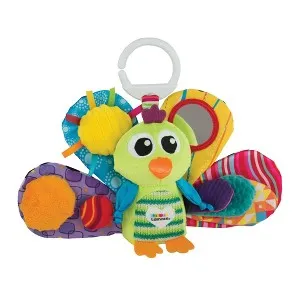
Lamaze Jacques the Peacock
“Same brand, different textures and activities. Extends the multimodal sensory experience.”
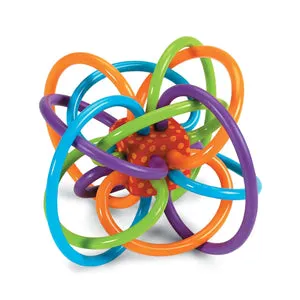
Manhattan Toy Winkel Rattle & Teether
“Different tactile experience. Tubes vs crinkle fabric.”
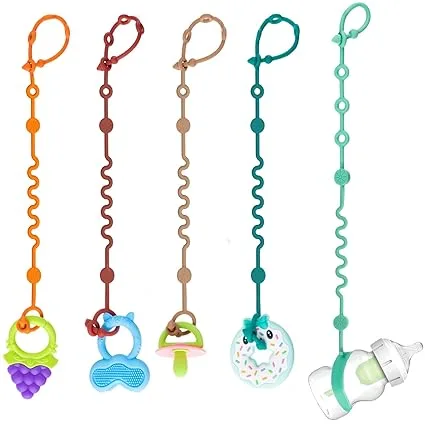
LittleHugs Silicone Toy Straps for Baby (5-Pack)
“Food-grade silicone straps keep Freddie attached to stroller or car seat. Prevents the 'baby dropped the toy' cycle.”