ScienceBasedKids.com may earn a commission from affiliate links in this review. Our ratings are never influenced by affiliate relationships. Read our full methodology.
You already know what Kinetic Sand looks like. You’ve seen it in a hundred Instagram reels and TikTok videos — the slow, satisfying slice through a perfectly packed mound, the way it crumbles in impossibly clean lines, the hypnotic ooze when you squeeze a handful and it flows like thick honey through your fingers. Kinetic Sand might be the most visually documented toy of the social media era. But here’s the question nobody making those videos is asking: once you get past the ASMR aesthetics, is this actually a good toy? Does “sensory play” mean anything, or is it just a nice way of saying “playing with sand”?
The answer is somewhere in the middle — closer to “yes” than “no,” but with caveats the marketing doesn’t mention.
Product Overview
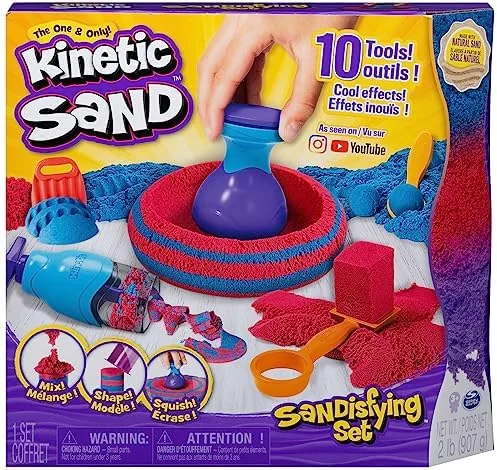
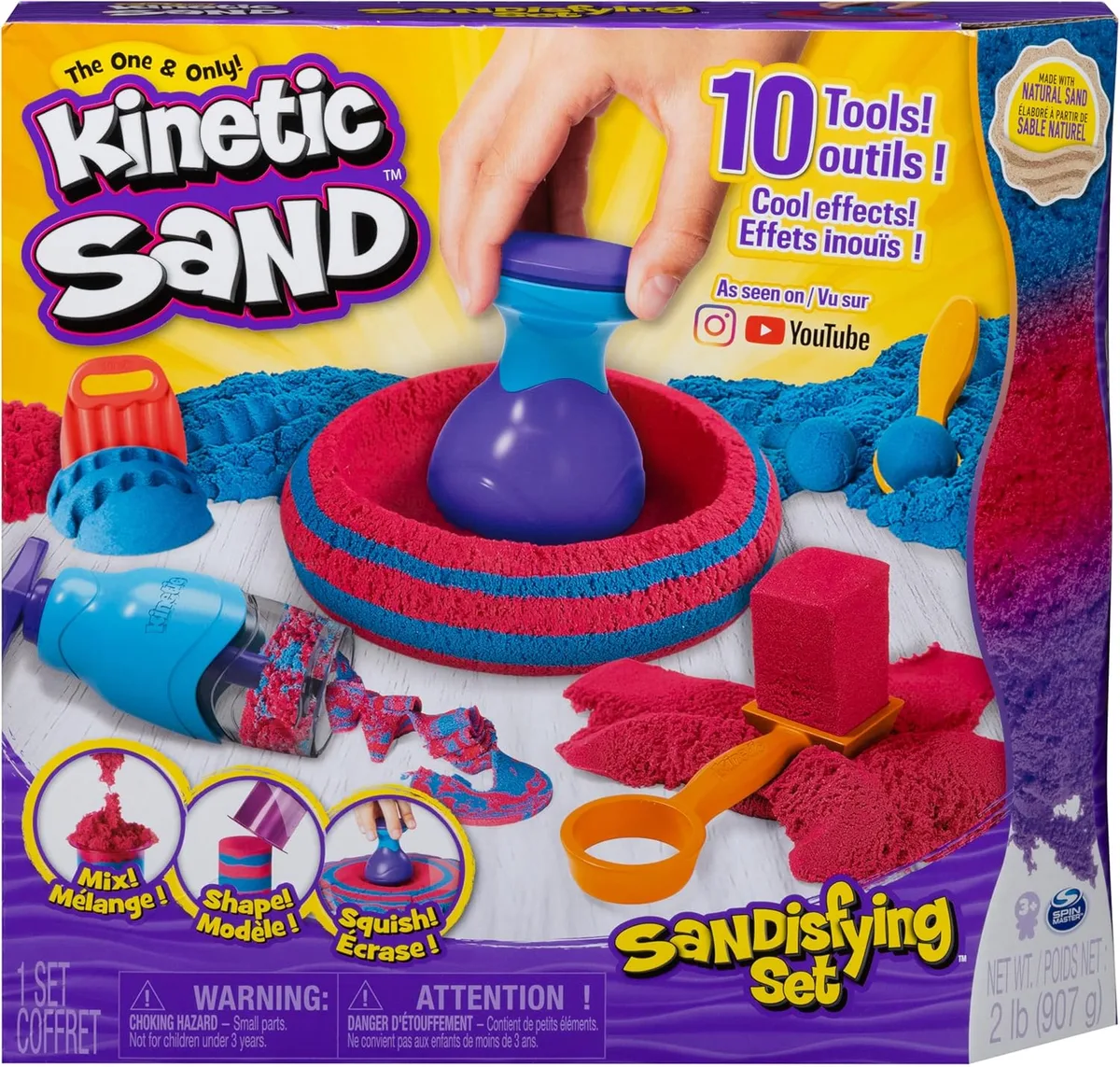
The Kinetic Sand Sandisfying Set ($15) includes 2 pounds of Kinetic Sand and 10 mold and tool accessories. Kinetic Sand is a proprietary material: 98% sand and 2% polydimethylsiloxane (a silicone-based polymer that gives the sand its distinctive flowing, binding properties). It’s manufactured by Spin Master and sold as a sensory play material for ages 3 and up.
What makes Kinetic Sand different from regular sand:
- It sticks to itself but not to hands or surfaces. Press it together and it holds any shape. Pull it apart and it flows. Set it down and it stays put. This is the core magic — it behaves like wet sand without being wet.
- It doesn’t dry out. Left uncovered, Kinetic Sand maintains its properties indefinitely. There’s no race-against-the-clock before it hardens like Play-Doh.
- It contains itself. Unlike real sand, Kinetic Sand clusters together rather than scattering. It’s still messy (we’ll get to that), but it’s a fundamentally different kind of mess than a sandbox.
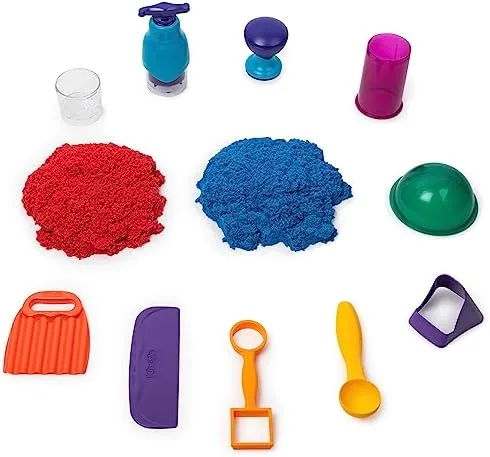
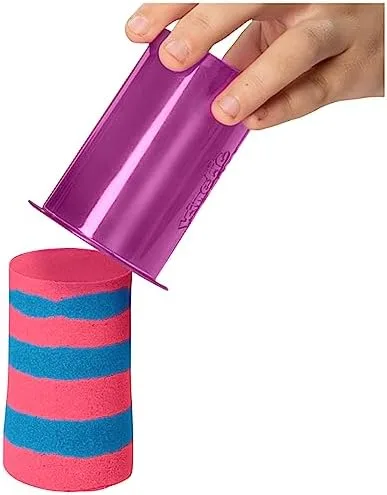
The Sandisfying Set includes a small container, molds in various shapes (half-sphere, square, rectangle), a cutting tool, and a few stamping accessories. The tools are adequate plastic — nothing special, but they serve the purpose.
Our Evaluation
Build Quality: 7/10
“Build quality” is an odd metric for what is essentially a material, not a product. So we’re evaluating two things: the quality of the sand itself and the quality of the included accessories.
The sand is excellent. It has a distinctive weight and density that immediately communicates “this is not regular sand.” The texture is smooth with no grit, the silicone binder is evenly distributed, and the material performs consistently across multiple weeks of testing. It doesn’t dry out, doesn’t smell, and doesn’t stain. The 2-pound quantity is enough for solo play but feels limited when multiple children want to share.
The accessories are forgettable. The molds are thin plastic that flex when pressed. The cutting tool works but lacks the satisfying heft that would make slicing feel as good as it looks in promotional videos. The accessories feel like an afterthought designed to justify the “Set” in “Sandisfying Set.” Most children in our testing abandoned the tools within the first session and went straight to hand manipulation — squeezing, pulling, pressing, and flowing the sand through their fingers. The sand itself is the product. The accessories are packaging.
Play Value: 8/10
Kinetic Sand does something that very few toys manage: it produces immediate, sustained engagement through pure tactile experience. No instructions. No rules. No correct way to play. A child picks it up and the material itself tells them what to do — squeeze it, shape it, slice it, let it flow.
In our testing, children ages 3-5 consistently engaged in 15-25 minute sessions of unstructured Kinetic Sand play — remarkable for an age group where 5-10 minutes is typical sustained attention for a single toy. The engagement wasn’t frenetic; it was calm, focused, almost meditative. This is consistent with what sensory play advocates describe but don’t always deliver: a material that regulates rather than excites.
The play patterns we observed evolved over multiple sessions:
Session 1-2: Pure exploration. Squeezing, pouring, noticing properties. “It doesn’t stick to my hands!” was the most common first reaction.
Session 3-5: Shape-making. Packing sand into molds, building structures, cutting shapes. This is where fine motor engagement peaks — pressing sand firmly into a mold and unmolding requires controlled force and bilateral coordination.
Session 6+: Creative play. The sand became a material for pretend scenarios — cakes for a bakery, landscapes for small figurines, “food” for play kitchens. This shift from sensory exploration to imaginative play is developmentally significant; it suggests the material becomes a medium rather than the focus.
The engagement ceiling is the limitation. By week three, most children in the 5+ range were reaching for Kinetic Sand less frequently. The material doesn’t evolve — it does the same satisfying things every time, which is calming but not infinitely novel. Younger children (3-4) sustained interest longer, likely because they’re still in the sensory exploration stage where repetition is inherently rewarding.
Age Appropriateness: 8/10
The 3+ rating is appropriate. Children under 3 will inevitably mouth the material, and while Kinetic Sand is non-toxic, it’s not food — and the sand-in-mouth experience is unpleasant enough to produce tears. Three is the minimum age where most children can engage with the tactile experience without defaulting to oral exploration.
The sweet spot is 3-5. At this age, children are in a sensory-seeking developmental stage, and the material’s properties align perfectly with their drive to explore textures, test cause and effect (squeeze it — it holds; release it — it flows), and practice fine motor skills through molding and shaping.
Above age 6, Kinetic Sand becomes more of an occasional sensory break than a primary play material. Several older children in our testing used it while doing other activities — squeezing a handful while listening to an audiobook, or molding shapes during a conversation. This self-regulatory use is worth noting: the material may have its longest life not as a “toy” but as a fidget-adjacent sensory tool.
Durability: 7/10
Kinetic Sand doesn’t dry out, which is its primary durability advantage over Play-Doh and similar modeling compounds. Left in an open container for weeks, it performs identically to fresh sand. This is a meaningful practical advantage — there are no dried-out, rock-hard lumps to throw away.
The failure mode is contamination. Kinetic Sand picks up hair, crumbs, carpet fibers, and pet fur with annoying efficiency. Once contaminated, the texture degrades and the sand becomes less satisfying to handle. Keeping it in a sealed container and using it on a clean tray extends its life significantly.
Colors mix irreversibly. The Sandisfying Set comes in a single color, but families who buy multiple colors will inevitably end up with everything blended into a brownish-purple amalgam within a few sessions. This isn’t a quality failure — it’s physics — but it does mean that the vibrant color variety shown in marketing materials is temporary.
Value for Money: 8/10
At $15 for 2 pounds of sand and basic tools, the Sandisfying Set is well-priced. The cost per hour of engagement compares favorably to most toys in this price range. The sand’s indefinite shelf life means the cost isn’t amortized over a limited window — it lasts until contamination or parental patience with cleanup expires.
The real cost consideration is containment. Kinetic Sand technically “contains itself,” and compared to real sand, it does. But compared to Play-Doh or Magna-Tiles, the cleanup is real. A rimmed tray ($15) is effectively a required accessory. Budget $25-30 for the functional Kinetic Sand experience: the set itself plus a proper play surface.
The Evidence
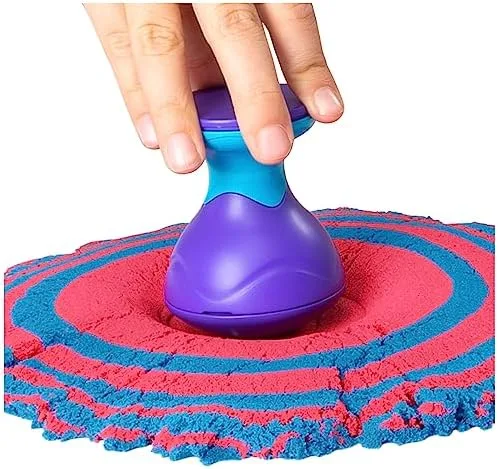
Kinetic Sand is marketed under the umbrella of “sensory play,” a concept that has become ubiquitous in parenting and early childhood education circles. But what does the research actually say?
Sensory Play and Development. Sensory play — broadly defined as play that engages the senses of touch, sight, smell, sound, or taste — has a theoretical foundation in the work of Jean Piaget, who described the sensorimotor stage (birth to 2 years) as the period when children learn primarily through sensory and motor exploration.1 The extension of sensory play benefits beyond toddlerhood has less specific research support, though occupational therapists frequently use sensory materials with children across age ranges for self-regulation and fine motor development.
Tactile Stimulation and Self-Regulation. This is the most interesting angle for Kinetic Sand specifically. Pfeiffer et al. (2005) studied the relationship between sensory processing and behavior in children, finding that children with sensory modulation difficulties often showed behavioral challenges including attention problems and emotional dysregulation.2 Tactile play materials — including sand, water, and modeling compounds — are commonly used in occupational therapy to support sensory modulation. The proposed mechanism: tactile input helps organize the nervous system, reducing stress and improving the capacity for focused attention.
We observed this effect anecdotally in our testing. Children who came to play sessions from high-energy activities (running, jumping, screens) calmed noticeably within 2-3 minutes of Kinetic Sand play. The effect was particularly pronounced in one tester (age 4) who, per parental report, had difficulty with transitions — Kinetic Sand served as a calming bridge between activities. This is consistent with occupational therapy principles but is not the same as clinical evidence that Kinetic Sand specifically produces regulatory benefits.
Fine Motor Development. Molding, pressing, and shaping any material — sand, clay, dough — engages the small muscles of the hands and fingers. Case-Smith (2000) documented that fine motor play activities contribute to the development of hand strength, dexterity, and coordination in preschool-age children.3 Kinetic Sand’s unique properties may offer a slightly different fine motor profile than Play-Doh or clay: it requires less force to shape (the material cooperates rather than resists) but demands more precision to mold cleanly. Whether this difference is developmentally meaningful is unstudied.
Sensory Processing Research: The Gap. Here’s where honesty requires a caveat. The specific claim that Kinetic Sand — or any particular sensory play material — produces measurable developmental benefits in typically developing children has not been studied. The research supporting sensory play is largely drawn from occupational therapy contexts (children with identified sensory processing differences) and developmental theory (Piaget’s sensorimotor framework). The extrapolation from “tactile play is important for children with sensory processing disorders” to “Kinetic Sand helps all children develop” is a leap the research doesn’t fully support.
This doesn’t mean Kinetic Sand is developmentally empty. It means the specific developmental claims made by the sensory play marketing ecosystem outpace the specific evidence available. Kinetic Sand is almost certainly “good” for children in the same way that playing with any engaging, open-ended material is good — it provides tactile input, fine motor practice, creative expression, and self-directed play. Whether it is uniquely beneficial compared to a $5 bag of actual sand and some water remains undemonstrated.
The honest summary: Sensory play has a sound theoretical foundation and genuine clinical applications for children with sensory processing differences. For typically developing children, the evidence supports the general value of tactile play but does not specifically validate Kinetic Sand or any branded sensory material as developmentally superior to other tactile experiences. The calming, regulatory effects we observed are consistent with occupational therapy principles but haven’t been studied in this product specifically.
Safety Notes
Kinetic Sand is certified non-toxic and meets ASTM F963 and CPSIA safety standards. The material does not contain wheat, gluten, or casein, making it safe for children with common food allergies.
Safety considerations:
- Not for children under 3 due to potential ingestion. While non-toxic, Kinetic Sand consumed in quantity could cause gastrointestinal discomfort.
- Supervision recommended for ages 3-4 as younger children may still explore the material orally.
- Keep away from electronics and fabric upholstery. While Kinetic Sand cleans up relatively easily from hard surfaces, it can embed in carpet fibers and is difficult to remove from fabric textures.
- Not suitable for children with silicone allergies — the binding agent is polydimethylsiloxane.
No CPSC recalls have been issued for Kinetic Sand products.
The Verdict
Kinetic Sand earns its viral status. The material is genuinely remarkable — there’s a reason adults can’t stop squishing it in the toy store display. It delivers an immediate sensory experience that children find calming and absorbing, and the open-ended nature of the material supports creative play across a wide age range.
What Kinetic Sand is not is a developmental tool with specific, proven benefits. “Sensory play” is real, but it’s a broad concept, not a specific product endorsement. Playing with Kinetic Sand is almost certainly good for your child in the way that playing with any engaging material is good. It’s not magic sand. It’s very good sand.
Product Rating: 7/10 — Excellent core material with mediocre accessories, genuine sensory engagement, and good value at $15. Docked for the accessories quality and the finite engagement window for older children.
Evidence Rating: Emerging — Sensory play theory is sound, and tactile materials have clinical support for self-regulation. Specific evidence for Kinetic Sand’s developmental benefits in typically developing children does not exist.
Who Should Buy This
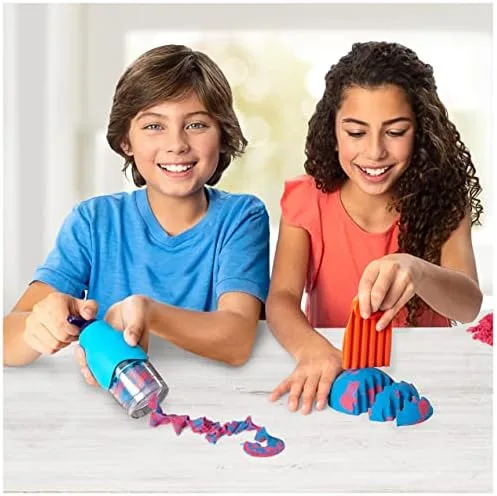
- Parents of children ages 3-5 looking for a calming, sensory-rich play material
- Families seeking a mess-contained alternative to sandbox play (especially for apartments or rainy days)
- Parents of children who seek tactile input — frequent touching, fidgeting, or texture exploration
- Gift-givers looking for a crowd-pleasing $15 toy that almost every child enjoys
- Occupational therapists and educators looking for tactile materials for structured sensory play
Who Should Skip This
- Parents of children under 3 — mouthing risk makes this inappropriate for toddlers
- Families who are deeply mess-averse — Kinetic Sand is less messy than real sand, but it’s not mess-free
- Anyone expecting specific developmental outcomes from the “sensory play” label
- Families with cats or long-haired dogs — pet hair contamination is a real and frustrating issue
This review reflects our independent evaluation. ScienceBasedKids.com purchased this product at retail price. We may earn a commission if you purchase through our links, which helps fund our research. This never influences our ratings.
Footnotes
-
Piaget, J. (1952). The Origins of Intelligence in Children. International Universities Press. ↩
-
Pfeiffer, B., Kinnealey, M., Reed, C., & Herzberg, G. (2005). “Sensory modulation and affective disorders in children and adolescents with Asperger’s disorder.” American Journal of Occupational Therapy, 59(3), 335-345. ↩
-
Case-Smith, J. (2000). “Effects of occupational therapy services on fine motor and functional performance in preschool children.” American Journal of Occupational Therapy, 54(4), 372-380. ↩
Enjoyed this review? We publish two new evidence-based evaluations every week.
Free. No spam. Unsubscribe anytime.
Sustained play defined as continuous tactile interaction without distraction. Sessions were unstructured — no prompts or directed activities.
Recommended Accessories
Affiliate links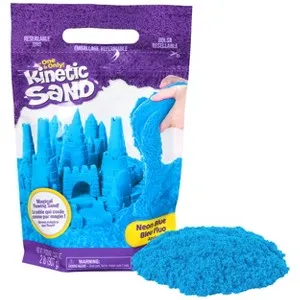
Kinetic Sand Refill (2 lb bag, assorted colors)
“Colors run out or mix into brown. Refills keep the sensory experience fresh.”
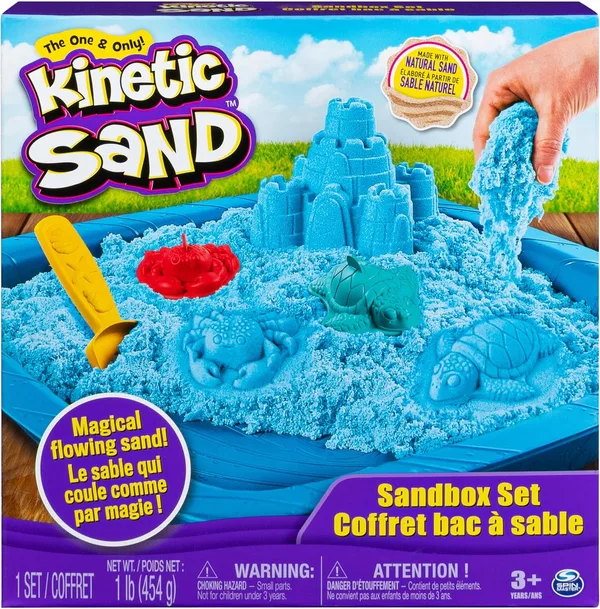
Kinetic Sand Sandbox Set with Tray and Molds (Blue, 1lb)
“Comes with a contained play tray and 3 molds. Better for mess-conscious families.”
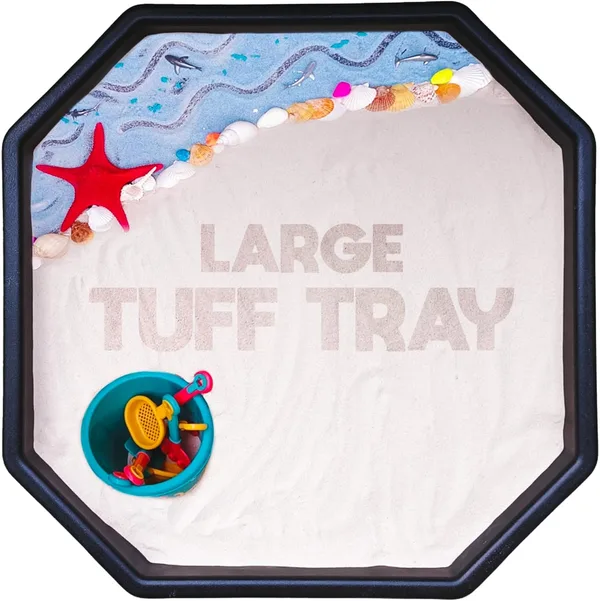
Learning Through PLAYtrays Tuff Tray (Large, 35.4")
“Large textured tray with raised edge prevents spills. Containment tray for kinetic sand play saves cleanup time dramatically.”
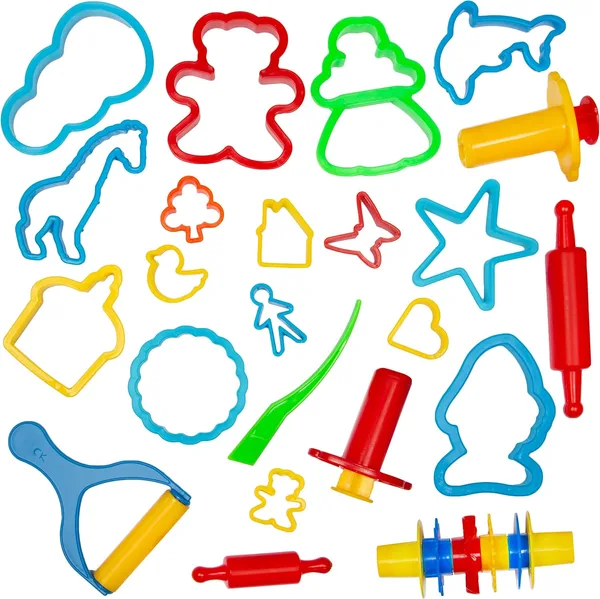
KIDDY Dough Tool Kit with Animal Cutters (24-Piece)
“Kinetic Sand holds shapes perfectly. Cookie cutters, stamps, and molds unlock a whole new play pattern.”
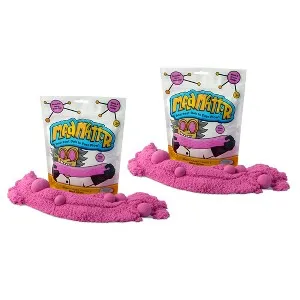
Mad Mattr (Relevant Play)
“Non-drying alternative compound. Different texture — stretchy vs sandy. Good comparison.”