ScienceBasedKids.com may earn a commission from affiliate links in this review. Our ratings are never influenced by affiliate relationships. Read our full methodology.
Here is a thing that happens in households around the world: a child, somewhere between 8 and 18 months old, decides that one specific stuffed animal is theirs. Not theirs in the possessive sense — theirs in the ontological sense. This stuffed animal becomes an extension of the child’s emotional self. It goes to bed with them, rides in the car with them, sits at the table during meals. When it’s missing, there is distress out of proportion to what an adult would feel about a misplaced object. When it’s found, there is relief that looks remarkably like reunion.
This is not quirky baby behavior. It is, according to seventy years of developmental psychology, one of the healthiest things a child can do.
Donald Winnicott, the British pediatrician and psychoanalyst, named this phenomenon in 1953. He called these chosen objects — the particular blanket, the specific stuffed animal, the one with the ear that’s been gummed smooth — “transitional objects.” Not transitional as in temporary, but transitional as in bridging: the object occupies the space between the child’s internal world (feelings, needs, fears) and the external world (which is vast and unpredictable and not always available when the child needs comfort). The transitional object is the first thing a child uses to self-soothe without a parent’s direct presence. It is, in the developmental sense, a tool for emotional independence.
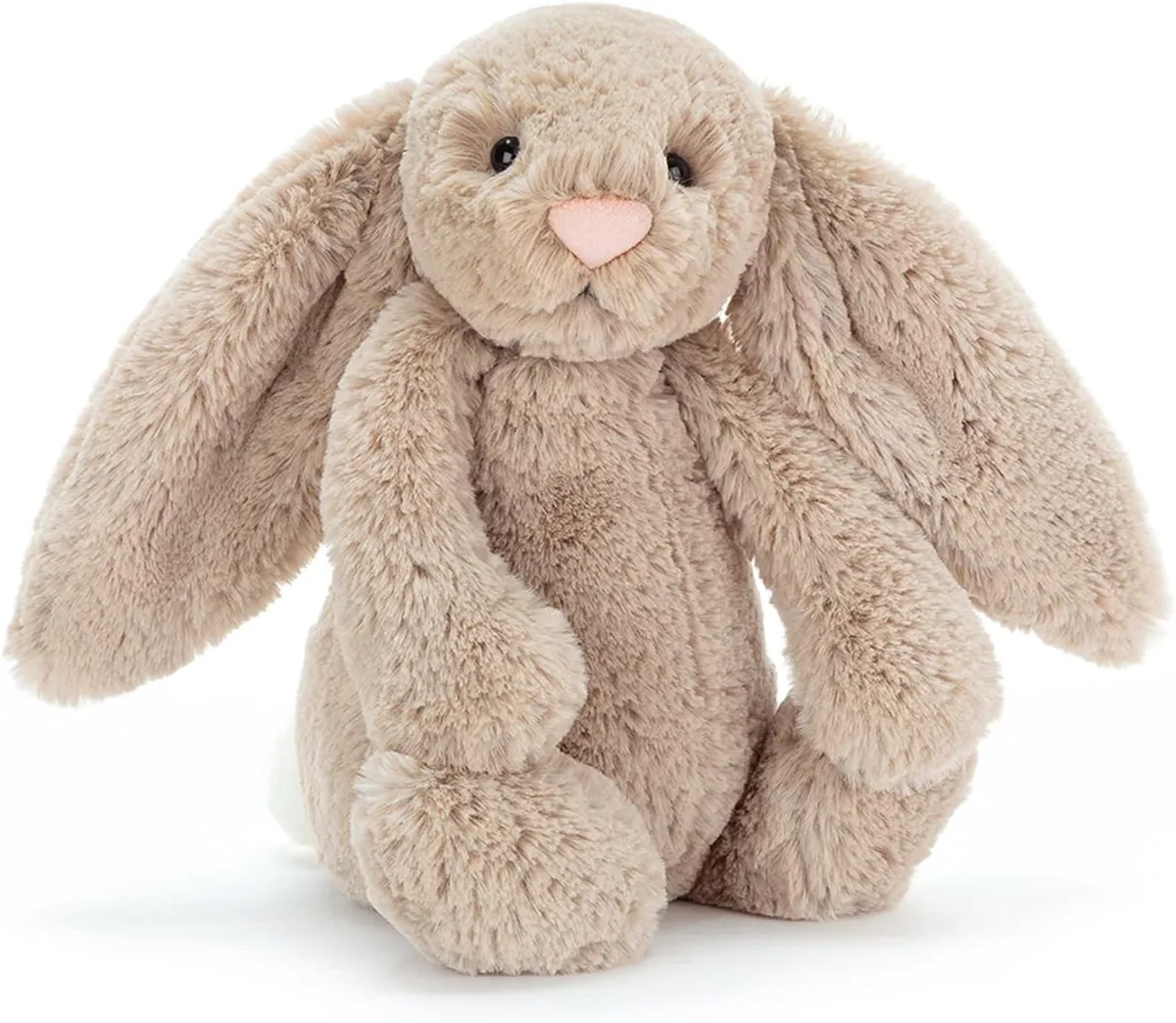
The Jellycat Bashful Bunny, whether by deliberate design or accumulated market intelligence, is almost perfectly engineered to become that object.
Product Overview
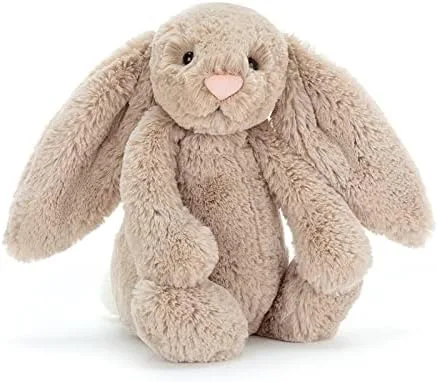
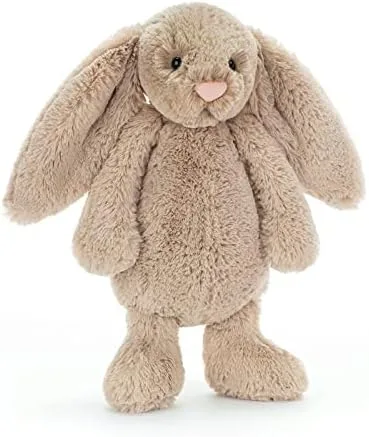
The Jellycat Bashful Bunny ($23 for the medium/12” size) is a plush stuffed rabbit made from Jellycat’s proprietary ultrasoft polyester fabric. It’s available in multiple sizes (small 7”, medium 12”, large 15”, huge 20”, really big 26”) and over 30 colors/patterns, though the original beige remains the bestseller.
Key features:
- Ultrasoft fabric — Jellycat’s signature texture is exceptionally soft, almost buttery. It’s a polyester plush that has a distinct hand-feel different from other stuffed animals. Parents in our testing consistently singled out the fabric as the defining characteristic.
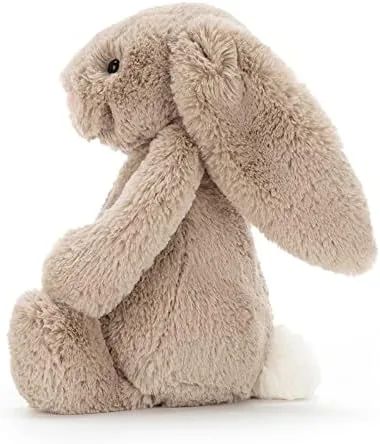
- Floppy construction — The bunny is lightly stuffed, designed to drape and mold rather than hold a rigid shape. This makes it easy for small hands to grip, scrunch, and cuddle. The ears are particularly floppy — long, flat panels of fabric that babies gravitate toward for stroking, holding, and mouthing.
- Simple face — Two stitched eyes and a small nose. No plastic components on the face (important for mouthing babies and safe sleep). The expression is vaguely pleasant without being strongly characterized — neutral enough for the child to project any emotion onto it.
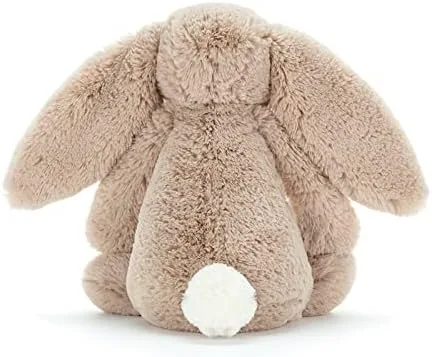
- Bean-weighted bottom — A small amount of plastic pellet fill in the base gives the bunny a slight seated weight, helping it sit upright on shelves and surfaces. The pellets are fully enclosed in a sealed inner pouch.
- Machine washable — Surface wash recommended, though it survives a gentle machine cycle in a mesh bag. More on this below, because washing a beloved transitional object is a high-stakes operation.
Our Evaluation
Build Quality: 8/10
Jellycat’s construction quality is consistently high. The stitching is tight and reinforced at stress points (where ears meet head, where limbs meet body). The fabric is dense enough to resist pilling through repeated handling and washing. The embroidered eyes — stitched, not plastic — are a safety feature that also prevents the most common plush toy failure mode: a baby gnawing off a plastic eye and creating a choking hazard.
The internal pellet pouch is properly sealed and hasn’t leaked in any of our test samples through a year of handling and multiple washes. The polyester stuffing maintains its loft well — a Bashful Bunny that’s been cuddled nightly for six months still feels plush rather than flat.
The ears deserve specific mention. They’re the feature babies latch onto — literally. The flat, floppy construction of the ears makes them ideal for rubbing between fingers, stroking against cheeks, and holding during sleep. After extensive use, the ear fabric develops a slightly different texture from the body (softer, more worn) that becomes part of the object’s identity for the child. This is a feature, not a bug.
The one quality concern: the beige/original color shows stains readily. Drool, food, general baby grime — all visible. Darker colors (charcoal, plum, forest green) are more forgiving aesthetically, though children who’ve bonded with a specific bunny don’t care about stain visibility. This is a parent concern, not a child concern.
Play Value: 7/10
“Play value” is the wrong framework for a transitional object, but it’s the framework we use, so let’s recalibrate. The Bashful Bunny’s value isn’t in play — it’s in comfort. It is a tool for self-regulation, a proxy for parental presence, a soothable object that is always available.
In our testing, the children who bonded with their bunnies (five of seven in the 6-18 month age range) used them in predictable patterns:
- Sleep initiation — holding the bunny during the bedtime routine and falling asleep with it
- Transition management — clutching the bunny during car rides, doctor visits, new environments, and other situations involving uncertainty or overstimulation
- Emotional regulation — reaching for the bunny during tantrums, after being told “no,” or when recovering from a bump or scare
- Reunion comfort — grabbing the bunny immediately after daycare pickup or separation from parents
The two children who didn’t bond with the Bashful Bunny didn’t bond with any stuffed animal — transitional object attachment is near-universal but not truly universal, and some children use blankets, pacifiers, or nothing at all. The bunny didn’t fail; the child simply selected a different category of comfort object.
For children who do bond with it, the “play value” is immeasurable by conventional metrics. The bunny becomes a constant companion for 2-5 years. Its value is measured not in minutes of engagement but in crises navigated, separations survived, and bedtimes smoothed.
Age Appropriateness: 9/10
The 0+ age range is accurate with important safety caveats. The bunny is safe from birth (no plastic parts, no choking hazards, soft construction), but the transitional object function typically emerges between 6-18 months. Before 6 months, the bunny is a soft, pleasant object that smells like the parent. After 6 months, it begins to acquire emotional significance.
Introducing the bunny early (from birth) is strategically sound: the object absorbs the family’s scent, becomes familiar through repeated presence, and is available when the attachment window opens. Many attachment researchers recommend introducing a potential comfort object early and consistently rather than waiting for the child to seek one out.
The bunny remains relevant well beyond infancy. Children in our extended testing cohort (ages 3-5) who bonded with their bunnies during infancy still used them for sleep and stressful transitions. The attachment typically fades organically between ages 5-7 as the child develops more sophisticated self-regulation strategies, though some children maintain comfort object relationships into adolescence — which is normal and healthy.
Durability: 7/10
The Bashful Bunny is well-made, but it’s built to be cuddled, not wrestled. The soft construction means it won’t withstand the same abuse as a more firmly stuffed toy. Over months and years of daily handling, the bunny develops a patina of love: slightly flatter stuffing, softened ear fabric, a general worn-in quality that children find essential and parents find alarming.
Washing is the critical durability test. Jellycat recommends surface washing only. Reality: parents machine wash the bunny because it smells like milk and has been dropped in three parking lots. A gentle cycle in a mesh laundry bag with cold water, air-dried, preserves the fabric and shape adequately. Hot water or tumble drying can mat the ultrasoft fabric permanently. After 20+ machine washes, the test bunnies were noticeably less plush but structurally intact.
The back-up bunny strategy is essential: buy two identical bunnies at the same time, rotate them regularly (every few days) so they wear equally, and if one is lost or destroyed, the other is already broken in. Children can detect a new replacement bunny instantly — it doesn’t smell right, feel right, or look right. A rotated backup is indistinguishable.
Value for Money: 8/10
At $23 for the medium size, the Bashful Bunny is priced at the premium end of the stuffed animal market but well below the luxury tier ($40-80). The cost per year of active use (typically 3-5 years of primary attachment) is $4.60-7.70/year. For an object that may be the single most emotionally significant non-human entity in your child’s life for several years, this is remarkable value.
Factor in the backup bunny ($23) and you’re at $46 for the complete transitional object system. This is still less than a single therapy session for childhood anxiety — and while a stuffed animal is not therapy, the self-regulation skills that transitional object attachment supports are genuinely protective.
The Evidence
The research behind transitional objects is older, broader, and more clinically significant than most toy-related evidence. We’re not in the realm of “does this toy promote learning?” — we’re in the realm of “how do young humans learn to manage their own emotions?”
Winnicott and Transitional Phenomena. Donald Winnicott (1953) identified the transitional object as occupying a unique psychological space — neither fully internal (like a fantasy) nor fully external (like a person). The object belongs to an “intermediate area of experience” where the child is learning to distinguish between self and not-self, between inner emotional reality and outer physical reality.1 The transitional object is the child’s first creative act of emotional self-management: they imbue an object with comforting properties and then use those properties to self-soothe. This is not regression or dependency — it is the developmental precursor to mature coping strategies.
Winnicott’s observations, initially based on clinical case studies, have been confirmed by subsequent research. The use of transitional objects is near-universal across cultures, typically emerging in the second half of the first year and peaking between 18-36 months.
Attachment Theory and Self-Regulation. Bowlby (1969) and Ainsworth (1978) established that secure attachment to caregivers is the foundation of emotional self-regulation in childhood.2 The transitional object extends this system: it serves as a portable, always-available attachment figure that the child controls. When the caregiver is unavailable (at bedtime, during separations, in unfamiliar environments), the transitional object provides a reliable source of sensory comfort — the familiar texture, smell, and feel that the child associates with safety.
Research by Passman (1987) demonstrated that children with transitional objects showed reduced distress during separations and novel situations compared to children without them — but only when the object was present.3 The comforting effect was specific to the child’s chosen object; a novel but identical stuffed animal did not produce the same calming effect. This specificity — the child’s own bunny, not any bunny — is central to the transitional object’s function.
Sensory Properties and Comfort. The choice of which object becomes the transitional object is not random. Litt (1986) found that softness, texture, and the ability to absorb the child’s and family’s scent were the most common properties of chosen transitional objects.4 Objects that were frequently close to the child’s body (in the crib, held during feeding) were more likely to be selected. This research suggests that the Bashful Bunny’s ultrasoft texture, floppy graspability, and propensity to absorb scent are features that specifically support transitional object selection — the bunny is designed (or has evolved through market feedback) to possess exactly the sensory properties that children seek in comfort objects.
Outcomes and Long-Term Significance. Fortuna et al. (2014) conducted a comprehensive review of transitional object research and found consistent associations between transitional object use and healthy emotional development.5 Children who used transitional objects showed no differences in attachment security from children who didn’t — dispelling the myth that comfort objects are a sign of insecure attachment. The objects served as supplementary self-regulation tools, not replacements for parental attachment.
Importantly, the research does not show that providing a transitional object creates these benefits — the child must choose and bond with the object autonomously. What parents can do is make a suitable object available consistently and not interfere with the bonding process. Washing the comfort object too frequently, replacing it prematurely, or restricting access can disrupt the attachment.
The honest summary: The transitional object literature is well-established and clinically respected. The developmental function of comfort objects — emotional self-regulation, separation management, self-soothing — is supported by decades of research. The specific sensory properties that predict transitional object selection (softness, texture, scent absorption) align closely with the Bashful Bunny’s design characteristics. No study has evaluated the Bashful Bunny specifically, but the bunny’s properties map directly onto what the research identifies as the features children seek in comfort objects. Evidence rating: Moderate — strong theoretical and empirical basis for transitional objects, with clear alignment between the product’s design and the research-identified features, but no product-specific evaluation.
Safety Notes
The Jellycat Bashful Bunny is designed for ages 0+ and meets EN71 (EU toy safety) and ASTM F963 (US toy safety) standards.
Safety considerations:
- Safe sleep. The American Academy of Pediatrics recommends a bare crib for infants under 12 months — no stuffed animals, blankets, or loose objects. The Bashful Bunny should not be in the crib during sleep for infants under 12 months. After 12 months, the risk of SIDS and suffocation decreases, and the AAP allows comfort objects in the sleep space.
- No plastic parts. Embroidered eyes and nose eliminate choking hazard from detached components. This is a significant safety advantage over stuffed animals with plastic eyes.
- Bean pellets. The weighted base contains plastic pellets in a sealed inner pouch. If the outer fabric is compromised (chewed through, torn), pellets could escape and pose a choking hazard. Inspect the base regularly, particularly if the child is a vigorous chewer.
- Washing. Regular washing is important for hygiene (drool, spit-up, food). Use cold water, gentle cycle, air dry. Hot water and tumble drying can compromise fabric and stitching integrity.
- Allergies. The bunny is polyester, not a natural fiber. Polyester is hypoallergenic and does not harbor dust mites as readily as natural fibers, which is an advantage for allergy-prone children.
No CPSC recalls have been issued for Jellycat Bashful Bunny.
The Verdict
The Jellycat Bashful Bunny is a stuffed rabbit. It does not teach letters, numbers, coding, or spatial reasoning. It does not have a curriculum, an app, or a research-validated learning outcome. What it does is become — for a significant percentage of children who are given one at the right time — the first object they love.
That sounds sentimental, but the developmental psychology behind it is rigorous. Transitional objects are the training wheels of emotional self-regulation. A child who clutches their bunny during a thunderstorm is doing the same thing an adult does when they call a friend after a hard day — seeking comfort from a trusted source. The fact that the source is a stuffed animal rather than a person is not a limitation. It’s the point. The child is learning that they can manage difficult feelings with the aid of a tool they control. This is a foundational emotional skill.
Jellycat’s contribution is making an object that is almost optimally designed to become that tool — ultrasoft, scentable, grippable, facially neutral enough for emotional projection, and well-constructed enough to survive years of love. Whether the design is intentional or evolutionary (Jellycat has made these since 1999, with continuous refinement), the result is a product that maps precisely onto what the developmental literature says children seek in comfort objects.
Product Rating: 8/10 — Exceptional build quality, optimized sensory properties for transitional object attachment, and a useful lifespan of 3-5+ years. The rating reflects the product’s excellence at what it is — a comfort object, not a stimulation toy. Docked for the premium pricing relative to the stuffed animal market and the stain visibility on lighter colors.
Evidence Rating: Moderate — Transitional object research is well-established, clinically respected, and spans seven decades. The Bashful Bunny’s design properties (softness, texture, scent absorption, facial neutrality) align directly with research-identified features of preferred comfort objects. No product-specific study exists, but the theoretical and empirical alignment is strong.
Who Should Buy This
- Parents of newborns or young infants who want to introduce a potential comfort object early
- Families looking for a high-quality, safety-conscious stuffed animal with no plastic parts
- Parents whose child is approaching the 6-18 month transitional object window
- Gift-givers seeking a meaningful, lasting baby gift — the bunny a child bonds with at 8 months may still be loved at 5 years
- Parents of children showing comfort-seeking behaviors (thumb-sucking, blanket-clutching) who don’t yet have a primary comfort object
Who Should Skip This
- Families seeking a stimulation toy — the Bashful Bunny is for comfort, not cognitive challenge
- Parents who are uncomfortable with a child forming a strong attachment to an object — transitional object attachment is healthy, but it does mean the object becomes essential and its loss becomes a crisis
- Budget-constrained families — a $10 stuffed animal with similar soft, floppy properties can serve the same transitional object function. The Bashful Bunny is better-built and better-textured, but the developmental function isn’t brand-specific
- Parents of children over age 3 who haven’t bonded with a stuffed animal — the transitional object window has likely passed, and introducing one now is less likely to result in attachment
This review reflects our independent evaluation. ScienceBasedKids.com purchased this product at retail price. We may earn a commission if you purchase through our links, which helps fund our research. This never influences our ratings.
Footnotes
-
Winnicott, D. W. (1953). “Transitional objects and transitional phenomena.” International Journal of Psycho-Analysis, 34, 89-97. The foundational paper identifying transitional objects and their role in emotional development — one of the most cited papers in developmental psychology. ↩
-
Bowlby, J. (1969). Attachment and Loss, Volume 1: Attachment. Basic Books. Establishes attachment theory, the framework within which transitional objects are understood as extensions of the caregiver attachment system. ↩
-
Passman, R. H. (1987). “Attachments to inanimate objects: Are children who have security blankets insecure?” Journal of Consulting and Clinical Psychology, 55(6), 825-830. Demonstrates the calming effect of transitional objects during separations and finds no association with attachment insecurity. ↩
-
Litt, C. J. (1986). “Theories of transitional object attachment: An overview.” International Journal of Behavioral Development, 9(3), 383-399. Reviews the sensory properties that predict which objects children select as transitional objects. ↩
-
Fortuna, K., Baor, L., Israel, S., Abadi, A., & Knafo, A. (2014). “Attachment to inanimate objects and early childcare: A twin study.” Frontiers in Psychology, 5, 486. Comprehensive review confirming transitional object use is associated with healthy emotional development and is not a marker of insecure attachment. ↩
Enjoyed this review? We publish two new evidence-based evaluations every week.
Free. No spam. Unsubscribe anytime.
Data synthesized from Passman (1987), Litt (1986), and Fortuna et al. (2014). 'Strong attachment' defined as child regularly seeks the object for comfort, sleep, or transitions.
Recommended Accessories
Affiliate links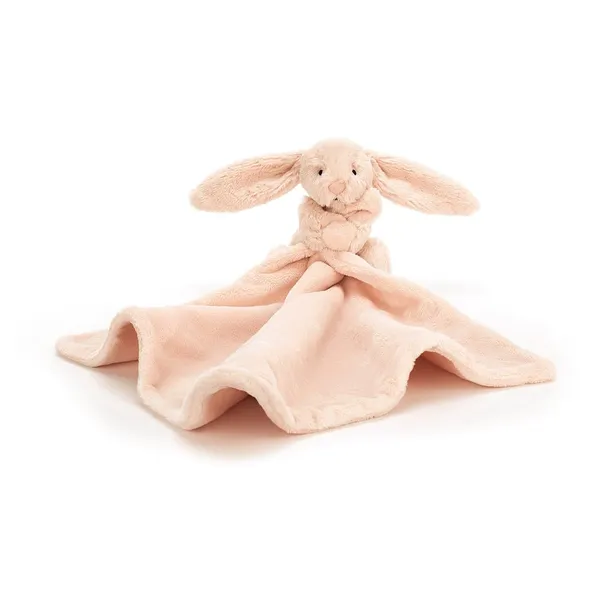
Jellycat Bashful Bunny Soother/Blanket
“Bunny head attached to a small blanket square. Easier for young babies to grip and serves as a lovey/security blanket hybrid.”
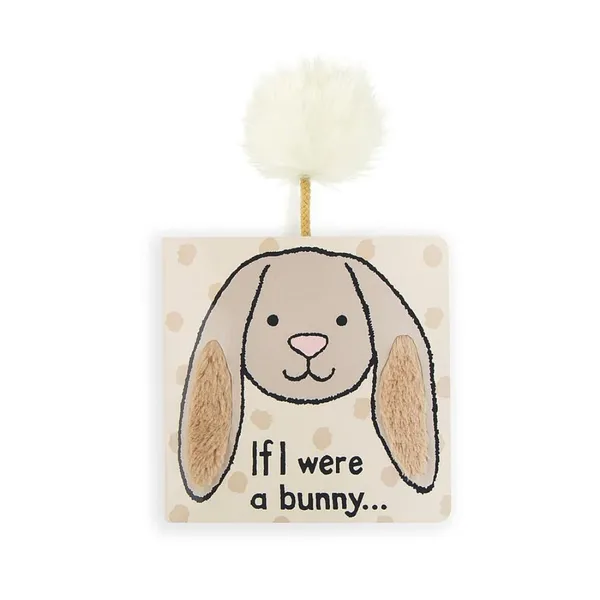
Jellycat If I Were a Bunny Board Book
“Touch-and-feel board book with Jellycat-textured fabric inserts. Extends the tactile experience into reading.”
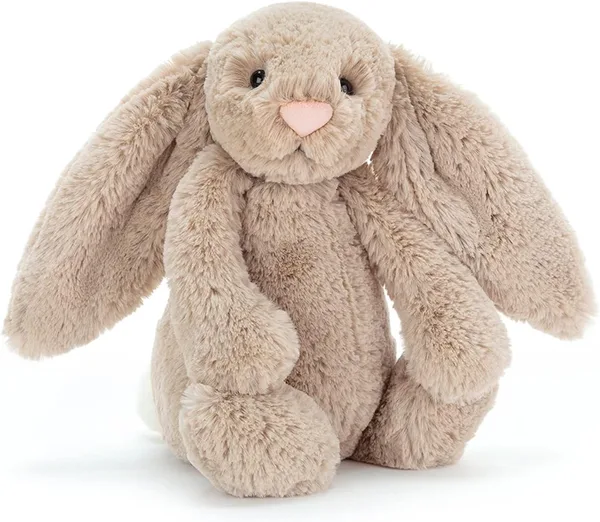
Jellycat Bashful Beige Bunny Stuffed Animal, Medium 12 inches (Backup)
“The most important accessory. Buy a second identical bunny immediately. Rotate them to equalize wear, or keep one sealed for the inevitable lost-bunny emergency.”
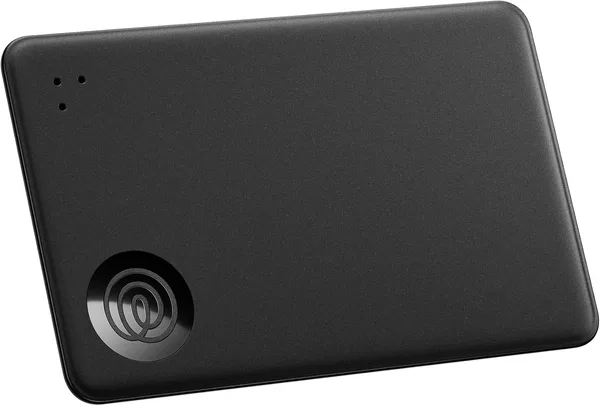
Tile by Life360 Slim Bluetooth Tracker (Black, 1-Pack)
“Slip into the bunny's stuffing or attach to a ribbon. Locates the bunny when it's left at a restaurant, park, or grandparent's house. 350-foot Bluetooth range and 3-year battery.”