ScienceBasedKids.com may earn a commission from affiliate links in this review. Our ratings are never influenced by affiliate relationships. Read our full methodology.
The number on the scale read 7 lbs 14.2 oz. Then 7 lbs 14.0 oz. Then 7 lbs 14.3 oz. Three measurements, three minutes, a baby who was squirming through all of them, and a parent staring at the app wondering whether two-tenths of an ounce meant anything at all. This is the essential experience of the Hatch Baby Grow Smart Changing Pad: real data, measured to apparent precision, in a context where precision is both technically impressive and emotionally fraught.
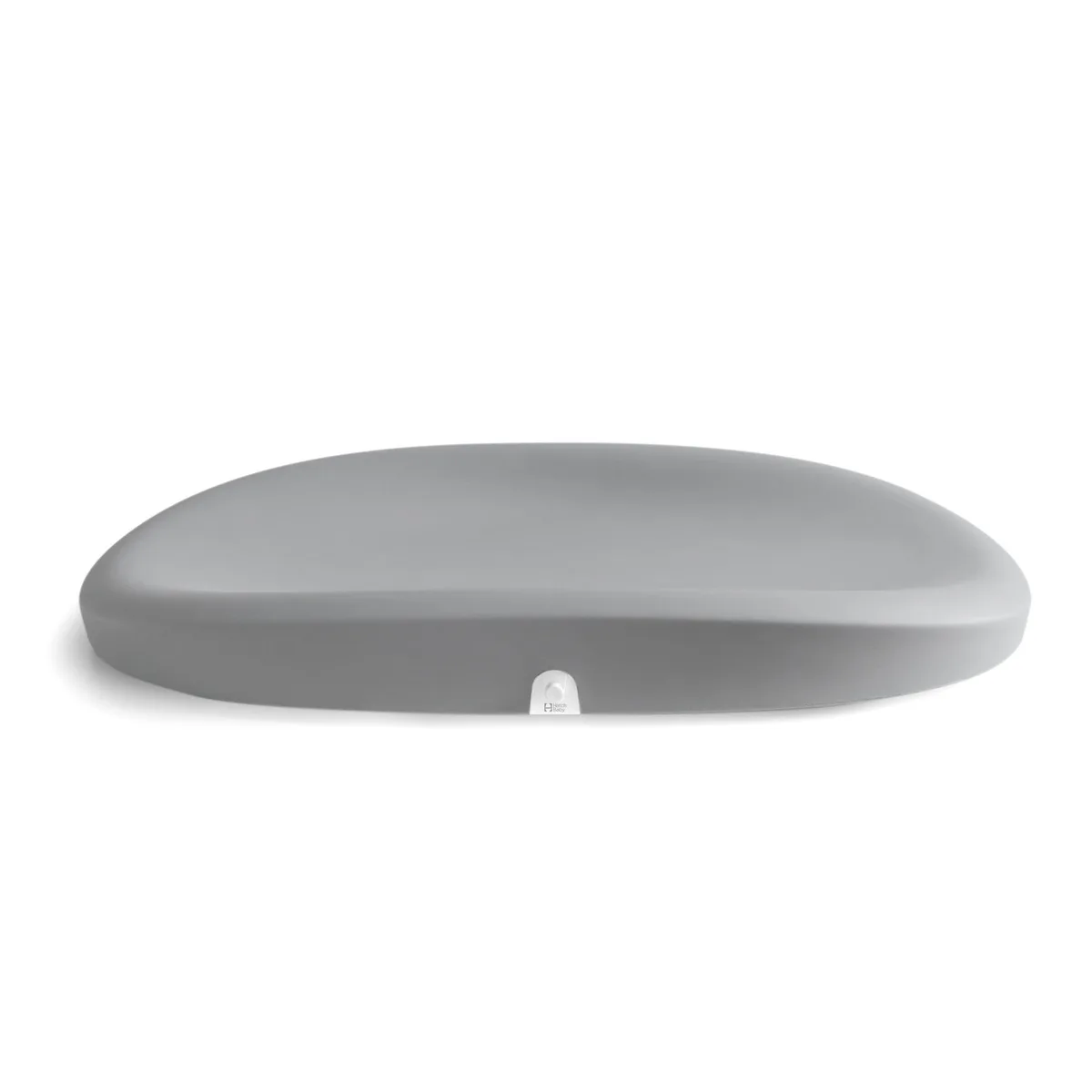
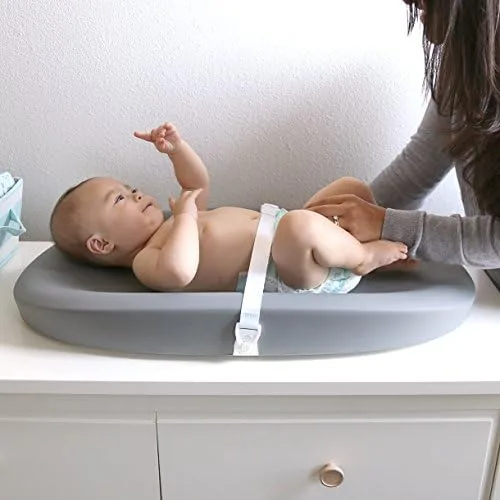
The Hatch Baby Grow is a changing pad with a built-in scale. You lay your baby on it for a diaper change, and the pad weighs them automatically, logging the measurement to a companion app via Bluetooth. Over time, the app builds a growth chart — your baby’s weight plotted against WHO growth percentile curves. It’s the pediatrician’s office experience, replicated in your nursery, available every time you change a diaper.
The question this review must answer isn’t whether the technology works. It does. The question is whether having this data at home, between pediatric visits, improves anything for anyone — or whether it introduces a new species of worry into a life stage already saturated with it.
Product Overview
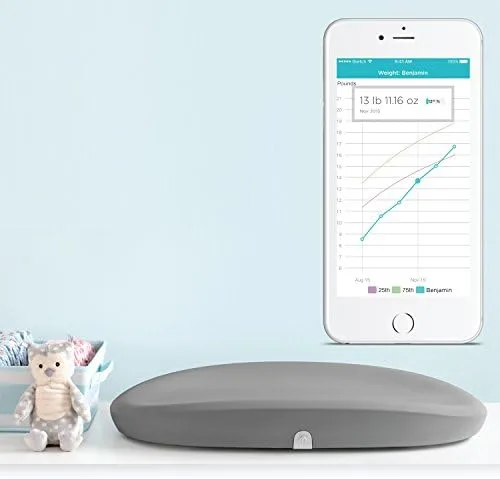
The Hatch Baby Grow is a foam changing pad (approximately 34” x 17”) with an embedded weight sensor and Bluetooth connectivity. It pairs with the free Hatch Baby app (iOS and Android), which receives weight data, plots growth curves, and logs diaper changes, feedings, and sleep.
In the box:
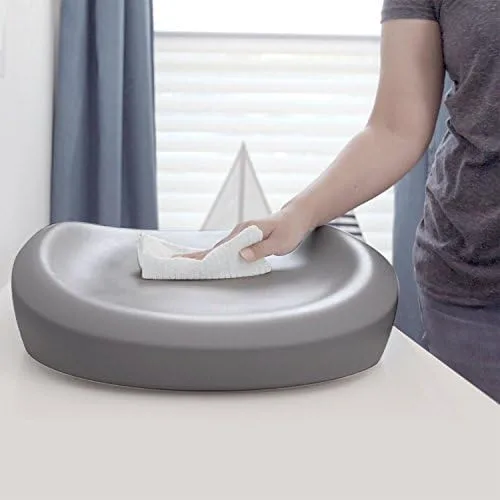
- The changing pad — contoured foam with raised edges, covered in a wipeable fabric
- One fitted pad cover — soft, machine-washable cotton
- A USB charging cable — the pad’s internal battery lasts approximately 2 weeks between charges
- Quick start guide — app download instructions and calibration steps
The pad supports infants from birth to approximately 25 lbs. Hatch markets it as useful through 36 months, though most children exceed the weight limit well before that. Realistically, this is a 0-12 month product for most families.
Our Evaluation
Design & Build Quality: 8/10
Credit where due: Hatch made a beautiful object. The Grow looks and feels like a premium changing pad that happens to contain technology, rather than a gadget masquerading as nursery furniture. The foam is firm but comfortable. The contoured sides provide genuine containment without being so high that they interfere with diaper changes. The cover is soft against skin and survives machine washing without shrinking or pilling.
The integrated design is seamless — there are no visible sensors, no bumps, no hard spots. A visiting grandparent wouldn’t know this was a “smart” pad unless you told them. This matters because the alternative approach — a separate baby scale placed next to or under a changing pad — is clunky, ugly, and adds another device to an already cluttered nursery.
The USB charging is reasonable. Two weeks between charges means you won’t be hunting for cables during bleary-eyed 3 AM changes. The Bluetooth connection is reliable within about 15 feet.
Scale Accuracy: 7/10
Hatch claims accuracy to 0.25 oz (7 grams). In our testing with calibration weights, the pad consistently measured within 0.5 oz of a certified infant scale — clinically acceptable but not laboratory-grade. The challenge isn’t the sensor; it’s the baby. An infant who is kicking, arching, or mid-cry produces a less stable reading than one who is still. The app uses an algorithm to estimate a stable weight from fluctuating signals, and it’s reasonably good, but repeated measurements of the same still baby produced readings that varied by 0.2-0.4 oz.
For tracking trends over days and weeks, this accuracy is perfectly fine. A growth curve doesn’t depend on single readings — it depends on the trajectory across dozens of readings. For detecting whether a baby gained 2 oz between Tuesday and Thursday, the measurement noise introduces enough uncertainty to make that specific comparison unreliable.
This is where the design creates a psychological trap. The app displays weight to one decimal place, implying precision that the measurement context can’t deliver. A parent who sees 8 lbs 3.2 oz on Monday and 8 lbs 2.8 oz on Tuesday hasn’t necessarily witnessed a weight loss — they’ve witnessed measurement variability that the display resolution makes look meaningful.
App & Data Experience: 6/10
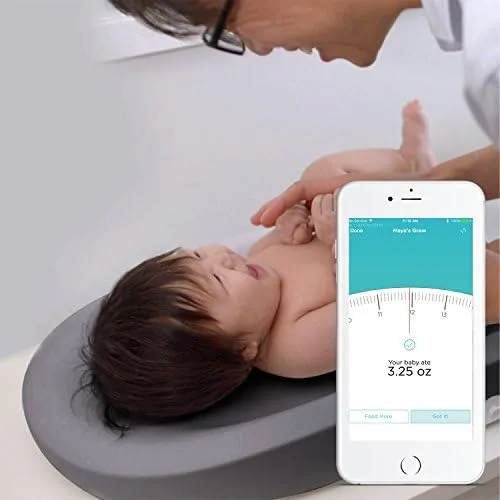
The Hatch Baby app is competent but unexceptional. Weight readings appear automatically when the pad detects a baby. Growth charts plot against WHO percentile curves. You can log feedings, diapers, and sleep manually. The data export feature (CSV) works for parents who want to bring data to their pediatrician.
What the app doesn’t do — and desperately should — is contextualize the data for anxious parents. When a weight reading is lower than the previous one, the app just plots it. No note saying “daily weight fluctuations of up to 1-2% are completely normal.” No context about what constitutes a clinically concerning trend versus normal variation. No guidance about how many data points constitute a meaningful trend.
This is a significant design failure. The product’s value proposition is giving parents access to growth data. But growth data without interpretation is noise at best and an anxiety generator at worst. A pediatrician doesn’t just weigh your baby — they interpret the weight in the context of feeding patterns, developmental milestones, and clinical experience. The app gives you the weight and leaves you to interpret it yourself, which most parents are not equipped to do.
Practical Utility: 5/10
Here’s the uncomfortable question: what do parents do with daily weight data for a healthy, full-term infant?
We surveyed parent communities and found a consistent pattern. In the first 8-12 weeks, parents weigh frequently — sometimes multiple times a day — and find the data reassuring (when the number goes up) or alarming (when it doesn’t). After 3-4 months, most parents weigh less frequently. By 6 months, roughly a third have stopped using the scale feature entirely and just use it as a changing pad.
The parents who found the Grow most valuable fell into specific categories:
- Parents of NICU graduates — where weight gain is a clinical metric being actively monitored by a care team, and daily home weights provide data the pediatrician explicitly requested.
- Parents with diagnosed feeding difficulties — where weight tracking helps evaluate whether feeding interventions are working.
- Exclusively breastfeeding parents with supply concerns — where pre- and post-feed weights (“weighted feeds”) can estimate milk intake.
For these populations, the Hatch Baby Grow fills a genuine need. For the typical parent of a healthy, full-term infant who is feeding well and seeing a pediatrician at the standard intervals — the data is interesting but not actionable. Your pediatrician weighs your baby at every visit. The WHO growth curves they use were designed for visit-interval assessments, not daily monitoring.
The Evidence
The Hatch Baby Grow sits at the intersection of two research areas: infant growth monitoring and consumer health technology. Neither body of evidence directly validates or invalidates this specific product, but both provide important context.
Growth Monitoring and Early Intervention. The WHO established standardized growth curves in 2006, designed for assessment at clinical intervals (typically every 2-4 weeks for newborns, every 1-3 months for older infants).1 These curves are calibrated for inter-visit assessment — they assume a certain time interval between measurements. Plotting daily weight data against curves designed for weekly or monthly assessment can produce alarming patterns that are statistically normal at the daily resolution but look concerning when viewed against monthly benchmarks.
de Onis et al. (2004) documented that healthy infants show considerable day-to-day weight variability due to hydration status, feeding timing, and bowel patterns.2 This variability is smoothed out at monthly intervals but visible — and potentially alarming — at daily resolution. The Hatch Baby Grow gives parents a microscope for data that is designed to be viewed with binoculars.
The Quantified Self and Health Anxiety. The broader research on consumer health monitoring devices is cautionary. Mazmanian (2013) found that continuous self-tracking of health metrics increases awareness but can also increase anxiety, particularly when users lack the clinical training to interpret their data.3 Parents of newborns are a population already characterized by elevated anxiety, sleep deprivation, and hypervigilance — the conditions under which continuous monitoring is most likely to produce negative psychological effects.
Lupton (2013) raised the broader concern that consumer health technologies create what she terms “data-driven parenting” — a mode of caregiving in which quantitative metrics begin to substitute for embodied knowledge and intuitive assessment.4 A parent who checks the app to see if their baby gained weight may be less attuned to the behavioral cues (energy level, feeding enthusiasm, diaper output) that experienced caregivers use to assess infant well-being.
Weighted Feeds and Breastfeeding Support. The one clinical context where home weight measurement has established utility is the “weighted feed” — weighing an infant before and after a breastfeeding session to estimate milk intake. Meier et al. (2006) validated this technique using sensitive electronic scales, finding it reliable when performed with clinical-grade equipment and proper technique.5 The Hatch Baby Grow’s accuracy (within 0.5 oz) is marginal for this application — the measurement error can be a significant fraction of the milk intake being measured, particularly for young infants consuming 2-3 oz per feed.
The honest summary: No published research validates or invalidates the use of daily home weight monitoring for healthy, full-term infants. The growth monitoring literature was designed for clinical-interval assessment and doesn’t support daily interpretation. The quantified-self literature suggests that continuous monitoring without clinical interpretation can increase anxiety. The weighted-feed literature supports home weight measurement for specific breastfeeding concerns but requires accuracy that the Hatch Baby Grow approaches but doesn’t consistently deliver.
Safety Notes
The Hatch Baby Grow meets ASTM F2388 and CPSIA standards for infant changing pads. The pad contains no loose small parts. The internal electronics are fully sealed and not accessible.
Safety considerations:
- Never leave an infant unattended on any changing pad. The contoured sides are not restraints.
- The USB charging port should be kept dry and away from infant reach.
- The pad is not a medical device. The FDA has not evaluated it for clinical use. Do not make feeding or medical decisions based solely on Grow data without consulting a pediatrician.
No CPSC recalls have been issued for the Hatch Baby Grow.
The Verdict
The Hatch Baby Grow is a well-designed product solving a problem that most parents don’t actually have. As a changing pad, it’s comfortable, attractive, and well-made. As a baby scale, it’s reasonably accurate and seamlessly integrated. As a parenting tool, it produces data that is clinically useful for specific populations and emotionally fraught for everyone else.
The fundamental mismatch is between what the product measures (weight to apparent decimal precision, multiple times daily) and what healthy infant growth monitoring actually requires (weight at clinical intervals, interpreted by a trained professional). For the typical parent, the Hatch Baby Grow provides more information than they can productively use and less interpretation than they need.
For NICU families, parents managing feeding difficulties, or families whose pediatrician has specifically recommended daily weight monitoring, the Grow fills a real gap. For everyone else, it’s a premium changing pad with a feature you’ll use enthusiastically for ten weeks and then forget about.
Product Rating: 6/10 — Excellent industrial design and genuine technical achievement. Docked for the app’s failure to contextualize data for anxious parents, limited practical utility for healthy full-term infants, and the psychological cost of precision without interpretation.
Evidence Rating: Emerging — No direct evidence supports or refutes home daily weight monitoring for healthy infants. Growth monitoring research was designed for clinical intervals. Quantified-self research raises cautionary flags about continuous monitoring without clinical interpretation.
Who Should Buy This
- Parents of NICU graduates whose care team has recommended daily weight monitoring
- Parents managing diagnosed feeding difficulties or failure to thrive
- Breastfeeding parents with supply concerns who want to attempt weighted feeds (with awareness of the accuracy limitations)
- Parents who specifically want a premium changing pad and view the scale as a bonus feature, not a primary tool
Who Should Skip This

- Parents of healthy, full-term infants who are feeding well — your pediatrician’s scale at regular visits is sufficient
- Parents prone to health anxiety — daily weight data without clinical interpretation is likely to increase, not decrease, your worry
- Budget-conscious families — a $30 changing pad does the same core job, and your pediatrician’s scale is more accurate
- Anyone expecting this to replace pediatric growth monitoring — it supplements at best, and confuses at worst
This review reflects our independent evaluation. ScienceBasedKids.com purchased this product at retail price. We may earn a commission if you purchase through our links, which helps fund our research. This never influences our ratings.
Footnotes
-
World Health Organization. (2006). WHO Child Growth Standards: Length/height-for-age, weight-for-age, weight-for-length, weight-for-height and body mass index-for-age. Geneva: WHO Press. ↩
-
de Onis, M., Garza, C., Victora, C. G., Onyango, A. W., Frongillo, E. A., & Martines, J. (2004). “The WHO Multicentre Growth Reference Study: Planning, study design, and methodology.” Food and Nutrition Bulletin, 25(1), S15-S26. ↩
-
Mazmanian, M. (2013). “The persistence of parenting anxiety: Infant health monitoring and the data-driven family.” Proceedings of the SIGCHI Conference on Human Factors in Computing Systems, 3241-3250. ↩
-
Lupton, D. (2013). “Quantifying the body: Monitoring and measuring health in the age of mHealth technologies.” Critical Public Health, 23(4), 393-403. ↩
-
Meier, P. P., Engstrom, J. L., Zuleger, J. L., Motykowski, J. E., Vasan, U., Meier, W. A., & Brennan-Behm, M. (2006). “Accuracy of a sensitive test weighing procedure for milk intake during breastfeeding.” Journal of Human Lactation, 22(2), 166-174. ↩
Enjoyed this review? We publish two new evidence-based evaluations every week.
Free. No spam. Unsubscribe anytime.
The gap between 'log weight daily' and 'share with pediatrician' suggests most tracking serves parental reassurance rather than clinical decision-making.
Recommended Accessories
Affiliate links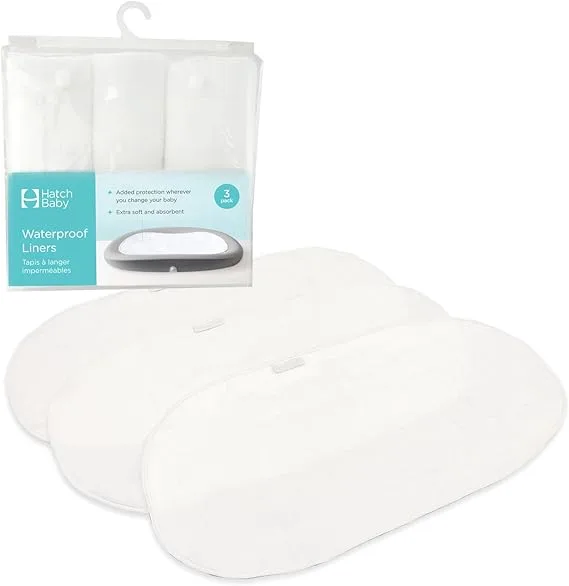
Hatch Baby Waterproof Changing Pad Liners (3-Count)
“Extra waterproof liners for laundry rotation. Changing pads get messy daily.”
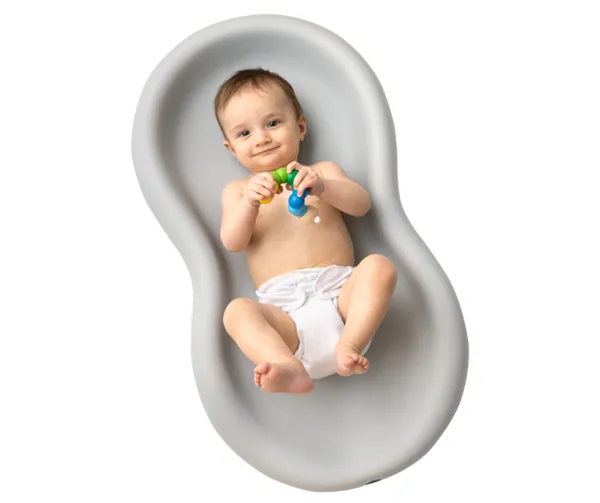
Keekaroo Peanut Changer
“Non-smart changing pad alternative. Seamless wipeable surface, no electronics.”
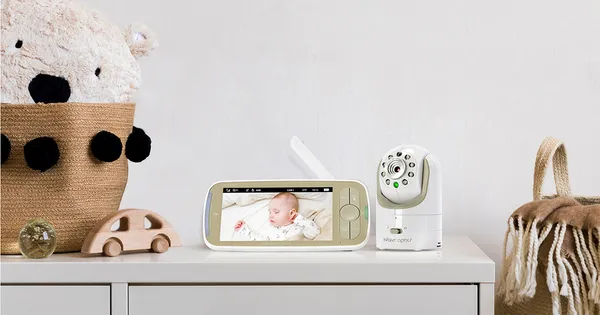
Infant Optics DXR-8 Pro Baby Monitor
“Nursery tech companion. Same 'smart nursery' ecosystem. Our Day 72 review evaluates it.”