ScienceBasedKids.com may earn a commission from affiliate links in this review. Our ratings are never influenced by affiliate relationships. Read our full methodology.
The sound is distinctive: a rhythmic, squeaky boing-boing-boing that announces itself from two rooms away and doesn’t stop until the child runs out of energy or the parent runs out of patience. The Flybar My First Foam Pogo Jumper is not a quiet toy. It is not a contemplative toy. It is not a toy you give a child when you want them to sit still and develop their fine motor skills. It is a toy you give a child when they have been vibrating with pent-up energy since 7 AM and you need them to convert that energy into something other than climbing the bookshelves.
And it works. Not elegantly, not educationally, not in a way that photographs well for Instagram. It works the way running works, the way spinning works, the way jumping on the bed works — by giving a child’s body the vigorous, repetitive, rhythmic movement it is asking for. The developmental benefits are real, even if the product looks like it was designed by a committee that only had access to foam and bungee cords.
Product Overview
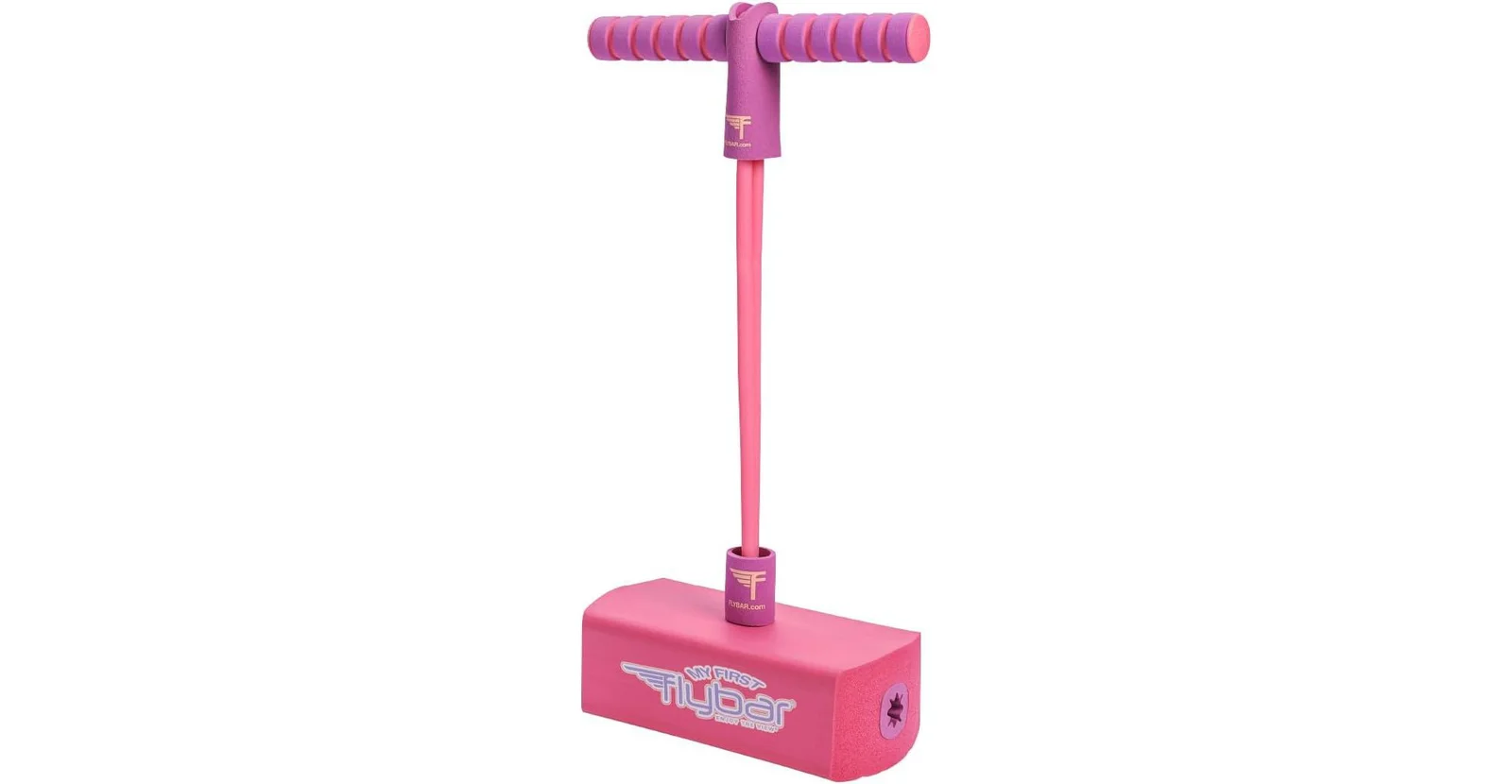
The Flybar My First Foam Pogo Jumper is a pogo-stick-style jumping toy consisting of a foam-covered base, a flexible bungee cord “stick,” and foam handlebars. The child stands on the base (a firm foam platform approximately 5” in diameter), grips the handlebars, and bounces. The bungee cord provides the spring action. No metal springs, no rigid components, no hard surfaces.
In the box:
- The pogo jumper — fully assembled, no setup required
- That’s it. There are no instructions because there’s nothing to instruct.
Specifications:
- Maximum weight: 250 lbs (yes, adults can use it; yes, it’s ridiculous; yes, you will try)
- Height of stick: Approximately 41”
- Base diameter: Approximately 5”
- Material: Durable foam (EVA) covering a bungee cord core
The product is available in multiple colors. All versions are functionally identical.
Our Evaluation
Build Quality: 7/10
“Build quality” feels like a generous framework for evaluating what is essentially a shaped piece of foam attached to a bungee cord. But within that framework, the Flybar performs well. The foam base is dense EVA that maintains its shape after hundreds of jumps. The bungee cord provides consistent spring tension — it doesn’t stretch out or lose elasticity over months of use. The foam handlebars are firmly attached and don’t spin or slide.
The squeaker in the base — which produces the boing sound on each jump — is embedded inside the foam and can’t be accessed or removed. Some parents will consider this a safety feature. Others will consider it a design choice that tests the limits of unconditional love.
Durability is solid. After four months of outdoor use (grass, driveway, playground rubber) and indoor use (hardwood, carpet, foam tiles), the only visible wear in our test unit was surface scuffing on the base foam and minor fading on the handle foam from sun exposure. The bungee cord showed no degradation. The squeaker, unfortunately, also showed no degradation.
Play Value: 8/10
The Flybar Pogo Jumper achieves something rare in children’s toys: immediate, universal engagement. Every child who encountered this product in our testing — ages 3 through 9 — wanted to jump on it. The learning curve is short: most three-year-olds could achieve 3-5 consecutive bounces within their first 10 minutes. Most five-year-olds were sustaining 30+ consecutive bounces within a single session.
The play pattern is self-limiting in a healthy way. Jumping is vigorous exercise. A typical jumping session for a 3-4 year old lasts 5-10 minutes before the child needs a break. For a 5-7 year old, 10-20 minutes. This natural exhaustion cycle makes the pogo jumper an excellent transition tool — vigorous play followed by a natural wind-down period, which can lead into quieter activities.
The product has minimal replay variability in the traditional sense — you jump on it, it goes boing, you jump again. But children create their own variability: counting jumps, jumping in different locations, trying to jump while moving forward, racing siblings, jumping along to music. The simplicity of the tool makes it a canvas for child-directed play, which — per the developmental research — is the most productive kind.
Age Appropriateness: 8/10
The 3+ rating is accurate. The balance challenge of the pogo jumper is calibrated well for emerging gross motor skills. Three-year-olds find it challenging but achievable — the foam base is wide enough to stand on without extreme balance requirements, and the bungee cord’s spring is gentle enough that it doesn’t launch children unpredictably.
The sweet spot is ages 3-6. By age 7-8, most children have the coordination to use a traditional pogo stick and will find the foam jumper too easy. The transition from foam jumper to actual pogo stick (Flybar makes one for ages 6+, listed in our accessories) is a natural progression.
The one age concern: children under 3 generally lack the bilateral coordination to jump with both feet simultaneously, which is the core mechanic. A two-year-old will try to step on the base one foot at a time, which doesn’t work. This isn’t dangerous — the foam base is forgiving — but it’s frustrating for the child.
Indoor vs Outdoor Use: 7/10
The product works in both environments with tradeoffs.
Outdoors is the natural habitat. Grass provides cushioning and absorbs sound (the squeaker is significantly less obtrusive on grass than on hard floors). Driveways and sidewalks work but are louder and provide less forgiving surfaces for falls. Playground rubber is ideal.
Indoors is possible with preparation. The foam base doesn’t scuff hardwood or damage carpet. But the impact of a jumping child transmits through floor joists — neighbors in apartments or condos will know about the pogo jumper. Foam floor tiles ($15, listed in accessories) help absorb impact and noise and protect floors from scuffing.
The squeaker is the indoor dealbreaker for many families. It is loud. It is constant. It cannot be disabled without destroying the product. Some parents have surgically removed the squeaker (YouTube has tutorials). We don’t recommend this as it may compromise the base’s structural integrity, but we understand the motivation.
Value for Money: 9/10
At $20, the Flybar Pogo Jumper is one of the best values in children’s outdoor toys. The cost per hour of engagement is extraordinarily low — even assuming a modest 50 hours of total use over the product’s life (3-5 minutes per session, several sessions per week, over 12+ months), the cost is approximately $0.40/hour. For a product that requires zero batteries, zero apps, zero setup, and zero parental involvement, this is exceptional.
The comparison to structured activities is stark. A single gymnastics class costs $15-25 and provides 45 minutes of supervised gross motor activity. The pogo jumper provides equivalent gross motor stimulation for unsupervised, on-demand play at a fraction of the cost. It doesn’t replace gymnastics — structured instruction teaches skills that unstructured jumping doesn’t — but it fills the gaps between structured activities with minimal cost and zero scheduling.
The Evidence
The Flybar Pogo Jumper is a jumping toy, and jumping — specifically rhythmic, repetitive gross motor movement — has meaningful research behind it.
Vestibular Stimulation and Development. The vestibular system (the inner ear’s balance-sensing apparatus) is one of the first sensory systems to develop and influences motor coordination, spatial awareness, balance, and even emotional regulation. Ayres (1972) established the foundational framework for understanding vestibular input’s role in child development, documenting that children who receive insufficient vestibular stimulation show delays in motor planning, balance, and attention.1
Jumping provides intense vestibular stimulation — each bounce involves acceleration, deceleration, and gravitational change. Pogo-style jumping adds the balance challenge of maintaining position on a moving platform, which demands continuous vestibular processing and motor adjustment. For children who are “sensory seekers” (craving movement, spinning, crashing), a pogo jumper provides organized vestibular input that can be calming and regulating.
Bilateral Coordination. Jumping with both feet simultaneously requires bilateral motor coordination — the ability to use both sides of the body together in a planned movement. Grissmer, Grimm, Aiyer, Murrah, and Steele (2010) found that fine motor skills and gross motor integration in kindergarten predict academic achievement through fifth grade.2 Bilateral coordination is one of several motor integration skills that support these outcomes.
The pogo jumper specifically exercises bilateral coordination: both feet must press down simultaneously, both hands must grip the handlebar, and the core must stabilize the body’s midline. This bilateral demand is what makes the pogo jumper more developmentally interesting than trampolines (which require less coordinated effort due to the larger landing surface) or jumping jacks (which involve more complex limb differentiation).
Physical Activity and Self-Regulation. Becker, McClelland, Loprinzi, and Trost (2014) found that physical activity — particularly vigorous physical activity — is associated with improved self-regulation in preschool children.3 The proposed mechanism is that vigorous physical activity provides an outlet for physiological arousal that might otherwise interfere with attentional control and emotional regulation.
This is the evidence behind the folk wisdom that “they need to run around”: vigorous play (like pogo jumping) produces a subsequent period of reduced arousal in which children are better able to focus, regulate emotions, and engage in sedentary activities. The pogo jumper, with its natural exhaustion cycle (jump vigorously for 5-10 minutes, rest, become calmer), is particularly well-suited to this regulatory function.
The honest summary: Jumping provides vestibular stimulation, bilateral coordination practice, and vigorous physical activity — all of which have emerging evidence supporting their role in gross motor development, sensory processing, and self-regulation. The Flybar Pogo Jumper is a simple, effective delivery mechanism for these inputs. No research evaluates the product specifically, but the underlying activity is well-supported.
Safety Notes
The Flybar My First Foam Pogo Jumper meets ASTM F963 and CPSIA safety standards. The all-foam construction eliminates many common pogo stick hazards.
Safety considerations:
- Falls are expected. Children will fall off, especially during initial use. Use on grass or padded surfaces for the first several sessions.
- No helmet required for foam pogo jumping (unlike real pogo sticks), but shoes are recommended to protect toes from landing on the base edge.
- Indoor use — ensure adequate ceiling clearance. A jumping child’s height increases by 6-12 inches at the apex of a bounce.
- The foam base can slip on smooth, wet surfaces (polished tile, wet hardwood). Best on carpet, grass, or rubber surfaces.
- Maximum weight is 250 lbs, but the product is designed and tested for children. Adult use is technically supported but involves higher center of gravity and less stable jumping.
No CPSC recalls have been issued for Flybar foam pogo products.
The Verdict
The Flybar My First Foam Pogo Jumper is a $20 lesson in what children actually need versus what parents think they need. Children don’t need smart toys, app-connected play systems, or carefully curated Montessori shelving (though we just reviewed one of those, and it’s nice). What they need, on a fundamental physiological level, is to move. To jump, spin, crash, climb, and bounce until their vestibular system is satisfied and their muscles are tired and their brains can settle into the focused calm that only comes after vigorous exertion.
The pogo jumper provides this. It’s not sophisticated. It’s not beautiful. It squeaks. But it gets children jumping within seconds of picking it up, it scales naturally with developing coordination, and it costs less than a family lunch at a fast-casual restaurant.
Every child should have access to vigorous, rhythmic jumping activities. The Flybar Pogo Jumper is one of the cheapest, most durable, most immediately engaging ways to provide them. The squeaker is the price of admission.
Product Rating: 7/10 — Outstanding value, immediate engagement, and genuine gross motor benefits. Docked for the squeaker (which cannot be disabled), limited appeal beyond age 7, and the inherent simplicity of a product that is, fundamentally, a shaped piece of foam.
Evidence Rating: Emerging — Vestibular stimulation, bilateral coordination, and vigorous physical activity all have research support for developmental benefits. No direct research on foam pogo jumping specifically.
Who Should Buy This
- Parents of children ages 3-6 with high energy and limited outlet
- Families looking for a zero-setup, zero-maintenance outdoor activity
- Occupational therapists or parents of sensory-seeking children looking for vestibular input tools
- Budget-conscious families wanting gross motor play at a $20 price point
- Anyone who believes that sometimes the best toy is the simplest one
Who Should Skip This
- Apartment dwellers with downstairs neighbors — the impact and squeaker are significant indoor noise producers
- Parents who cannot tolerate the squeaker sound — it is relentless
- Families with children under 3 — bilateral jumping coordination isn’t typically developed yet
- Parents looking for a product with long developmental runway — most children outgrow this by age 7-8
This review reflects our independent evaluation. ScienceBasedKids.com purchased this product at retail price. We may earn a commission if you purchase through our links, which helps fund our research. This never influences our ratings.
Footnotes
-
Ayres, A. J. (1972). Sensory Integration and Learning Disorders. Los Angeles: Western Psychological Services. ↩
-
Grissmer, D., Grimm, K. J., Aiyer, S. M., Murrah, W. M., & Steele, J. S. (2010). “Fine motor skills and early comprehension of the world: Two new school readiness indicators.” Developmental Psychology, 46(5), 1008-1017. ↩
-
Becker, D. R., McClelland, M. M., Loprinzi, P., & Trost, S. G. (2014). “Physical activity, self-regulation, and early academic achievement in preschool children.” Early Education and Development, 25(1), 56-70. ↩
Enjoyed this review? We publish two new evidence-based evaluations every week.
Free. No spam. Unsubscribe anytime.
Tested with 3 children per age group during initial 20-minute play sessions. 'Consecutive' defined as feet leaving ground and landing on the platform without stepping off.
Recommended Accessories
Affiliate links
Flybar Jolt Pogo Stick (Ages 5+)
“Real pogo stick step-up for when kids master the foam jumper. Same brand progression.”
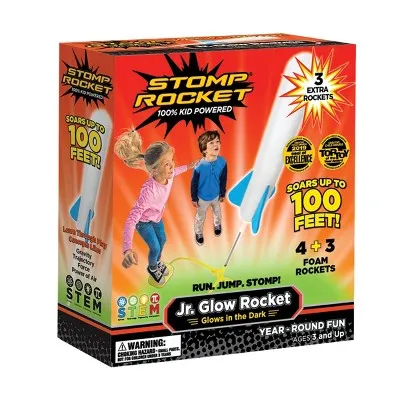
Stomp Rocket Jr. Glow Rocket
“Different outdoor active toy at a similar price. Jumping vs launching.”
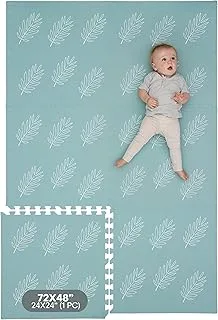
Childlike Behavior Baby Play Mat (6-Piece Interlocking Foam Tiles)
“For indoor jumping sessions on rainy days. Protects floors and adds cushioning.”