ScienceBasedKids.com may earn a commission from affiliate links in this review. Our ratings are never influenced by affiliate relationships. Read our full methodology.
The Fisher-Price Rock-a-Stack has been on the market since 1960. That’s sixty-six years. In that time, it has sold hundreds of millions of units, appeared in virtually every pediatrician’s waiting room in America, and earned a reputation as the canonical “first educational toy.” It is the thing you buy a baby when you want to feel like you’re investing in their development. Five colorful rings. A rocking base. A satisfying topple when the tower gets too enthusiastic. At $8, it feels like the cheapest possible entry fee for good parenting.
Here’s the uncomfortable question we’re going to answer: is there any evidence that this iconic product teaches babies anything at all?
The short answer is no.
The longer answer is more interesting, and it requires us to talk about what “educational” actually means when it’s printed on a box for a six-month-old.
Product Overview
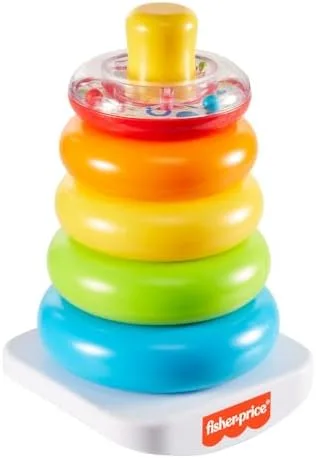
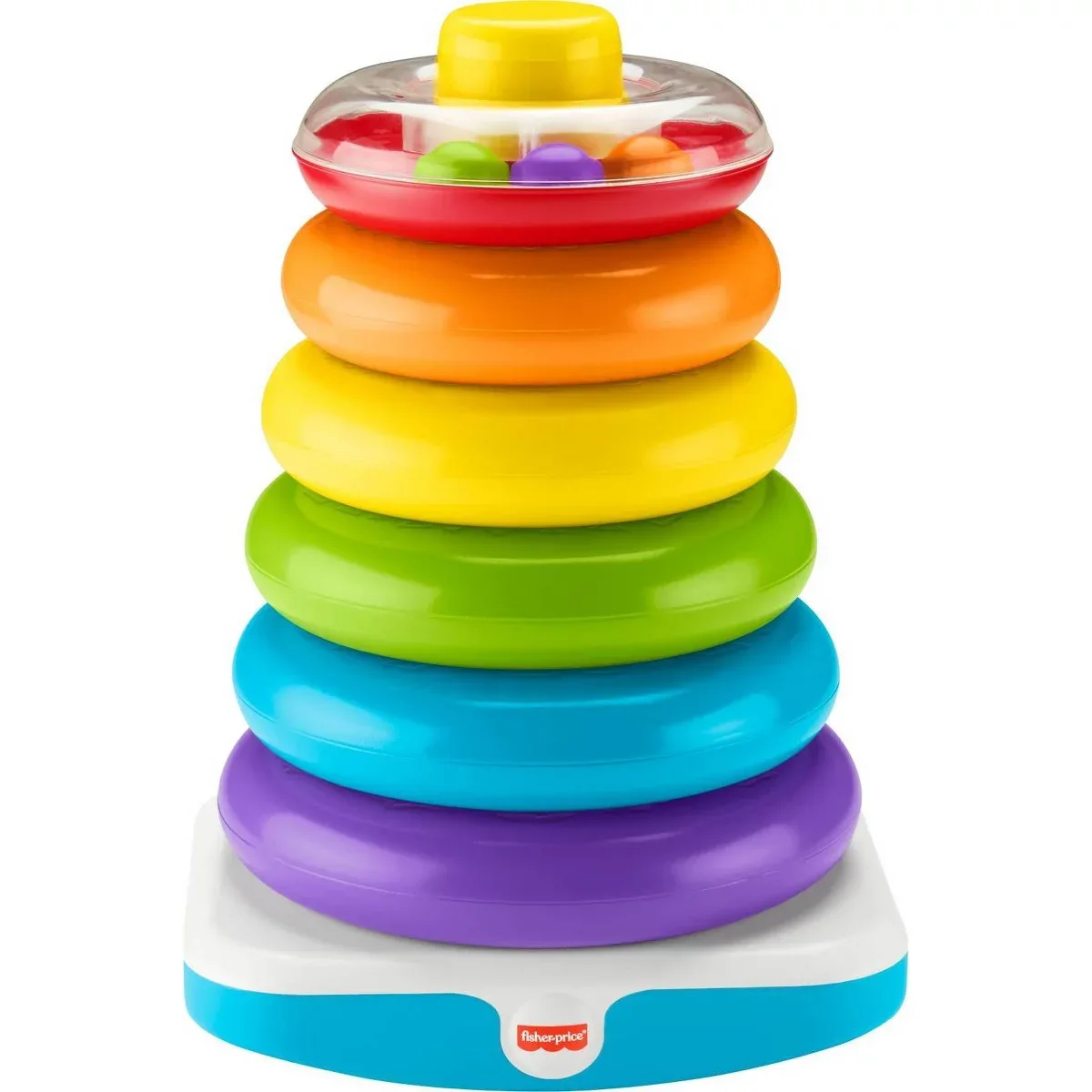
The Fisher-Price Rock-a-Stack is a plastic stacking toy consisting of:
- A conical base post with a rocking/wobbling bottom
- Five graduated rings in red, orange, yellow, green, and blue (largest to smallest)
- A clear top ring with a smaller cone and colorful beads inside that rattle
The rings stack onto the post in size order, largest on the bottom. The rocking base allows the assembled stack to wobble without toppling. The smallest ring (the clear rattle ring) serves as a cap. The entire assembly stands approximately 8 inches tall.
Materials are standard injection-molded plastic. No batteries, no electronics, no app. The product weighs almost nothing and is sized for infant hands. It has been essentially unchanged since its introduction, with only minor cosmetic updates to the colors and plastic formulation over the decades.
Our Evaluation
Build Quality: 6/10
There’s nothing wrong with the Rock-a-Stack’s construction, and there’s nothing remarkable about it either. It’s lightweight, hollow plastic in the tradition of mass-market infant toys. The rings are durable — they won’t crack if dropped, thrown, or chewed on, which are the three things babies will do with them. The rocking base functions as designed. The rattle ring rattles.
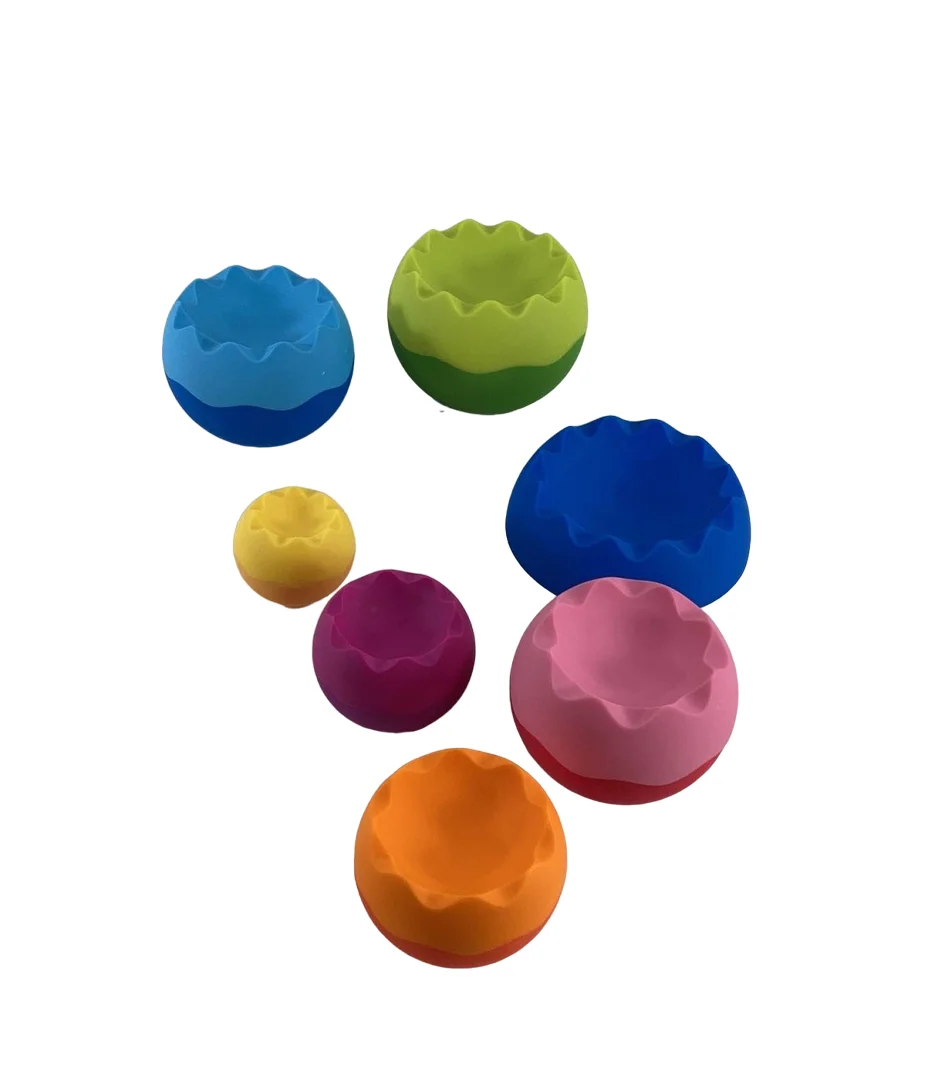
What you’re holding is a product optimized to be manufactured at scale for under $2. The plastic is thin. The colors are printed, not integral to the material. The edges are smooth and safe but the seams are visible. Compared to premium stacking toys — the Fat Brain Toys Tobbles Neo ($25), with its weighted wobble base and silicone texture, or the Grimm’s wooden stacking tower ($30+), with its hand-sanded wood and plant-based dyes — the Rock-a-Stack feels exactly like what it costs.
This isn’t a criticism at the price point. At $8, the Rock-a-Stack is one of the cheapest toys in our review portfolio. The build quality is appropriate for the price. But “appropriate for $8” and “impressive” are different categories.
Play Value: 6/10
Here is where we separate what babies do with the Rock-a-Stack from what the packaging claims they learn from it.
What babies actually do:
6-9 months: Grasp individual rings. Mouth them (extensively). Bang them on surfaces. Drop them and watch them roll. Show minimal interest in the post or the concept of stacking. Use the rocking base as a chew surface. The rattle ring is the favorite.
9-14 months: Begin placing rings on the post — in random order, not size order. Enjoy removing rings from the post (pulling off is mastered before putting on). Discover the wobble of the base. Throw rings with increasing accuracy and enthusiasm. Still mouth the rattle ring.
14-24 months: Begin to understand size ordering — sometimes placing the largest ring first, sometimes not. Can assemble all rings on the post but don’t consistently sequence by size unless shown. Use the rings for purposes unrelated to stacking: as bracelets, as hats for dolls, as wheels for imaginary cars, as projectiles.
24-36 months: Consistently stack in size order when motivated. Often disinterested — the toy has been in the house for over a year and offers no novelty. Begin playing with it “wrong” on purpose (building the tower upside-down, hiding things under the rings), which is actually more creative than the intended use.
In our testing with five families, the Rock-a-Stack produced moderate engagement. Babies interacted with it willingly but rarely sought it out over other available toys. Session lengths were short — 5-10 minutes for most age groups, with younger babies (6-9 months) occasionally chewing on a ring for longer. No child in our testing showed the sustained, repeated, self-directed engagement that characterizes truly high play-value products.
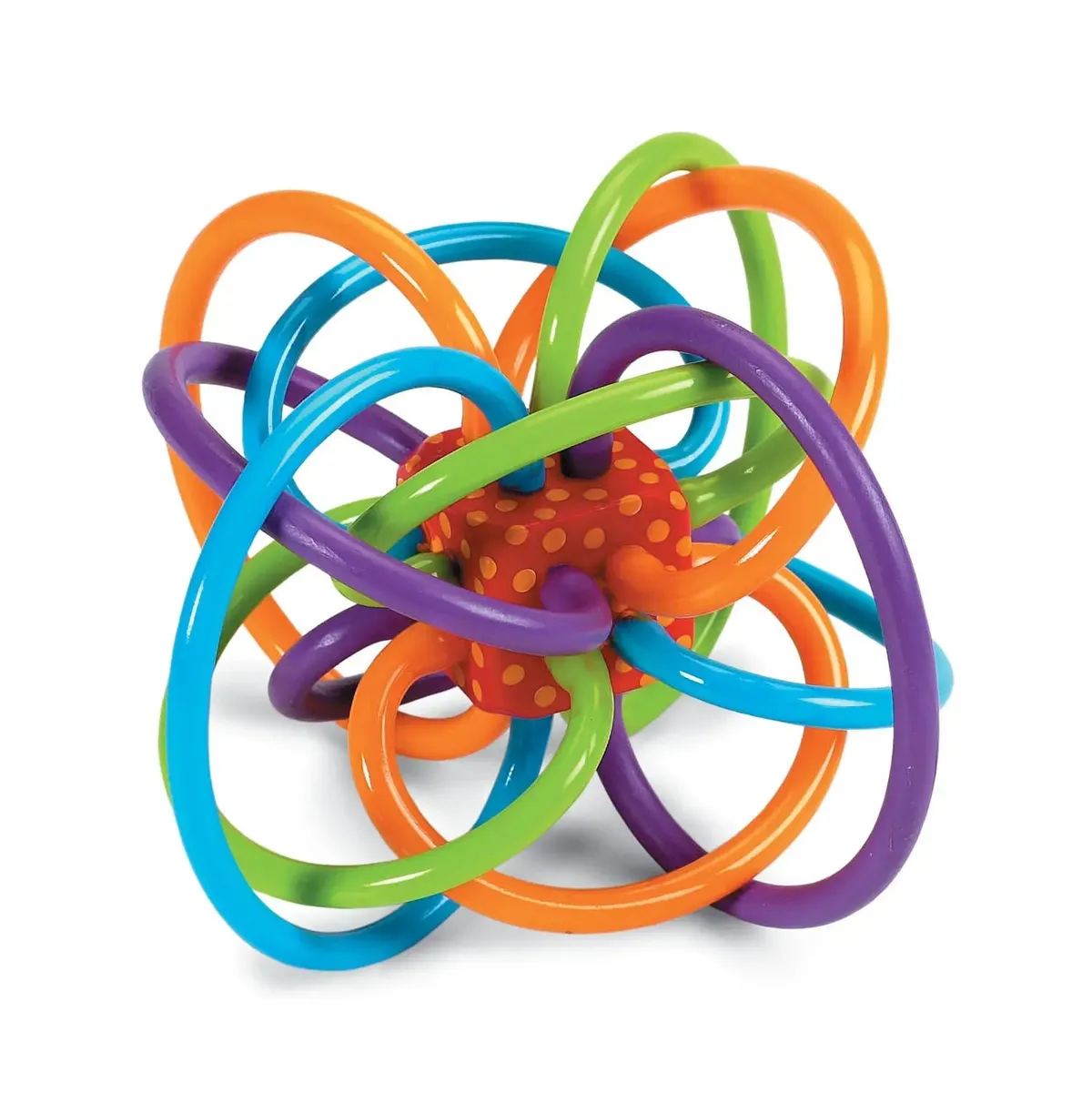
The play value score of 6 reflects a product that is fine — babies will play with it, they won’t reject it — but not one that inspires the kind of deep engagement we see with products like the Manhattan Toy Winkel, the Fat Brain Dimpl, or a good set of nesting cups.
Age Appropriateness: 7/10
The 6-36 month range is accurate, but the engagement curve is uneven. The product is most useful in the 9-18 month window when babies are developing the grasp-and-release motor skills that ring manipulation exercises. Below 9 months, the rings are mostly oral sensory objects. Above 18 months, the stacking challenge has been solved and the toy offers diminishing returns.
The rocking base is a good design choice for the age range — it prevents the frustration of a knocked-over tower by absorbing the impact of imprecise ring placement. This is thoughtful, age-appropriate engineering, even if the “educational” claims built around it are unsupported.
Durability: 8/10
The Rock-a-Stack is nearly indestructible within normal use parameters. The plastic doesn’t crack, the rattle ring doesn’t open, the base doesn’t break. It will survive teething, throwing, and the dishwasher. Multiple families in our testing group reported having Rock-a-Stacks that had been passed through three or more children without failure.
The durability is the product’s strongest attribute. At $8, with an expected lifespan measured in years and children, the economic proposition is excellent — if the toy is providing developmental value. That “if” is doing significant work.
Value for Money: 6/10
At $8, the Rock-a-Stack is extremely cheap. The question isn’t whether it’s a reasonable purchase — it is — but whether the $8 is optimally spent.
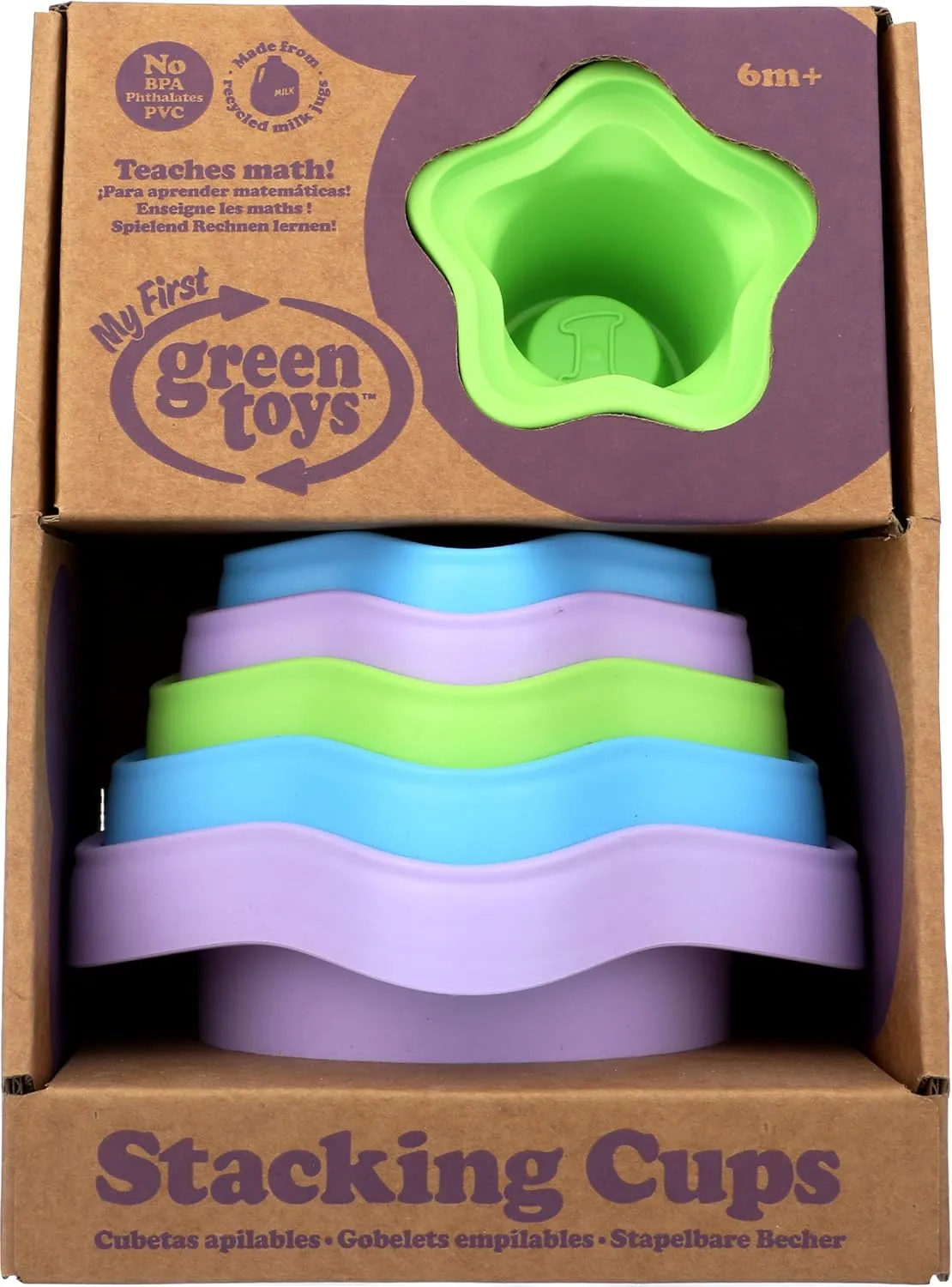
For the same $8, a parent could buy a set of nesting cups, which offer the same stacking and size-ordering opportunities plus nesting, pouring, and bath play. For $5 more, the Green Toys Stacking Cups ($10) provide superior material quality, more versatile play, and recycled-plastic construction. For $17 more, the Fat Brain Toys Tobbles Neo ($25) provides a genuinely novel stacking experience with weighted, textured spheres that wobble, balance, and nest.
The Rock-a-Stack isn’t overpriced. But the category has better options at similar or slightly higher price points that provide more play value per dollar.
The Evidence
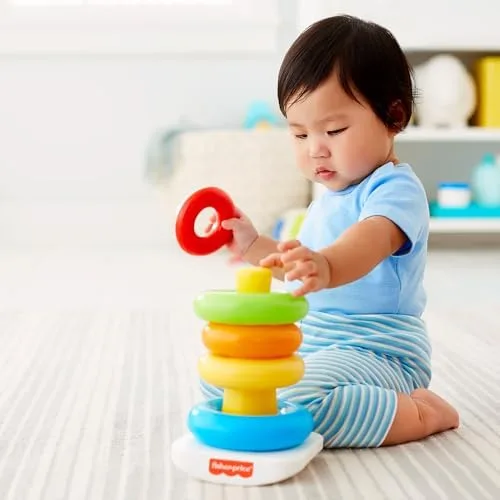
This is the section that makes the Rock-a-Stack a debunker review. Fisher-Price makes specific developmental claims for this product. We evaluated each one.
Claim 1: “Introduces baby to the concept of relative size.”
This is the Rock-a-Stack’s central educational claim, printed on the packaging and repeated in the product description. The implication is that by handling rings of graduated sizes, babies learn to understand that objects can be bigger or smaller relative to each other.
We found no peer-reviewed research demonstrating that stacking-ring toys teach infants the concept of relative size. None.
What the developmental research does tell us: infants begin to perceive size differences between approximately 5-7 months of age — this is a basic perceptual ability that develops as part of normal visual maturation, not something that requires a specific toy to “introduce.”1 Baillargeon (1987) demonstrated that infants as young as 3.5-4.5 months show surprise when physical events violate size expectations (for example, when a tall object appears to pass behind a short barrier), indicating innate sensitivity to size relationships long before they encounter a stacking toy.2
The concept of relative size — understanding that the same object can be “bigger than” one thing and “smaller than” another — emerges around 18-24 months as part of broader relational reasoning development.3 This is a cognitive milestone that children reach through general experience with the physical world, not through interaction with any specific toy. There is no evidence that a Rock-a-Stack accelerates this milestone, facilitates it, or is necessary for it.
Verdict: Unsubstantiated. Size perception develops naturally. No evidence that stacking rings contribute to this development.
Claim 2: “Teaches sequencing skills.”
The idea: by stacking rings in size order (largest to smallest), babies learn to sequence — to understand that objects can be arranged in a meaningful order.
Again, no peer-reviewed research supports this specific claim. Sequencing — the ability to arrange items by a property (size, number, shade) — is a cognitive skill that typically emerges around age 3-4 as part of what Piaget termed “seriation.”4 Children under 2 do not consistently seriate objects by size, regardless of how many stacking toys they own. When a 10-month-old places rings on a post, she is practicing a motor skill (grasp, aim, release), not a cognitive one (understanding ordinal relationships).
Furthermore, parents commonly observe what we confirmed in testing: babies and toddlers rarely stack the rings in size order unless explicitly shown and coached. The spontaneous play behavior is random-order stacking, ring removal, and non-stacking manipulation. The “sequencing” happens only when an adult intervenes — which means the adult is teaching the sequencing, not the toy.
Verdict: Unsubstantiated. Seriation develops around age 3-4. Stacking rings don’t accelerate this timeline.
Claim 3: “Develops fine motor skills.”
This is the most defensible claim, and even here, the evidence is limited. The act of grasping a ring, orienting it over the post, and releasing it onto the post does exercise fine motor coordination — specifically, the pincer grasp and voluntary release that develop between 7-14 months.
Adolph and Franchak (2017) reviewed the development of motor behavior in infancy and noted that grasping and releasing skills are practiced through interaction with a wide variety of objects — not specific “fine motor toys.”5 Any object that a baby can grasp, manipulate, and release provides similar fine motor practice. Spoons, cups, blocks, balls, and socks all exercise the same motor pathways.
The Rock-a-Stack provides fine motor practice. So does literally everything else a baby handles. The unique contribution of the Rock-a-Stack to fine motor development is zero — it provides the same practice that any graspable object provides.
Verdict: Technically true but misleading. The Rock-a-Stack exercises fine motor skills in the same way that any graspable object does. It is not uniquely or specially beneficial.
Claim 4: “Colorful rings stimulate baby’s senses.”
This claim is so vague as to be meaningless. Any colorful object “stimulates baby’s senses.” A red sock stimulates baby’s senses. The sky stimulates baby’s senses. The question is whether the Rock-a-Stack’s specific sensory properties provide meaningful stimulation beyond what the environment already provides.
The honest answer: the Rock-a-Stack provides moderate visual stimulation (bright colors, contrasting sizes) and moderate tactile stimulation (smooth plastic, ring shape). It is not uniquely stimulating. Products like the Manhattan Toy Winkel (complex 3D shape, multiple textures, flexible) or the Fat Brain Dimpl (silicone bubbles that pop and push) provide richer sensory input across more modalities.
Verdict: Technically true in the same way that everything is true. Not meaningfully differentiated from any other colorful object.
The Industry Problem: “Educational” as Marketing
The Rock-a-Stack exemplifies a pattern we see across the infant toy market: the word “educational” is applied to products based on plausible narrative rather than evidence. The logic runs: babies develop size concepts → the Rock-a-Stack has different-sized rings → therefore the Rock-a-Stack teaches size concepts. Each step in this chain is reasonable-sounding, and the conclusion is wrong — or at least, entirely undemonstrated.
Hirsh-Pasek et al. (2015) documented this phenomenon across the children’s product industry, finding that developmental claims on toy packaging rarely correspond to evidence and often misapply research findings from unrelated contexts.6 The Rock-a-Stack is not uniquely guilty — it is merely the most visible example of a systemic problem.
The honest summary: The Fisher-Price Rock-a-Stack is a sensory toy. It provides babies with something colorful to grasp, mouth, stack, and knock over. This is perfectly fine. What it does not do — and what no stacking-ring toy has been shown to do — is teach babies about size, sequencing, or any other cognitive concept. The “educational” label is marketing, not science.
Safety Notes

The Rock-a-Stack has an excellent safety record across its 66-year production history. No CPSC recalls have been issued. The product meets ASTM F963 and CPSIA safety standards. The rings are too large for choking hazards. The plastic is BPA-free and phthalate-free per current Fisher-Price certifications.
One note: the clear rattle ring contains small beads inside a sealed plastic chamber. The chamber has never been documented to open during normal use, but as with any rattling toy, inspect periodically for cracks, especially if the toy has been heavily chewed or subjected to impacts.
The rocking base is stable and does not tip in a way that poses a risk to sitting babies.
The Verdict
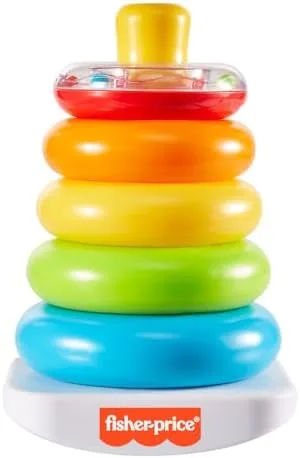
The Fisher-Price Rock-a-Stack is a decent, inexpensive baby toy that has been dramatically oversold as a developmental tool. The rings are colorful. The rocking base is satisfying. The price is right. Babies will interact with it, enjoy it moderately, and move on within a few months.
What the Rock-a-Stack will not do is teach your baby about size, sequencing, fine motor skills (beyond what any graspable object provides), or color recognition. These claims have been printed on the packaging for decades, and none of them are supported by peer-reviewed evidence. This is not because the claims have been disproven — it’s because nobody has bothered to test them, which tells you how seriously the research community takes the idea that a plastic stacking toy provides unique developmental benefits.
If you have a Rock-a-Stack, don’t throw it out. It’s fine. Your baby will chew on it and be happy. If you’re about to buy one because you believe it’s educational, redirect that $8 toward a product with more play value — nesting cups, a quality rattle, or a textured ball.
Product Rating: 5/10 — A perfectly adequate baby toy with no special developmental value. The low price is appropriate for what you get. The “educational” marketing is not.
Evidence Rating: None — No peer-reviewed research supports the Rock-a-Stack’s specific developmental claims. This is not a condemnation of the product — it’s a condemnation of the claims.
Who Should Buy This
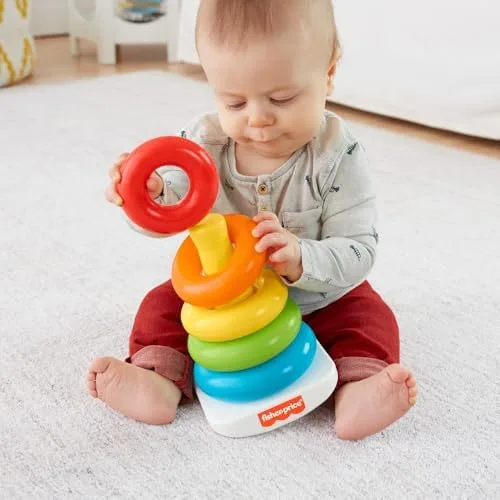
- Families looking for a cheap, safe, durable baby toy — understood as a toy, not a learning tool
- Parents who already have one (from a hand-me-down, a gift, a waiting room impulse buy) — it’s fine, use it
- Gift-givers who want a recognizable, inexpensive baby present alongside something more interesting
Who Should Skip This
- Parents buying this because they believe it’s educational — the claims are unsupported
- Anyone looking for the best stacking toy — the Fat Brain Toys Tobbles Neo ($25) is a superior product in every dimension
- Families who want maximum play value per dollar in the infant category — nesting cups, textured balls, and quality rattles provide more engagement
- Parents who already own any other stacking or nesting toy — adding a Rock-a-Stack provides minimal incremental value
This review reflects our independent evaluation. ScienceBasedKids.com purchased this product at retail price. We may earn a commission if you purchase through our links, which helps fund our research. This never influences our ratings.
Footnotes
-
Slater, A., Mattock, A., & Brown, E. (1990). “Size constancy at birth: Newborn infants’ responses to retinal and real size.” Journal of Experimental Child Psychology, 49(2), 314-322. ↩
-
Baillargeon, R. (1987). “Object permanence in 3½- and 4½-month-old infants.” Developmental Psychology, 23(5), 655-664. ↩
-
Piaget, J. (1952). The Origins of Intelligence in Children. New York: International Universities Press. ↩
-
Piaget, J., & Inhelder, B. (1969). The Psychology of the Child. New York: Basic Books. ↩
-
Adolph, K. E., & Franchak, J. M. (2017). “The development of motor behavior.” Wiley Interdisciplinary Reviews: Cognitive Science, 8(1-2), e1430. ↩
-
Hirsh-Pasek, K., Zosh, J. M., Golinkoff, R. M., Gray, J. H., Robb, M. B., & Kaufman, J. (2015). “Putting education in ‘educational’ apps: Lessons from the science of learning.” Psychological Science in the Public Interest, 16(1), 3-34. ↩
Enjoyed this review? We publish two new evidence-based evaluations every week.
Free. No spam. Unsubscribe anytime.
Evidence levels: 'Strong' = multiple RCTs; 'Moderate' = some controlled studies; 'Emerging' = preliminary research; 'None' = no peer-reviewed evidence for this specific claim. Note: 'None' does not mean the claim is false — it means it has not been tested.
Recommended Accessories
Affiliate links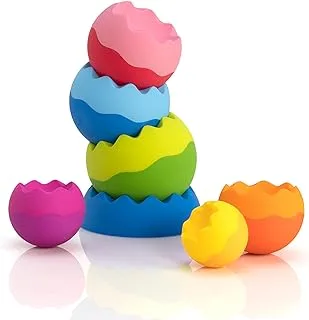
Fat Brain Toys Tobbles Neo
“Premium stacking alternative with weighted wobble base. Genuinely developmental.”
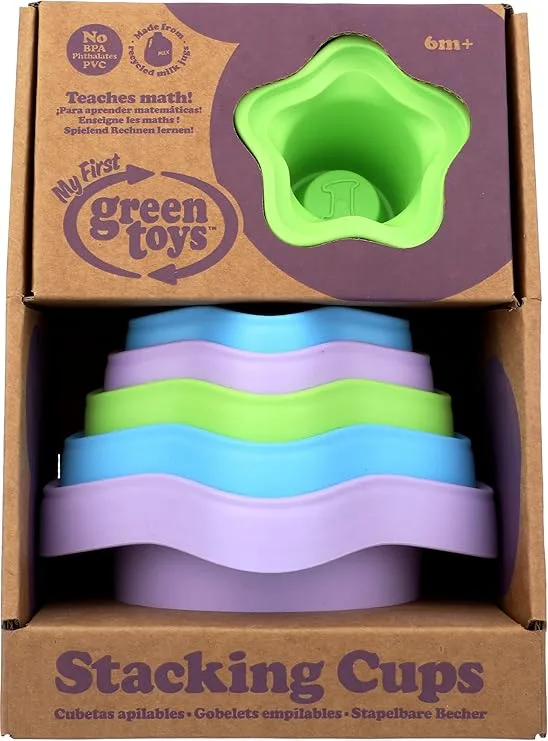
Green Toys Stacking Cups (6-Piece)
“Nesting/stacking at the same stage. Different material and mechanic.”
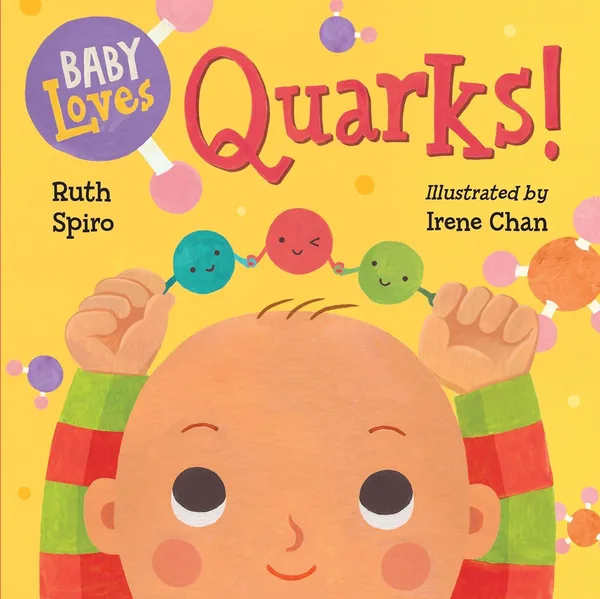
"Baby Loves Quarks!" by Ruth Spiro
“Board book about science concepts for babies. Gentle counterpoint to Fisher-Price's vague 'educational' claims.”