ScienceBasedKids.com may earn a commission from affiliate links in this review. Our ratings are never influenced by affiliate relationships. Read our full methodology.
Hand a Dimpl to a six-month-old and watch what happens. The fingers find a bubble — the largest one, usually, because it’s the easiest target for a palm that still thinks “grab” means “close entire hand around thing.” The fingers press. The silicone yields, then resists, then — pop — inverts through the frame to the other side. The baby startles. The baby examines. The baby presses the bubble from the other side. Pop. The baby has discovered cause and effect, and cause and effect is the most interesting thing in the universe when you’re six months old.
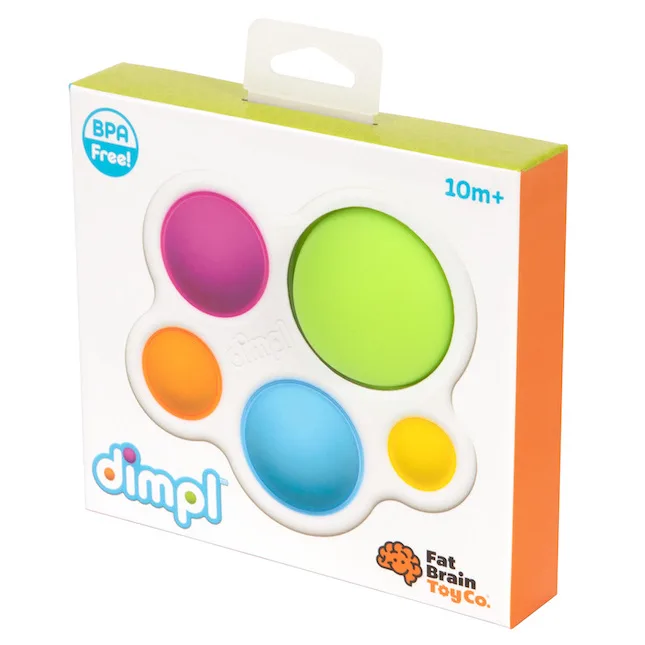
Fat Brain Toys’ Dimpl is not the kind of product that wins innovation awards. It’s five silicone bubbles embedded in a plastic frame. It doesn’t light up, play music, or connect to an app. It costs $13. And it is, consistently, one of the first toys we recommend when someone asks what to buy for a baby.
Product Overview
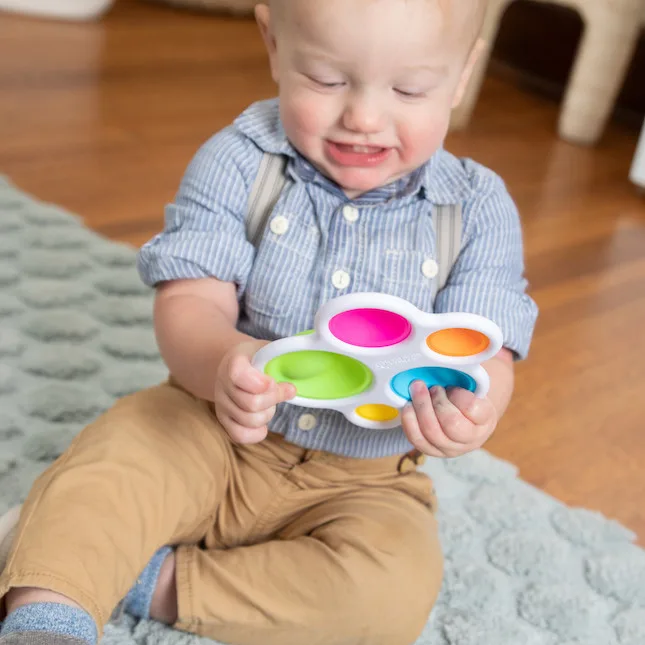
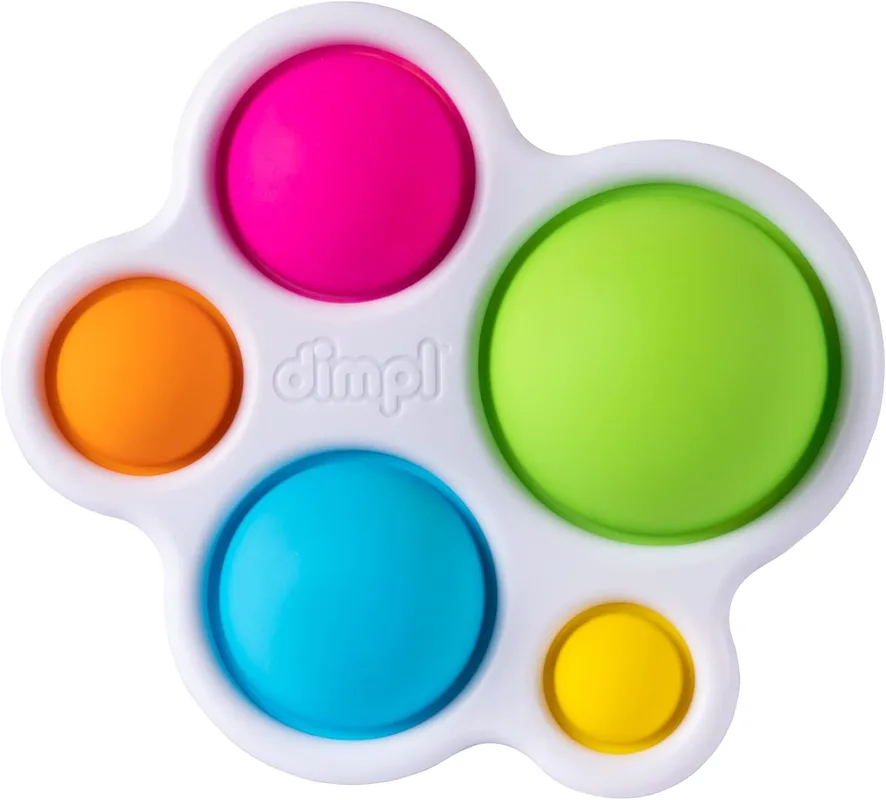
The Fat Brain Toys Dimpl ($13) is a sensory toy designed for infants and young toddlers, consisting of:
- Frame: A sturdy ABS plastic frame, roughly 7 × 4 inches, with five circular openings of decreasing size
- Bubbles: Five food-grade silicone bubbles, each a different bright color (green, blue, orange, yellow, red), seated in the frame openings
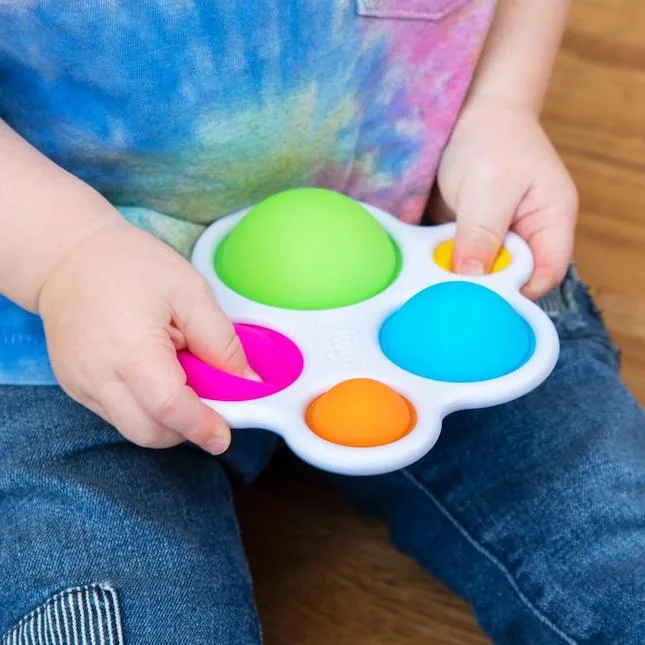
- Mechanism: Each bubble can be pushed from either side of the frame, popping through to the other side with a satisfying tactile and auditory “pop”
That’s the entire product. There are no batteries, no additional pieces, no assembly, and no instructions needed beyond what any baby will figure out in approximately four seconds.
The design details matter more than they appear to:
- Bubble sizes are graduated. The largest bubble (approximately 2 inches) requires less fine motor precision to push; the smallest (approximately 1 inch) requires more. This creates a natural difficulty progression as the infant’s hand control develops — they start with the big bubbles and gradually work toward the small ones.
- The silicone has a specific durometer. The bubbles are soft enough to be satisfying to push but firm enough to provide resistance — the sensation is closer to pressing a ripe grape than pressing a marshmallow. This resistance is the key sensory element: it creates proprioceptive feedback (the baby’s muscles sense how much force they’re applying) and a clear cause-effect boundary (push this hard, and the bubble pops through).
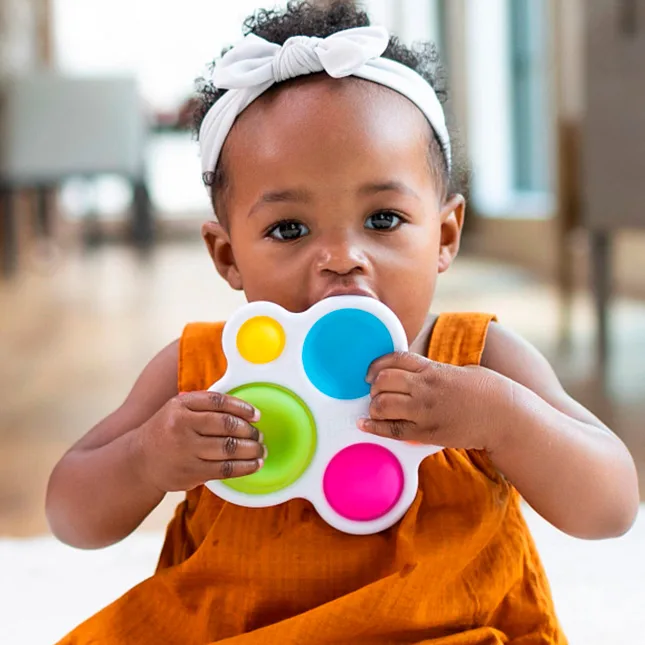
- The frame is mouthable. The edges are rounded, the plastic is BPA-free, and the entire object fits no choking categories. Babies will mouth this toy — it’s designed for that.
- The colors are high-contrast. The bright, saturated colors against the white frame provide strong visual contrast, supporting early visual discrimination.
Our Evaluation
Build Quality: 8/10
Dimpl is built like a medical device. The silicone bubbles are bonded to the plastic frame with a seal that shows no signs of separation after months of daily use, including aggressive mouthing, throwing, and the occasional trip through the dishwasher (it’s dishwasher safe on the top rack — a detail that earns bonus points in the baby toy category, where “can I sanitize this quickly?” is a genuine purchasing criterion).
The silicone maintains its elasticity over time. After three months of testing, the pop resistance on our test unit is indistinguishable from a fresh unit. The bubbles don’t stretch, thin, or develop weak spots. The ABS plastic frame is rigid and shows no stress marks at the bubble-frame junction — the most vulnerable structural point.
The only quality concern is cosmetic: the silicone attracts dust, lint, and pet hair. In a household with a dog, the Dimpl requires a rinse before each play session to clear the accumulated fuzz. This is inherent to the material choice (silicone’s slight tackiness is what makes it pleasant to touch) and not a design flaw, but it’s worth noting for families with shedding pets.
Play Value: 7/10
Dimpl’s play value is concentrated and age-specific. It is not a toy that grows with the child. It is a toy that meets the child at a specific developmental moment and serves that moment perfectly.
0-3 months: Sensory stimulus. Newborns and very young infants engage with Dimpl primarily as a visual and tactile object. They don’t push bubbles deliberately, but they grasp the frame, mouth the edges, and track the bright colors. Engagement is brief (1-3 minutes) but present.
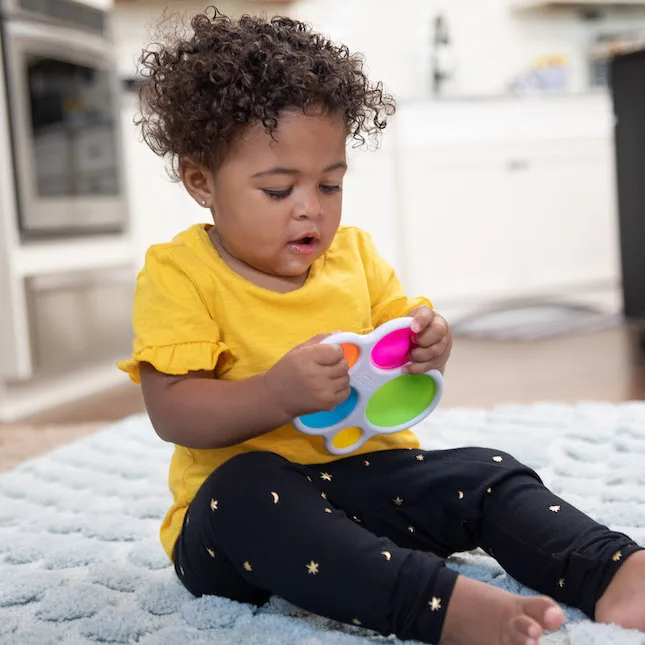
3-6 months: Discovery phase. This is when deliberate bubble-pushing begins. The baby’s improving hand coordination (specifically the transition from reflexive grasping to voluntary reaching and pressing) finds a perfect target in Dimpl’s large bubbles. The pop of a bubble inverting is surprising and rewarding. Our testers in this range showed clear surprise-reaction-repetition patterns: push, startle, examine, push again. Classic sensorimotor exploration.
6-10 months: The golden window. Dimpl’s engagement peaks here. Babies in this range have sufficient hand control to push all five bubbles, are developing the bilateral coordination to hold the frame with one hand and push with the other, and are deep in the sensorimotor stage where cause-and-effect is intrinsically fascinating. Our testers averaged 8-10 minutes of sustained engagement per session — long for a baby toy. The smaller bubbles provide a progressive challenge as finger isolation improves.
10-18 months: Declining novelty. By their first birthday, most infants have mastered the Dimpl mechanic. The cause-and-effect is understood, the surprise is gone, and the sensory feedback, while still pleasant, is no longer novel. Dimpl becomes a quick-play item — 1-3 minutes of idle bubble-popping, then on to something more complex. This is appropriate — the baby is graduating to toys with more variables and challenges.
Beyond 18 months: Dimpl is effectively outgrown. Toddlers may return to it occasionally for fidget-style idle play, but it doesn’t offer the complexity their developing cognition demands. The exception: Dimpl remains useful as a calming/transition object for some toddlers, who find the repetitive popping sensation self-soothing.
The limitation is depth. Dimpl does one thing (push/pop bubbles). It does that one thing exceptionally well, for about 6-12 months of a baby’s life. Then it’s done. At $13, the cost-per-month during the active window is approximately $1-2 — excellent value for a toy with a defined lifespan.
Age Appropriateness: 9/10
The “0+ months” age rating is generous but defensible. While newborns don’t engage with Dimpl in the intended push-pop manner, the toy is safe from birth and provides visual and tactile stimulation appropriate for the earliest months. The meaningful engagement window (3-12 months) is well-targeted, and the product’s simplicity means there’s no cognitive mismatch at any point during this range.
Dimpl earns its age-appropriateness score through design restraint. It doesn’t overwhelm a young infant with lights, sounds, and multiple interaction modes. It offers one interaction (push a bubble) with graduated difficulty (five bubble sizes) and clear feedback (the pop). This simplicity is developmentally appropriate for the sensorimotor period, when babies are building their understanding of the physical world one variable at a time.
The safety profile supports the age rating: no small parts, no choking hazards, food-grade silicone, BPA-free plastic, and a size/shape that prevents airway obstruction.
Durability: 9/10
Dimpl is nearly indestructible under infant play conditions. We have not been able to separate a bubble from the frame through pulling, twisting, or mouthing. The silicone has not torn, punctured, or degraded. The frame has not cracked from dropping or throwing.
The dishwasher-safe construction means the toy can be sanitized regularly without degradation — important during the mouthing-intensive months. We tested 20+ dishwasher cycles with no visible change in material quality, bubble elasticity, or frame integrity.
The only durability scenario we can imagine causing failure is direct cutting (scissors, pet teeth) of the silicone bubbles. Under normal infant play — which includes aggressive mouthing, throwing across rooms, and being sat upon — Dimpl endures.
Value for Money: 9/10
At $13 for 6-12 months of daily engagement during a critical sensory development period, Dimpl’s value is exceptional. The direct comparison is other baby sensory toys in the $10-20 range:
- Manhattan Toy Winkel Rattle & Teether ($13): Different tactile profile (tubes vs. bubbles), similar engagement window, comparable quality. These are complements, not competitors — having both provides sensory variety.
- Generic pop-it/fidget toys ($5-10): Cheaper but manufactured from lower-quality silicone, with less thoughtful bubble sizing and no food-grade safety certification. For mouthing-age babies, the material quality matters.
- Fat Brain Toys Tobbles Neo ($25): Different toy category (stacking vs. sensory), but a useful comparison within the Fat Brain Toys ecosystem. Tobbles offers more play complexity at a higher price point and slightly older target age.
The Dimpl expansions (Dimpl Duo, $15; Dimpl Digits, $15) add letters, numbers, or dual-sided play, extending the product’s relevance into toddlerhood. For families who love the original, these are worthwhile next steps.
The Evidence
Tactile sensory play in infancy has a broad evidence base, though no study has examined the Dimpl specifically.
Sensorimotor Development and Tactile Exploration. Piaget (1952) described the first two years of life as the sensorimotor period — a stage when infants construct understanding of the world through sensory experience and motor action.1 Tactile exploration — touching, pressing, mouthing — is the primary investigative tool during this period. Every bubble push on a Dimpl is a micro-experiment in cause and effect: “What happens when I press this? Does it happen again? Does the same thing happen with the smaller one?”
Rochat (1989) demonstrated that infants as young as 2 months engage in systematic tactile exploration of objects — they don’t just grasp randomly; they explore surfaces, edges, and textures with increasing specificity.2 Dimpl’s graduated bubble sizes provide an implicit exploration structure: the large bubble is the easiest to find and push, the small bubble demands more precise finger placement, and the progression between them maps onto the infant’s developing fine motor control.
Proprioceptive Feedback and Force Calibration. The resistance of Dimpl’s silicone bubbles provides proprioceptive feedback — the body’s internal sense of force, position, and movement. When a baby pushes a bubble and feels it resist, then yield, then pop through, the muscles are receiving information about how much force is required for this specific action. Shumway-Cook and Woollacott (2017) describe proprioception as essential for motor learning, with the developing motor system using force-feedback to calibrate future movements.3
This is the same proprioceptive learning mechanism at work in peg-insertion toys (like Spike the Fine Motor Hedgehog), but at an earlier developmental stage and with a simpler motor demand. Pushing a Dimpl bubble requires less coordination than inserting a peg — making it an appropriate proprioceptive challenge for the 3-10 month range.
Bilateral Coordination. Holding the Dimpl frame in one hand while pushing a bubble with the other requires bilateral coordination — two hands doing different things simultaneously. Fagard and Lockman (2005) found that this type of asymmetric hand use emerges between 5 and 7 months and is a significant milestone in manual skill development.4 Dimpl’s frame-and-bubble design naturally elicits bilateral coordination once the infant has sufficient developmental readiness — the frame is too large to push one-handed for most infants, creating a practical demand for two-hand coordination.
The Caveat. The evidence supporting tactile sensory play in infancy is robust. The evidence supporting this specific product is nonexistent. We don’t know whether babies who play with Dimpl develop fine motor skills or proprioceptive calibration faster than babies who play with other tactile toys, or no tactile toys. The activity category (tactile exploration) has strong developmental support. The specific product is a well-designed representative of the category. The transfer from category-level evidence to product-level claims is reasonable but unvalidated.
The honest summary: Dimpl’s design aligns with well-established principles of sensorimotor development. The graduated bubble sizes, proprioceptive feedback, and bilateral coordination demands are developmentally appropriate for the target age range. No evidence validates the specific product, and the developmental benefits are not unique to Dimpl — any high-quality tactile toy provides similar stimulation. Dimpl’s advantage is design quality and price, not developmental exclusivity.
Safety Notes
Fat Brain Toys Dimpl meets ASTM F963 and CPSIA safety standards. The toy has passed small-parts testing and is certified safe for ages 0+.
Safety considerations:
- Food-grade silicone. The bubbles are made from 100% food-grade silicone, which is non-toxic and safe for mouthing. No BPA, PVC, or phthalates.
- No small parts. The bubbles are permanently bonded to the frame and cannot be removed through normal play. The toy as a whole is too large to present a choking or airway obstruction hazard.
- Supervision for young infants. While the toy is safe from birth, infants under 3 months should be supervised during any toy interaction, per standard infant safety guidelines.
- Cleaning. Dishwasher safe (top rack) or hand-washable with warm soapy water. Regular cleaning is recommended during the mouthing phase.
No CPSC recalls have been issued for Fat Brain Toys Dimpl.
The Verdict
Dimpl is a reminder that good toy design doesn’t require complexity. Five bubbles, one frame, one interaction — and a sensory experience that reliably engages babies for months. The material quality is excellent, the safety profile is impeccable, and the price makes it an almost automatic recommendation for anyone shopping for a baby gift.
The limitation is the same as its strength: simplicity means a defined lifespan. Dimpl serves the sensorimotor period beautifully and then its work is done. This isn’t a failure — it’s a toy that knows its job, does it well, and exits gracefully. The Dimpl Duo ($15) and Dimpl Digits ($15) extend the concept into toddlerhood for families who want to stay in the ecosystem.
Product Rating: 7/10 — Excellent sensory toy for the 3-12 month developmental window. Beautiful material quality, thoughtful graduated design, outstanding safety profile. Docked for the limited engagement window and the lack of play depth beyond the push-pop mechanic.
Evidence Rating: Emerging — Tactile sensory play in infancy is well-supported by developmental psychology research. Dimpl’s design aligns with sensorimotor development principles, proprioceptive learning, and bilateral coordination milestones. No direct evidence evaluates this specific product.
Who Should Buy This
- Parents of infants ages 3-10 months looking for a high-quality sensory toy
- Gift-givers looking for a universally appropriate, affordable baby gift
- Families who appreciate simple, well-designed toys over electronic stimulation
- Parents who want a dishwasher-safe, easy-to-clean baby toy
- Occupational therapists seeking tactile exploration tools for young infants
Who Should Skip This
- Parents of children over 12 months — the sensory novelty has likely passed
- Families seeking long-lifespan toys — Dimpl’s active window is 6-12 months
- Parents looking for educational content (letters, numbers, words) — try Dimpl Duo or Dimpl Digits instead
- Anyone expecting complexity — this is one interaction, refined to near-perfection
This review reflects our independent evaluation. ScienceBasedKids.com purchased this product at retail price. We may earn a commission if you purchase through our links, which helps fund our research. This never influences our ratings.
Footnotes
-
Piaget, J. (1952). The Origins of Intelligence in Children. International Universities Press. Foundational text describing the sensorimotor period (birth to ~2 years), during which infants construct understanding of the physical world through sensory experience and motor action. ↩
-
Rochat, P. (1989). “Object manipulation and exploration in 2- to 5-month-old infants.” Developmental Psychology, 25(6), 871-884. Demonstrates that even very young infants engage in systematic, non-random tactile exploration of objects. ↩
-
Shumway-Cook, A., & Woollacott, M. H. (2017). Motor Control: Translating Research Into Clinical Practice (5th ed.). Wolters Kluwer. Comprehensive text on motor learning, including the role of proprioceptive feedback in early force calibration. ↩
-
Fagard, J., & Lockman, J. J. (2005). “The effect of task constraints on infants’ (bi)manual strategy for grasping and exploring objects.” Infant Behavior and Development, 28(3), 305-315. Documents the emergence of asymmetric bilateral hand use between 5 and 7 months. ↩
Enjoyed this review? We publish two new evidence-based evaluations every week.
Free. No spam. Unsubscribe anytime.
Engagement defined as active manipulation (pushing, mouthing, or turning the Dimpl) rather than passive holding. The 6-10 month peak reflects the developmental sweet spot where hand coordination meets sensory curiosity.
Recommended Accessories
Affiliate links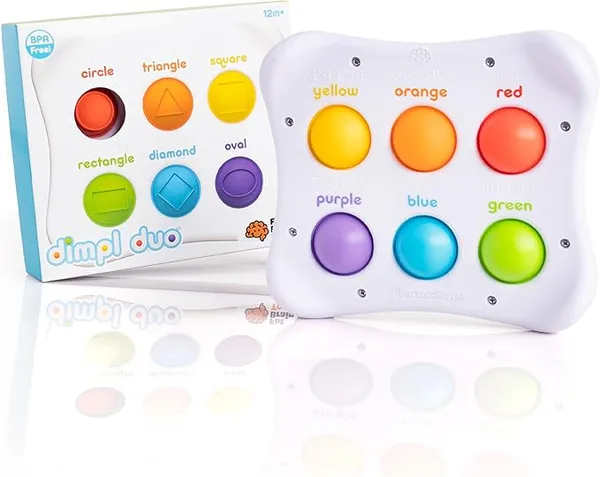
Fat Brain Toys Dimpl Duo
“Two-sided version with letters and numbers on each bubble. Adds learning layer.”
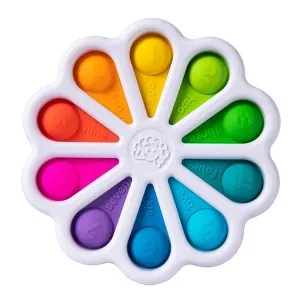
Fat Brain Toys Dimpl Digits
“Number version with 0-9 digits. Bridges sensory play and early math.”
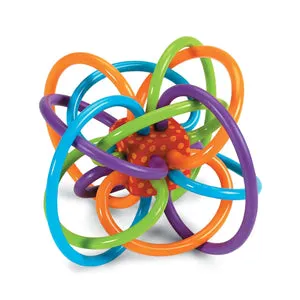
Manhattan Toy Winkel Rattle & Sensory Teether
“Different tactile experience for sensory variety. Tubes vs silicone bubbles.”