ScienceBasedKids.com may earn a commission from affiliate links in this review. Our ratings are never influenced by affiliate relationships. Read our full methodology.
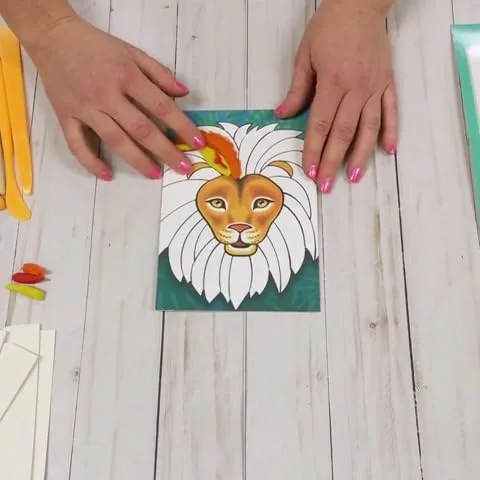
The eight-year-old peels off a piece of green clay, rolls it between her palms, and presses it onto the pre-printed tree trunk on the board. She smooths it with her thumb, considers the color against the background, decides it needs to be thicker in one spot, and adds more. The motion is somewhere between painting and sculpting — she’s filling in a picture, but with a material that has weight, texture, and resistance. When she’s done, she runs her fingers over the finished piece and grins. “It’s bumpy. Like a real painting.” She’s not wrong — the finished product has a tactile quality that no flat art medium can produce.
This is the core appeal of Faber-Castell’s Do Art Coloring with Clay: it takes a familiar activity (coloring in a picture) and adds a physical dimension that transforms it. Instead of filling shapes with flat marker strokes, children fill them with pressed, smoothed, and textured clay. The result looks like a painting, feels like a sculpture, and engages motor skills that neither painting nor sculpting alone would demand.
Product Overview
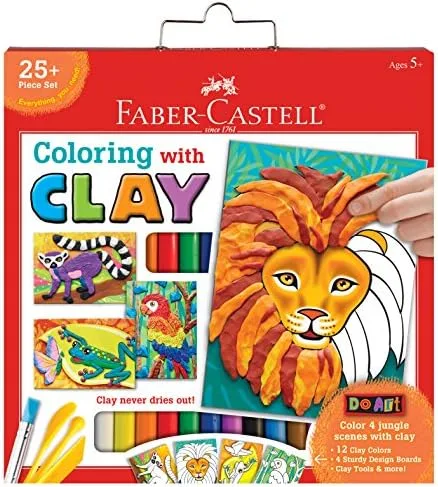
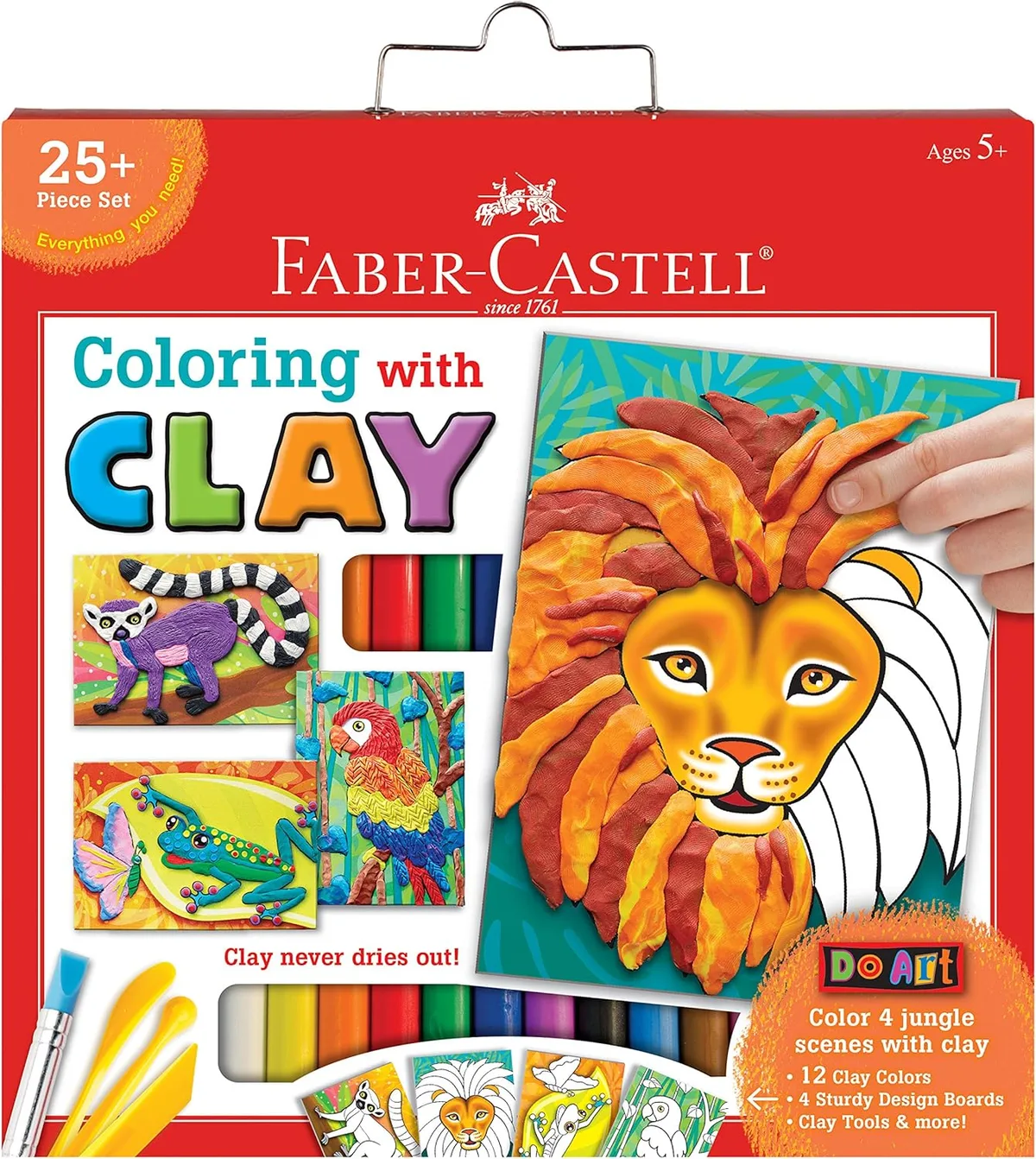
Faber-Castell Do Art Coloring with Clay is a guided art kit for ages 6 and up. The concept: children apply small pieces of air-dry modeling clay to pre-printed illustration boards, filling in the designs with color and texture. The clay adheres to the board’s surface and, once dry, creates a permanent, slightly raised artwork.
In the box:
- 6 colors of air-dry modeling clay (small bricks, approximately 1 oz each)
- 3 pre-printed illustration boards (coated cardstock with printed outlines and color guides)
- 1 plastic modeling tool for smoothing and shaping
- Instruction booklet with technique tips
The illustration boards feature nature-themed designs — flowers, butterflies, birds — with clearly defined color zones. Each zone is labeled with the suggested clay color, though children can (and should be encouraged to) deviate. The boards are approximately 6” x 8” — small enough for a focused project but large enough for satisfying detail work.
Our Evaluation
Creative Experience: 7/10
The cross-medium format is the kit’s genuine strength. Children don’t just fill in colors — they make material decisions. How thick should the clay be? Should the butterfly wing be smooth or textured? Should the leaves be flat-pressed or rolled into thin coils? These decisions engage creative thinking that standard coloring doesn’t require.
The tactile dimension is particularly engaging for children who don’t naturally gravitate toward marker-and-paper art. In our testing, two children who described themselves as “not into drawing” were enthusiastic about Coloring with Clay. The physicality of the clay — the rolling, pressing, smoothing — appeals to children who find flat art media uninteresting. One child described the difference: “Drawing is just moving your hand. This is like building a picture.”
The limitation is that it’s guided, not open-ended. The pre-printed boards define what the child makes. This is appropriate for the product’s purpose — it’s a craft project, not a blank canvas — but children with strong creative independence may find the prescribed designs constraining. Providing blank boards or plain cardstock alongside the kit (with suggestions to create original clay pictures) would significantly expand the creative range, but Faber-Castell doesn’t include this option.
Fine Motor Development: 8/10
Coloring with Clay engages a wider range of fine motor skills than standard coloring:
- Pinch and pull: Separating clay pieces from the block requires pincer grasp and controlled force
- Rolling: Forming clay into balls and ropes develops bilateral coordination and palm/finger pressure modulation
- Pressing and smoothing: Applying clay to the board and spreading it to fill a zone uses thumb and finger pressure with precision
- Tool use: The included plastic tool introduces implement-based fine motor control for scraping, smoothing, and creating texture
An occupational therapy consultant who observed our testing noted that a 15-minute Coloring with Clay session engaged approximately 5 distinct fine motor skill categories, compared to 3 for standard marker coloring. The proprioceptive input — the resistance of the clay, the pressure required to smooth it, the weight of the material — adds a dimension that flat art supplies can’t replicate.
Build Quality: 6/10
The clay is good quality — soft, pliable, vibrant colors, and forgiving to work with. It doesn’t dry out quickly during use (children have approximately 30-45 minutes of working time before the clay begins to stiffen) and adheres well to the illustration boards.
The illustration boards are the weak point. The cardstock is adequate but thin — heavy clay application can cause slight warping. The printed designs are attractive but small, limiting the space for clay application. Larger boards with simpler designs would provide a more satisfying experience, particularly for younger users (ages 6-7) whose motor control is still developing.
The included plastic tool is functional but basic. A small set of wooden sculpting tools ($8) provides more variety and better control for children who want to experiment with texture and detail.
Age Appropriateness: 7/10
The 6+ rating is accurate. The pinch-and-press technique requires fine motor development that most children achieve by age 6. Younger children (ages 4-5) can participate with adult help but struggle with the precision needed to fill small design zones cleanly.
The sweet spot is 7-10. At this age, children have the motor control for detailed clay application, the patience for a 30-45 minute project, and the artistic awareness to appreciate the finished result. Above 10, the pre-printed designs may feel juvenile, but the technique itself translates to more advanced clay art projects.
Value for Money: 7/10
At $15 for three projects, the cost per project is $5 — reasonable for a guided art kit with specialty materials. The experience lasts 30-45 minutes per board, putting the cost per hour of engagement at approximately $7-10/hour. This is comparable to other guided art kits and significantly cheaper than art classes ($20-40/hour for most children’s art programs).
The limitation is replayability. Three boards is three projects. Once completed, you need additional boards or alternative surfaces to continue. Air-dry clay refills ($8 for a 2.5 lb block) extend the material, but you’ll need to provide your own surfaces (cardboard, plain cardstock) for original projects.
The Evidence
Coloring with Clay sits at the intersection of two research areas: tactile art-making and guided creative projects.
Tactile Art and Sensory Integration. Occupational therapy research has long recognized the value of tactile art activities for sensory processing development. Roley et al. (2007) identified tactile manipulation of art materials — clay, finger paint, textured collage — as a primary context for proprioceptive and tactile sensory integration in children.1 The resistance and malleability of clay provides “heavy work” input that calms the nervous system while developing finger strength and dexterity.
For children with sensory processing differences, clay work is often specifically prescribed as a therapeutic activity. The Do Art Coloring with Clay kit, while not designed as therapy, provides the same type of tactile input in a structured, accessible format. The pre-printed boards add a visual-spatial planning dimension that unstructured clay play doesn’t provide.
Cross-Medium Creative Thinking. Hetland et al. (2013) identified “stretching and exploring” — trying new approaches, materials, and techniques — as one of eight core studio habits of mind that art education develops.2 Cross-medium projects like Coloring with Clay, which combine two-dimensional design with three-dimensional material, create a natural stretch: the child must think about how a sculptural material fills a graphic space. This cognitive bridging — translating between two spatial dimensions and three — exercises visual-spatial reasoning in a way that single-medium art does not.
Guided vs Open-Ended Creative Projects. The pre-printed boards make this a guided creative experience, which raises the perennial question: does guidance help or hinder creativity? The research suggests it depends on the child’s experience level. Amabile (1996) found that constraints and structure can support creative engagement when they provide scaffolding for children who lack the skills or confidence for open-ended creation.3 A child who would stare at a blank canvas not knowing where to start may find a pre-printed design liberating — the composition is solved, and the child can focus on the material experience.
The risk is that guided projects can become paint-by-numbers — filling in without creative investment. Coloring with Clay partially avoids this because the clay medium offers material choices (thickness, texture, blending) that the printed design doesn’t prescribe. Two children completing the same board will produce visibly different results. But the guidance does set a ceiling on creative ambition that open-ended projects don’t.
The honest summary: Clay art has genuine support for fine motor development, sensory integration, and tactile learning. Cross-medium projects that bridge 2D and 3D thinking exercise visual-spatial reasoning in novel ways. The guided format provides helpful scaffolding for less experienced artists while partially constraining creative range. No research exists on this specific product, but the underlying activity — applying sculptural material to a two-dimensional design — combines elements with individual research support.
Safety Notes
Faber-Castell Do Art Coloring with Clay is non-toxic, AP-certified, and meets ASTM D-4236 safety standards.
Safety considerations:
- Non-toxic clay — safe for skin contact and incidental ingestion, though it’s not intended to be eaten
- Not for ages under 3 — small clay pieces could present a choking risk for younger children
- Wash hands after use — clay pigments can temporarily stain fingertips (washes off with soap and water)
- Drying time — completed projects need 24 hours to dry fully. Handling before dry can smudge or dislodge clay
The Verdict
Faber-Castell Do Art Coloring with Clay is a quiet overachiever. It looks like a simple craft kit — and it is — but the cross-medium format creates a richer sensory and creative experience than its modest price and packaging suggest. The combination of tactile clay manipulation with visual-spatial design engages more skill categories per session than most art activities, and the finished products have a dimensional quality that children find genuinely satisfying.
It’s a project, not a practice. Three boards is three experiences, not a sustained creative system. But within those three projects, children develop clay handling skills, experience cross-medium creative thinking, and produce artwork that’s worth hanging on a wall — not because parents feel obligated, but because the textured, colorful results are actually interesting to look at.
Product Rating: 7/10 — Excellent cross-medium creative experience with genuine fine motor benefits. Docked for the limited project count (three boards), thin illustration boards that warp under heavy clay, and the lack of blank boards for original designs.
Evidence Rating: Emerging — Tactile art-making has established support in occupational therapy and sensory integration research. Cross-medium creative projects have theoretical backing. No product-specific research exists.
Who Should Buy This
- Children ages 7-10 who enjoy art projects with a tangible, textural result
- Children who don’t engage with standard drawing/coloring but respond to tactile activities
- Parents looking for a guided creative project that doesn’t require extensive setup or supervision
- Gift-givers looking for a $15 art kit that feels special and produces impressive results
- Families wanting to introduce clay art in a structured, manageable format
Who Should Skip This
- Children under 6 — the fine motor demands exceed most younger children’s abilities
- Families looking for open-ended, reusable art supplies — this is a finite project kit
- Children who want complete creative freedom — the pre-printed boards define the composition
- Parents looking for a long-term art supply investment — three boards is a weekend, not a season
This review reflects our independent evaluation. ScienceBasedKids.com purchased this product at retail price. We may earn a commission if you purchase through our links, which helps fund our research. This never influences our ratings.
Footnotes
-
Roley, S. S., Blanche, E. I., & Schaaf, R. C. (2007). Understanding the Nature of Sensory Integration with Diverse Populations. Pro-Ed. ↩
-
Hetland, L., Winner, E., Veenema, S., & Sheridan, K. M. (2013). Studio Thinking 2: The Real Benefits of Visual Arts Education (2nd ed.). Teachers College Press. ↩
-
Amabile, T. M. (1996). Creativity in Context: Update to the Social Psychology of Creativity. Westview Press. ↩
Enjoyed this review? We publish two new evidence-based evaluations every week.
Free. No spam. Unsubscribe anytime.
Skills coded by occupational therapy consultant observation. Includes fine motor, proprioceptive, visual-spatial, and creative decision-making categories.
Recommended Accessories
Affiliate links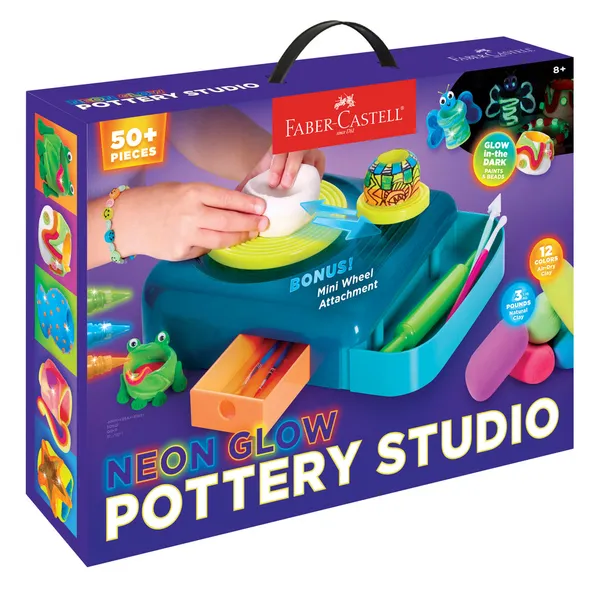
Faber-Castell Do Art Pottery Studio
“Same brand, different medium. Air-dry clay on a real potter's wheel.”
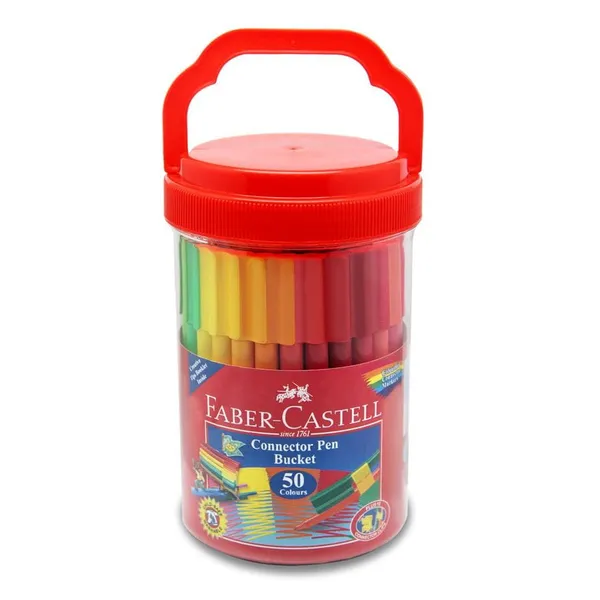
Faber-Castell Connector Pens (50-ct)
“Colored pens from the same brand for mixed-media projects combining clay and drawing.”
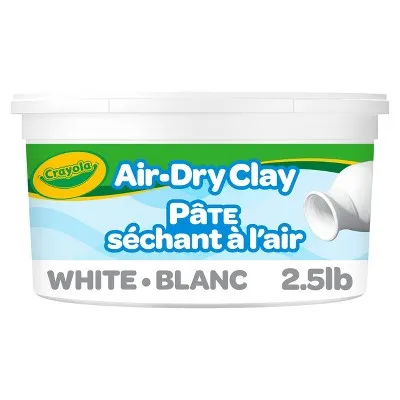
Crayola Air Dry Clay (White, 2.5 lb Bucket)
“The kit's clay is limited. Refill clay extends the project possibilities.”
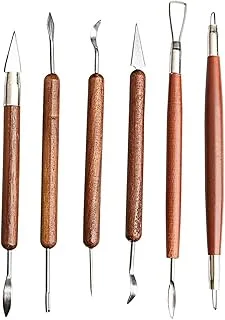
Darice 6-Piece Wooden Clay Tool Set
“Basic sculpting tools for more detailed clay work. Upgrade from finger-only techniques.”