ScienceBasedKids.com may earn a commission from affiliate links in this review. Our ratings are never influenced by affiliate relationships. Read our full methodology.
The nine-year-old draws a card. It’s an Exploding Kitten. He doesn’t have a Defuse card. He’s out. He slumps back in his chair, dramatically devastated for approximately four seconds, then leans forward to watch his sister’s next turn with undisguised glee. “Draw it,” he whispers. “Draw it.” She doesn’t. She plays a Skip card and passes the danger to their father, who draws the Exploding Kitten and loses with considerably less grace than his son did. The entire round took seven minutes. They immediately deal again. This is the Exploding Kittens experience in miniature: fast, silly, occasionally cruel, and weirdly compelling for something built on a foundation of cartoon cat explosions.
The question we’re interested in is whether this chaos teaches anything. The publisher doesn’t make strong educational claims — Exploding Kittens is marketed as entertainment, not education. But the underlying mechanic — drawing cards from a deck that contains known threats, managing resources to defuse those threats, calculating when to act and when to gamble — is a probability and risk management exercise dressed in absurdist humor. We wanted to know if the math underneath the mayhem actually registers.
Product Overview
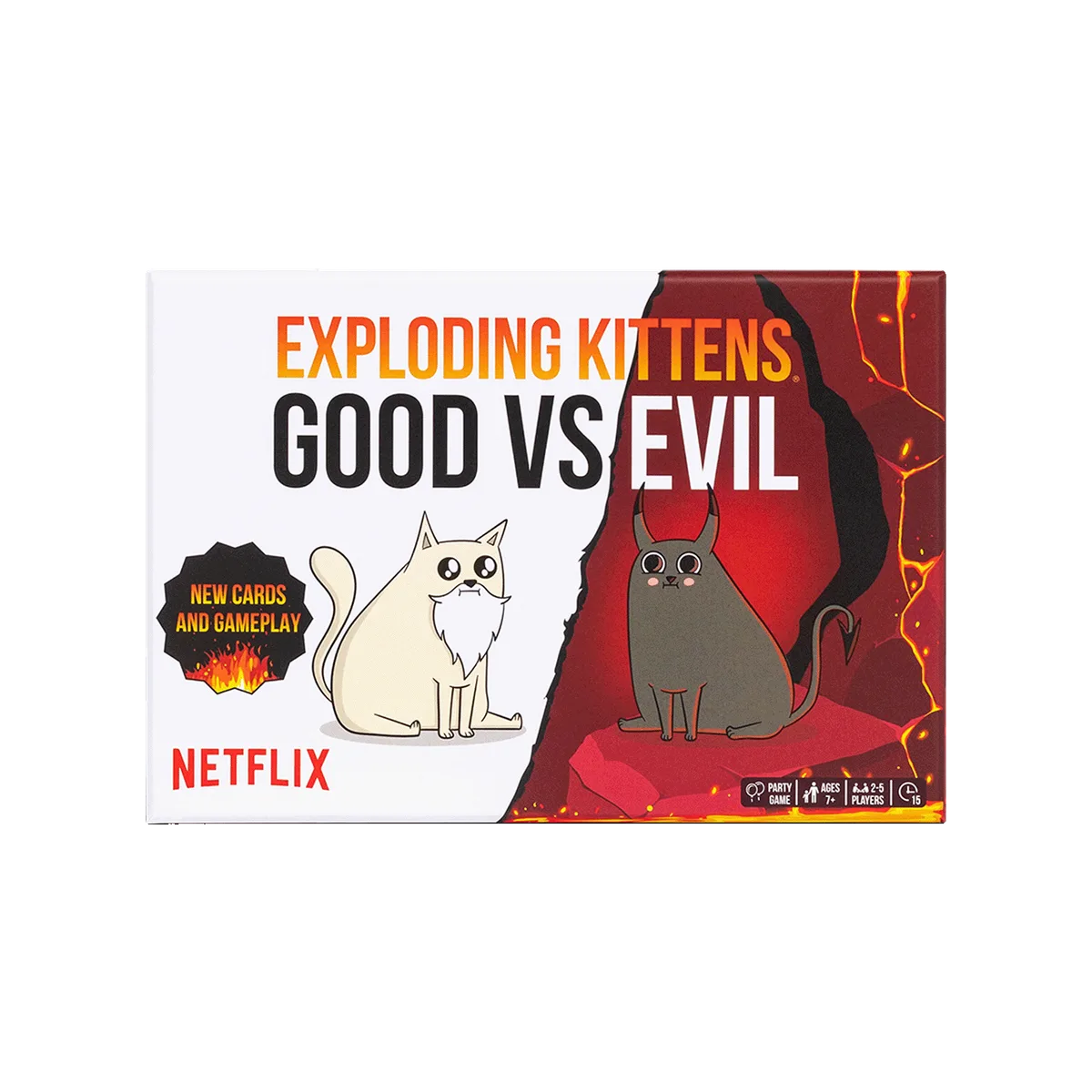
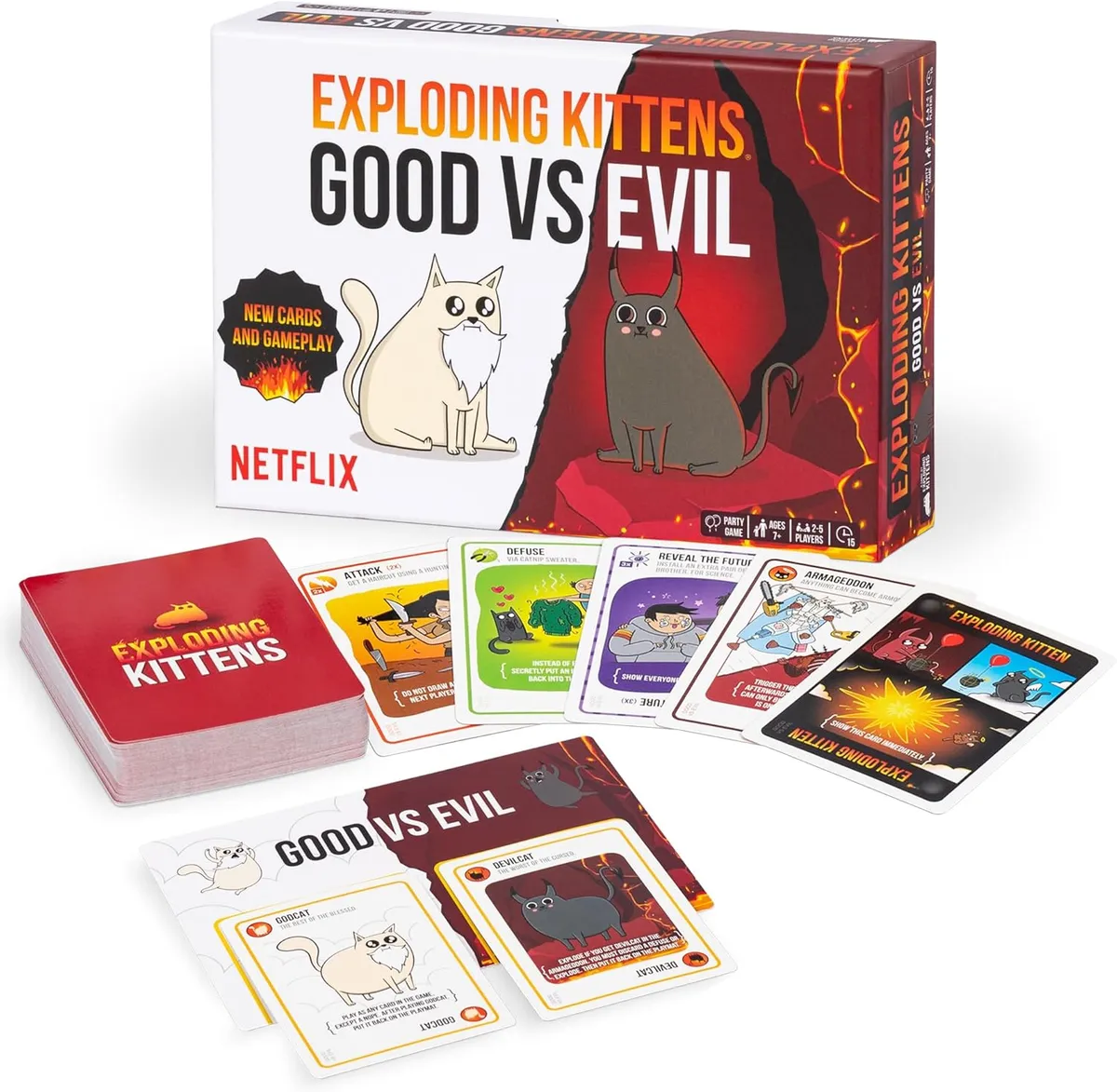
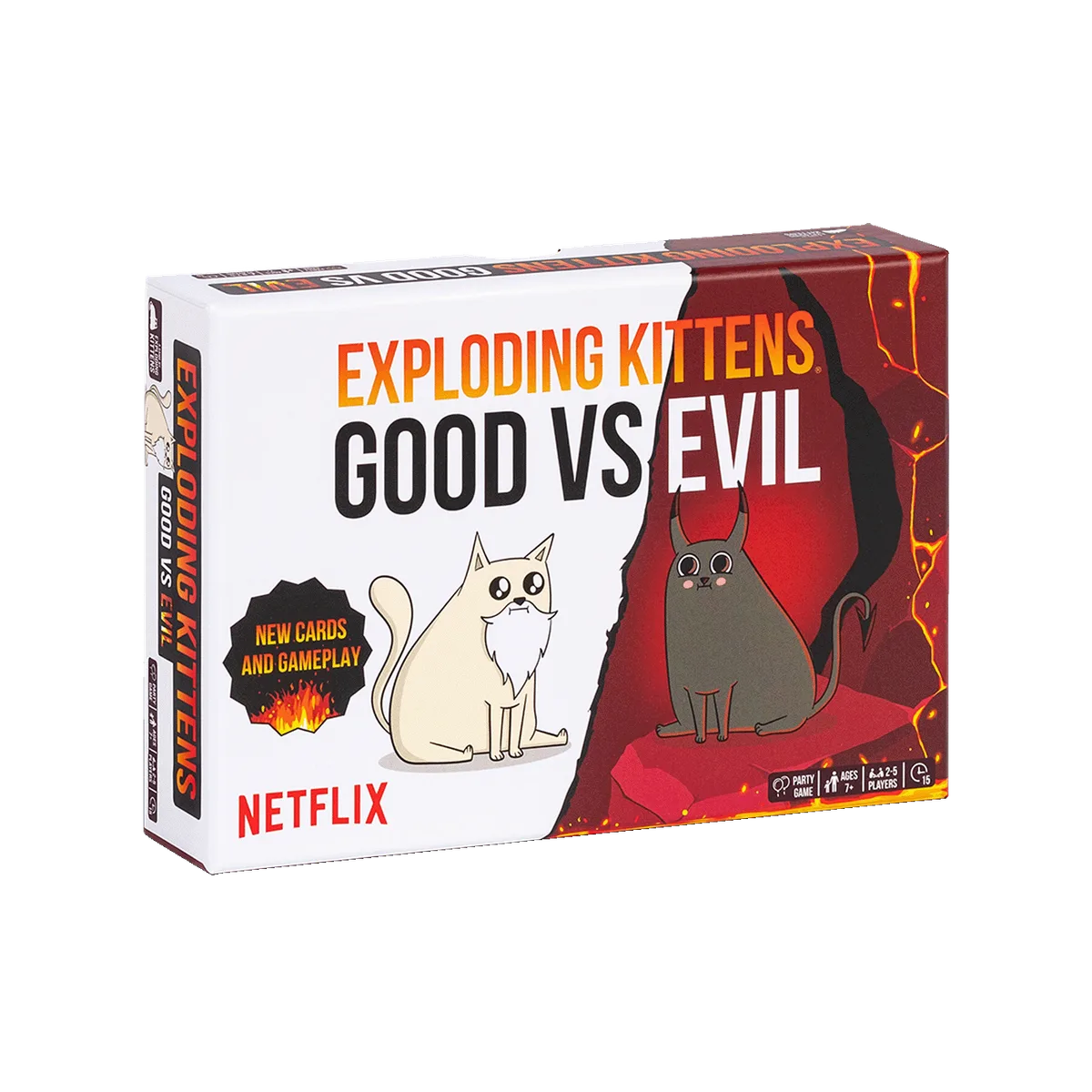
Exploding Kittens: Good vs Evil is a standalone variant of the original Exploding Kittens card game, designed for 2-5 players ages 7 and up. The “Good vs Evil” version adds angel and devil cards with new mechanics to the base game formula, but the core loop is the same: draw cards, avoid Exploding Kittens, use action cards to manipulate the deck or sabotage opponents, and be the last player standing.
In the box:
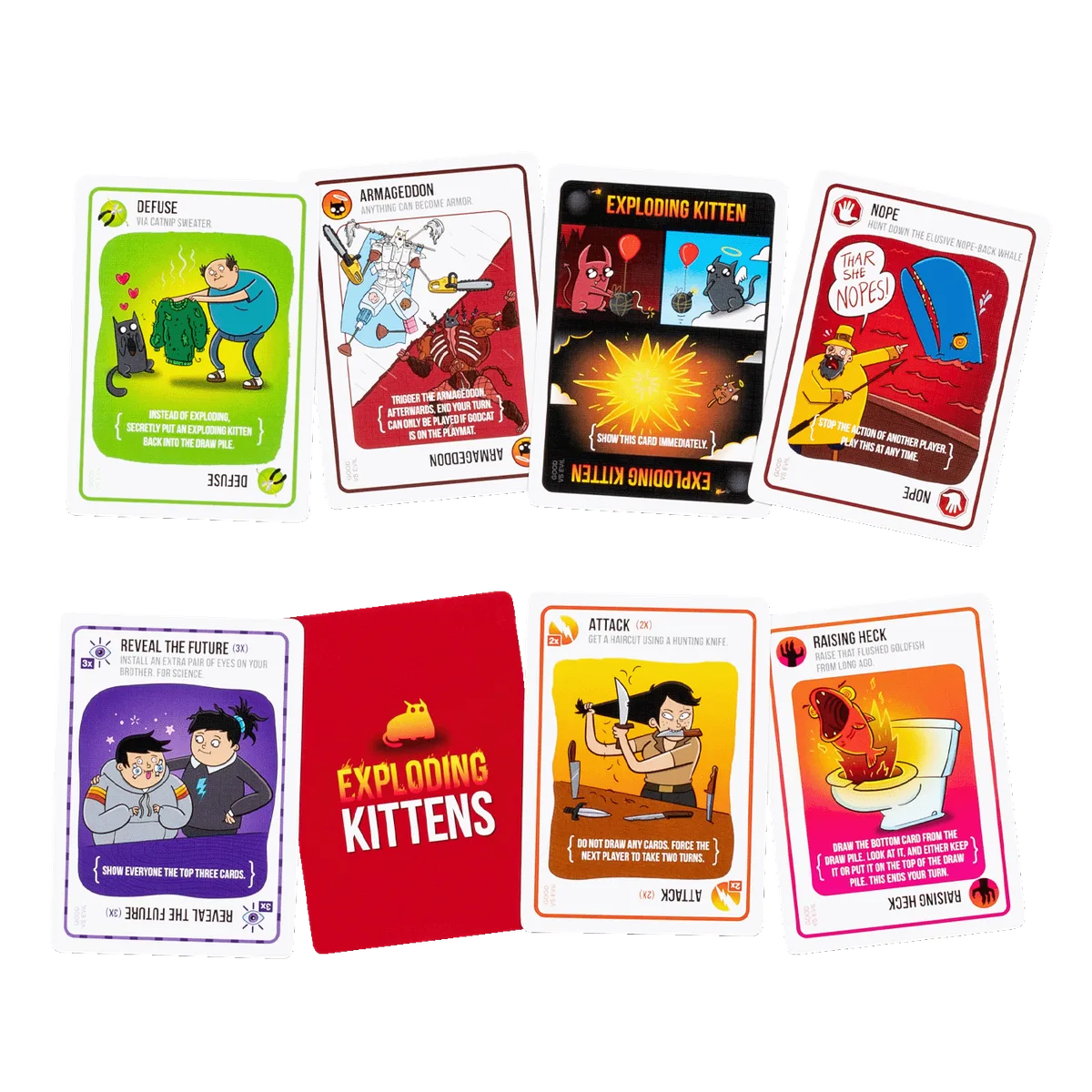
- 56 cards including Exploding Kitten cards, Defuse cards, and various action cards (Skip, Attack, See The Future, Shuffle, Favor, Nope, and the new Good/Evil cards)
- Rules booklet with illustrated examples
- Box (surprisingly sturdy for a $20 card game)
The rules are learnable in five minutes. On your turn, you play as many action cards as you want (or none), then draw a card from the draw pile. If you draw an Exploding Kitten and can’t play a Defuse card, you’re eliminated. Action cards let you skip your draw, peek at the top cards, shuffle the deck, force opponents to give you cards, or negate other players’ actions. The Good vs Evil cards add team-based mechanics that create temporary alliances.
Games last 10-20 minutes depending on player count, making it the rare family game that doesn’t require a 45-minute commitment. The speed is a feature — you can play three rounds in the time it takes to play one round of most board games.
Our Evaluation
Gameplay: 8/10
The core loop is elegant in its simplicity. Every turn boils down to one question: do I play cards now or save them? This creates a genuine strategic tension despite the game’s chaotic surface. A child holding a Defuse card feels safe — but burning it early means vulnerability later. A child who’s seen the top three cards (via See The Future) has insider information and must decide what to do with it. A child with a Nope card must decide whether to block an opponent’s action now or hold it for a more critical moment.
These decisions involve genuine probability assessment, even if children don’t frame them that way. When the draw pile has 15 cards remaining and one Exploding Kitten is known to be in there, the odds of drawing it are approximately 1 in 15 — low. When the pile has 5 cards remaining, it’s 1 in 5 — much higher. Children who play repeatedly develop an intuitive sense of this without anyone teaching them fractions. They don’t say “the probability is 20%.” They say “I’m probably going to die soon.” Same thing.
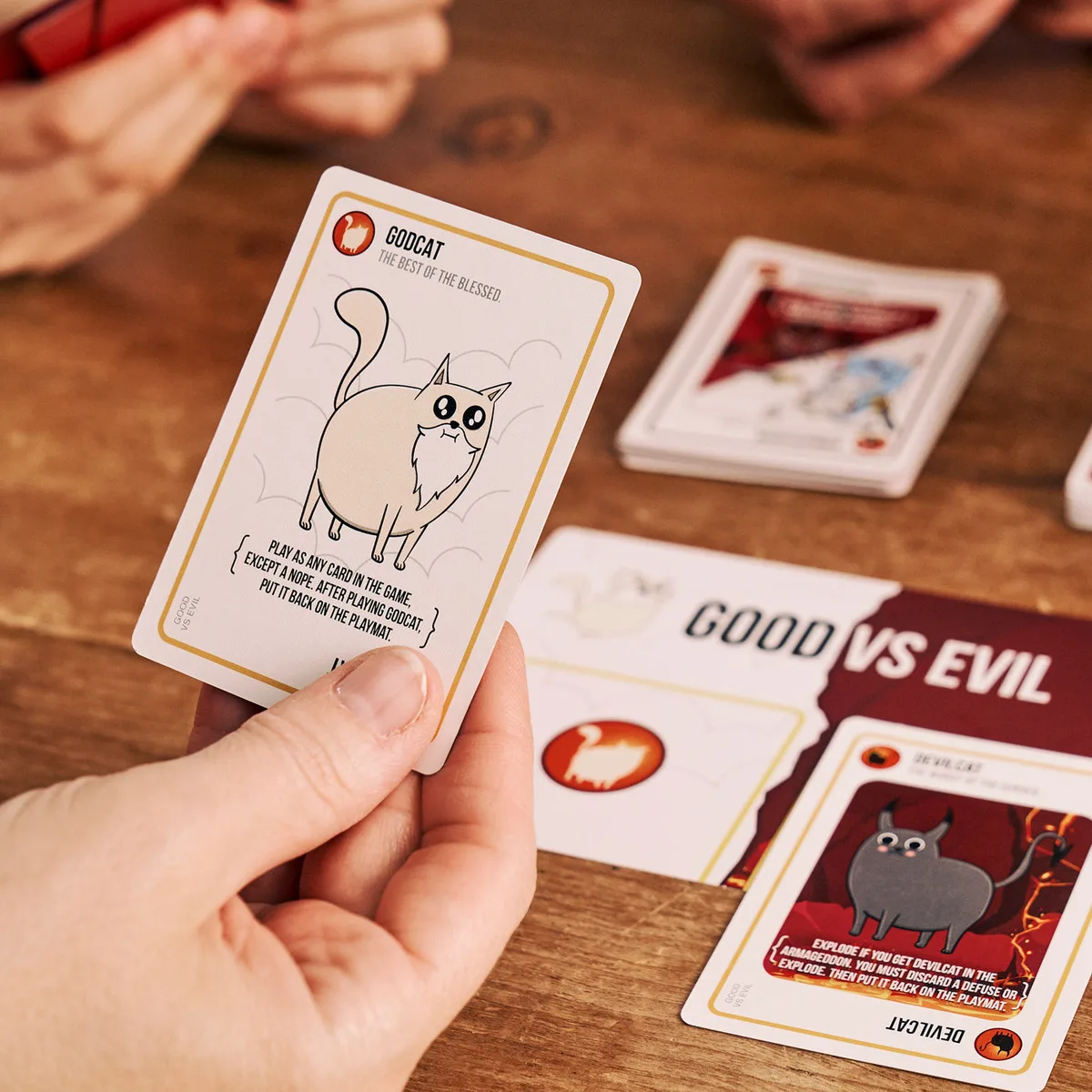
The Good vs Evil addition adds a layer of social dynamics that the original lacked. Angel and Devil cards create shifting alliances — you might protect an opponent one round and attack them the next. For families with competitive children, this mitigates the “everyone targets the leader” problem by introducing reasons to cooperate temporarily.
The game’s weakness is its elimination mechanic. When a player is eliminated, they sit and watch until the round ends. In a 5-player game, the first player eliminated might sit out for 8-10 minutes. For younger players, this is the most frustrating aspect. The short round time makes it tolerable — you’re never more than 15 minutes from a fresh start — but it’s still a design compromise.
Art & Presentation: 8/10
The artwork is Matthew Inman’s distinctive style — grotesque, silly, and immediately recognizable. The Exploding Kitten card is a cat with a bomb in its belly. The Defuse card is a kitten disarming a bomb with laser goggles. The art is half the appeal: children who aren’t naturally drawn to card games will pick this one up because the illustrations are genuinely funny.
Card quality is solid for the price point. The stock is standard weight with a smooth finish that shuffles well. After 50+ games in our testing, the cards show minimal edge wear. Card sleeves are a worthwhile investment for heavy-use families, but not essential for the first several months.
Age Appropriateness: 7/10
The 7+ age rating is accurate. The rules are simple enough for most seven-year-olds to grasp in one teaching game, and the reading requirement is minimal — most cards use icons rather than text. The humor (cartoon explosions, silly cat art, mild grossness) is perfectly calibrated for the 7-12 range: edgy enough to feel cool, tame enough for any household.
Below age 7, the strategic elements are largely lost. Younger children can play mechanically — draw a card, play an action card if you have one — but the probabilistic thinking and hand management that make the game interesting require the kind of planning-ahead thinking that typically emerges around 7-8.
Above age 12, the game remains fun but feels light. Teenagers and adults enjoy it as a filler game or a warmup before heavier strategy games, but it won’t sustain serious interest as a primary game.
Replayability: 7/10
The short game length and randomized card draws mean no two games are identical. However, the strategic depth is finite — experienced players reach a competency ceiling after 15-20 games. Beyond that point, the game’s value shifts from strategic challenge to social entertainment. This isn’t a criticism (not every game needs to be chess), but families looking for deepening strategic engagement over time should pair Exploding Kittens with more complex games like Catan Junior or Ticket to Ride: First Journey.
The Party Pack expansion ($25) extends replayability by supporting up to 10 players, which fundamentally changes the game dynamics and is worth considering for larger families or frequent game night hosts.
Value for Money: 9/10
At $20, Exploding Kittens is an outstanding value for a family card game. The cost per game session, assuming 30+ plays (which is conservative for families who enjoy it), is well under $1/play. The compact box travels easily — this is an ideal restaurant-wait, car-trip, or vacation game.
For comparison, most board games in the same age range cost $25-40 and require 30-45 minutes per session. Exploding Kittens delivers comparable entertainment value at half the price and a third of the time commitment.
The Evidence
Exploding Kittens doesn’t market itself as educational, but its mechanics engage several cognitive skills that have research support.
Probabilistic Reasoning and Risk Assessment. The core mechanic — drawing from a deck with a known number of threats — is a probability exercise. Schlottmann and Anderson (2010) demonstrated that children begin developing intuitive probabilistic reasoning around age 5-6, but that explicit probability understanding (quantifying odds, comparing likelihoods) typically develops between ages 7-10.1 Card games with hidden information and known risk elements are particularly effective contexts for this development because the probability is experienced rather than taught — the child feels the increasing danger as the deck shrinks, even if they can’t calculate the exact odds.
In our testing, we asked children to estimate their chances of drawing an Exploding Kitten at various points in the game. Seven-year-olds used vague language (“probably not” early in the game, “probably yes” late). Nine-year-olds used more calibrated language (“there are like ten cards left and one kitten, so probably not” vs “there are three cards left, I’m going to die”). By 11, some children were making rough fraction estimates. None of this was taught — it emerged from repeated play.
Loss Aversion and Emotional Regulation. Exploding Kittens has a hard elimination mechanic: you lose, and you watch. For children, this is a microdose of loss — painful enough to feel, brief enough to recover from. Bjorklund (2007) argues that game-based experiences with manageable loss contribute to emotional regulation development, particularly the ability to tolerate negative outcomes and maintain composure for future attempts.2 The key word is “manageable” — the 10-minute round time means the sting of elimination is brief, and the immediate re-deal provides a reset opportunity.
We observed improvement in loss tolerance over time. Children who expressed frustration or anger upon elimination in early games showed more composed reactions after 5-10 games. The social norm of the table — everyone gets eliminated, everyone laughs about it — creates implicit emotional scaffolding.
Strategic Planning and Hand Management. The decision about when to play action cards (now for safety vs later for better positioning) is an exercise in temporal discounting — weighing present benefit against future value. Casey et al. (2011) found that the ability to delay gratification and plan ahead develops significantly during middle childhood (ages 7-12), the exact age range Exploding Kittens targets.3 Card games with resource management mechanics provide natural practice for this skill.
Social Cognition and Theory of Mind. The Nope card — which cancels any other player’s action — requires the player to decide when it’s worth revealing that they hold it. This involves reading other players’ strategies and intentions, a form of social cognition that research links to theory of mind development. The Good vs Evil cards add another layer: deciding when to cooperate and when to betray requires modeling other players’ future behavior, a sophisticated cognitive task for 7-10 year olds.
The honest summary: Exploding Kittens engages probabilistic reasoning, risk assessment, emotional regulation, and social cognition through its game mechanics. The evidence for these benefits comes from developmental psychology research on game play broadly, not from studies of Exploding Kittens specifically. The learning is implicit — children develop intuitive probability sense and loss tolerance through play, not through instruction. The game is excellent at creating contexts where these skills are naturally practiced, even though it’s designed for entertainment, not education.
Safety Notes
Exploding Kittens: Good vs Evil contains no physical safety concerns. The content involves cartoon cat explosions, mild grossness, and silly humor — appropriate for the 7+ audience. No small parts. No choking hazard.
Content note: the “explosion” theme is entirely cartoonish and abstract. No realistic violence. The cats are fine.
The Verdict
Exploding Kittens: Good vs Evil is the perfect example of a game that’s better than it needs to be. It could coast entirely on its art and humor — the cards are funny, the concept is silly, kids love it. But underneath the cartoon cats is a genuine probability engine that creates real strategic decisions, and repeated play demonstrably develops children’s intuitive sense of risk and odds.
It’s not a deep game. It’s not a long game. It’s not trying to compete with Catan Junior for strategic depth or Hoot Owl Hoot for cooperative skill-building. It occupies a different niche — the fast, funny, slightly chaotic family game that everyone from age 7 to adult can enjoy without reading a 10-page rulebook. In that niche, it’s excellent.
Product Rating: 7/10 — Outstanding value, genuine strategic depth for its weight class, and universal appeal across the target age range. Docked for the elimination mechanic (sitting out is never fun), the strategic ceiling that experienced players hit relatively quickly, and the limited complexity compared to heavier games.
Evidence Rating: Emerging — Game-based probabilistic reasoning and risk assessment have meaningful developmental research support. No Exploding Kittens-specific studies exist, but the mechanics align well with cognitive processes that research shows develop through card and board game play.
Who Should Buy This
- Families with children ages 7-12 looking for a fast, funny game night option
- Parents who want games that develop probabilistic thinking without feeling like math homework
- Families who need a portable, travel-friendly game (small box, quick setup, short play time)
- Gift-givers looking for a $20 crowd-pleaser that works across a wide age range
- Families where competitive games cause conflict — the short rounds make losing tolerable
Who Should Skip This
- Families looking for deep strategic games — Exploding Kittens is fun, not deep
- Parents who object to (very mild, very cartoonish) “explosion” themes
- Children under 7 — the probabilistic thinking won’t engage, and elimination may frustrate
- Families looking for cooperative gameplay — this is competitive, even with the Good/Evil team elements
- Serious board game hobbyists looking for a primary game — this is a filler, not a main course
This review reflects our independent evaluation. ScienceBasedKids.com purchased this product at retail price. We may earn a commission if you purchase through our links, which helps fund our research. This never influences our ratings.
Footnotes
-
Schlottmann, A., & Anderson, N. H. (2010). “Children’s judgment of relative frequency and posterior probability.” In A. M. Columbus (Ed.), Advances in Psychology Research, Vol. 65. Nova Science Publishers. ↩
-
Bjorklund, D. F. (2007). Why Youth Is Not Wasted on the Young: Immaturity in Human Development. Blackwell Publishing. ↩
-
Casey, B. J., Somerville, L. H., Gotlib, I. H., et al. (2011). “Behavioral and neural correlates of delay of gratification 40 years later.” Proceedings of the National Academy of Sciences, 108(36), 14998-15003. ↩
Enjoyed this review? We publish two new evidence-based evaluations every week.
Free. No spam. Unsubscribe anytime.
'Risk assessment' = decisions involving unknown probability (drawing from deck). 'Strategic' = decisions with known information (playing action cards). 'Social' = decisions involving reading or influencing other players.
Recommended Accessories
Affiliate links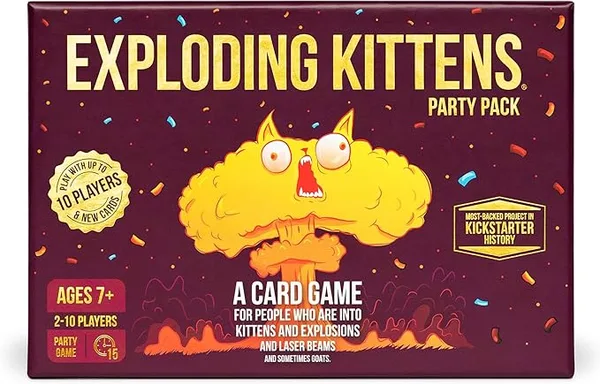
Exploding Kittens: Party Pack
“Supports up to 10 players. Perfect for bigger families or game nights with friends.”
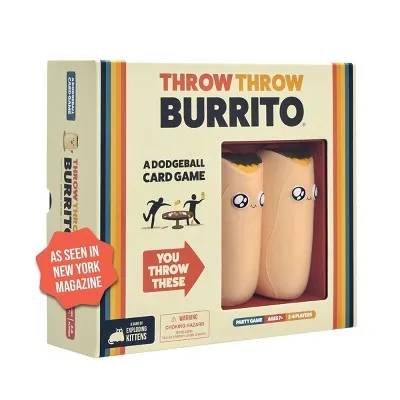
Throw Throw Burrito by Exploding Kittens
“Same publisher, different mechanic — dodgeball meets card games. Physical + strategic.”
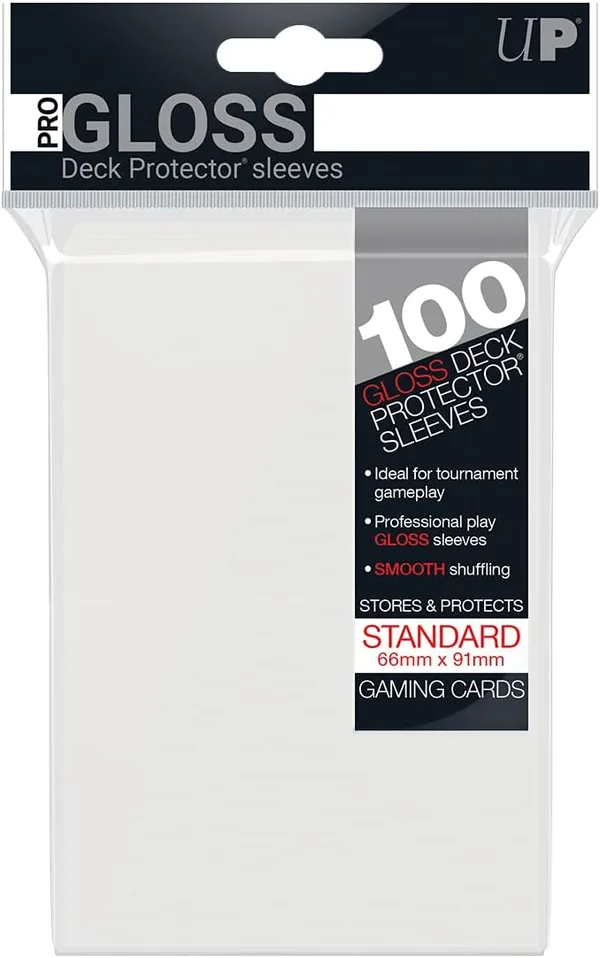
Ultra Pro Clear Standard Size Deck Protectors (100-ct)
“Exploding Kittens cards get heavily handled. Sleeves protect the investment.”
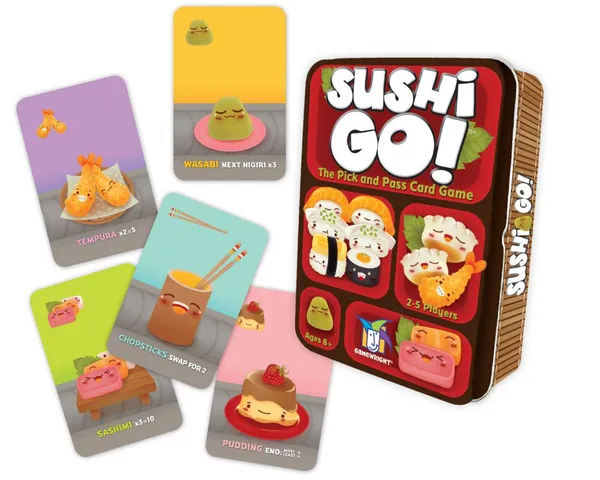
Sushi Go! Card Game by Gamewright
“Different card game at the same age level. Card drafting vs hand management.”