ScienceBasedKids.com may earn a commission from affiliate links in this review. Our ratings are never influenced by affiliate relationships. Read our full methodology.
Let’s start with what’s true: babies love this thing. Put a seven-month-old in the Neptune’s Ocean Discovery Jumper, and you will see a face of pure, uncomplicated joy. Legs pump. Body bounces. Hands grab spinning toys. Lights flash. Music plays. The baby is having the time of their short life. If a review could stop at “does the baby enjoy it?” this would be a 9/10.
But we don’t stop there. This is ScienceBasedKids.com, and this is a Baby Einstein product. We’ve already evaluated the Baby Einstein Curiosity Table and found the brand’s developmental claims significantly overstated. The Neptune’s Jumper continues that pattern — marketing language that implies developmental benefit (“discover ocean-inspired sights and sounds,” “encourages self-discovery and exploration”) wrapped around a product whose primary function is containment with entertainment.
We’re not here to tell parents that baby jumpers are bad. We’re here to separate what’s real from what’s marketing, and to address the question pediatricians and physical therapists increasingly raise: is extended jumper use genuinely safe for developing legs and hips?
Product Overview
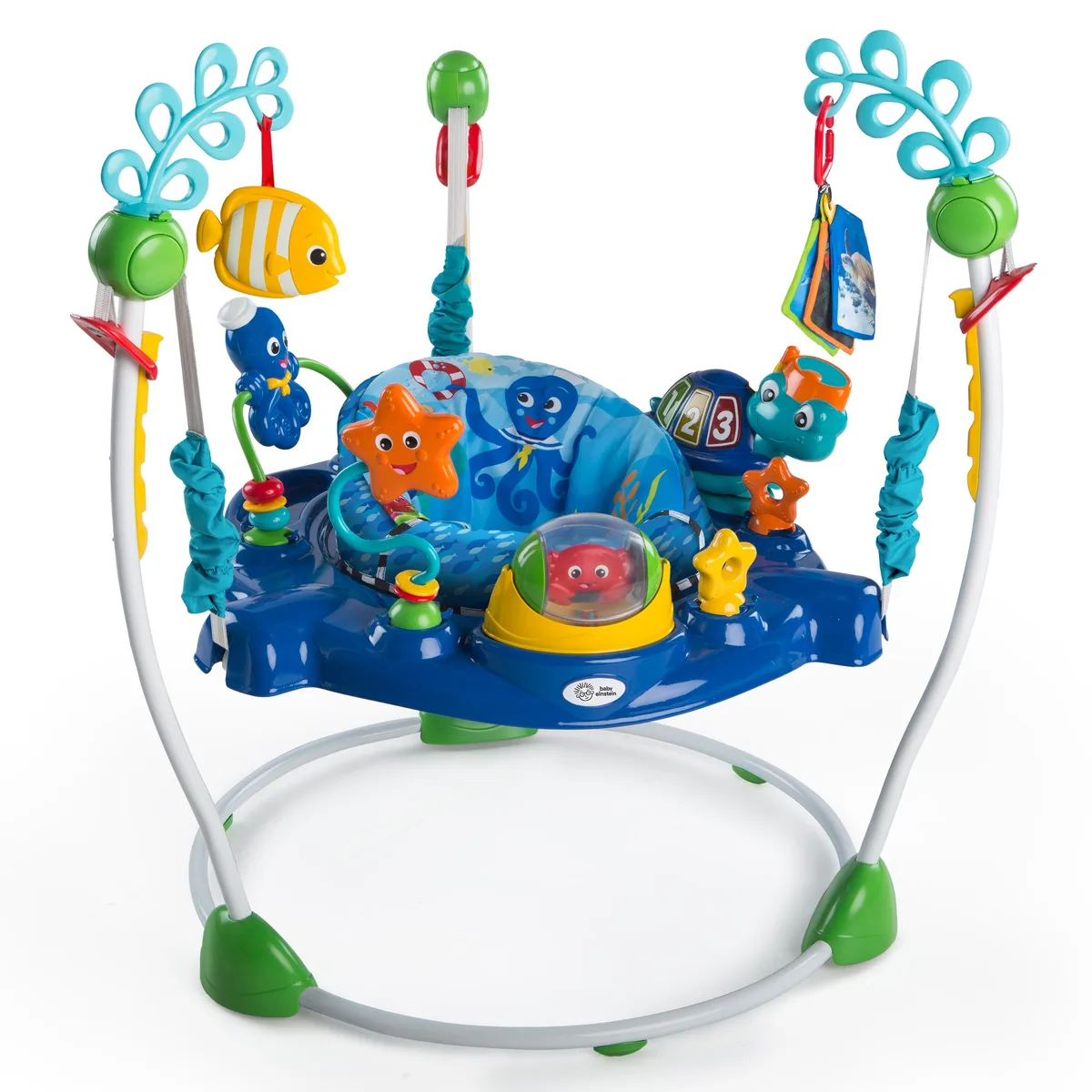
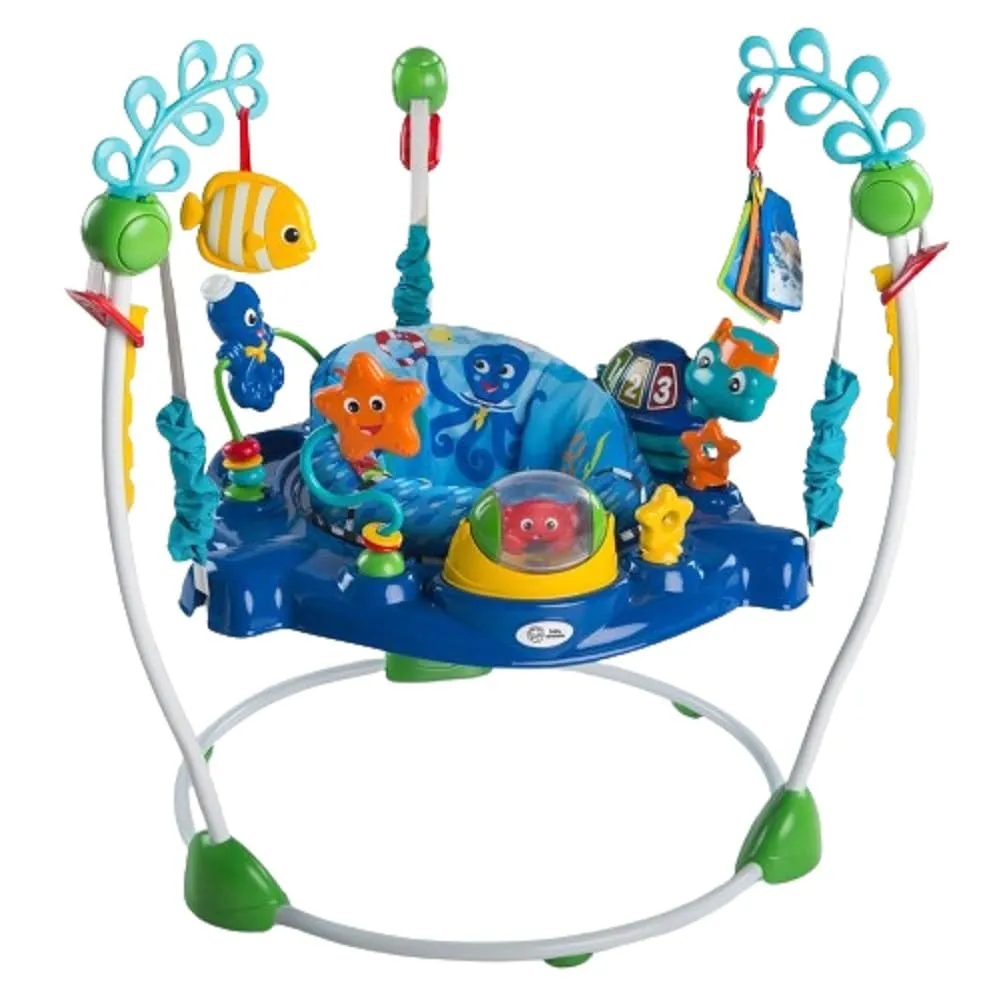
The Baby Einstein Neptune’s Ocean Discovery Jumper is a freestanding activity center with a 360-degree rotating seat suspended on springs. The baby sits in a fabric seat with leg holes, feet touching the floor (or a platform), and pushes off to bounce. Surrounding the bouncing station is a ring of attached toys, lights, and interactive elements with an ocean theme.
In the box:
- Freestanding activity frame (metal and plastic, approximately 30” x 30” footprint)
- Rotating fabric seat with adjustable height (3 positions)
- 12+ interactive toys including a spinning turtle, light-up jellyfish, bead maze, mirror, crinkle starfish, and piano keys
- Electronic sound unit with volume control and music (ocean sounds, melodies)
- 3 AA batteries required (not included)
The jumper accommodates babies who can hold their head up independently (approximately 6 months) through approximately 12 months or 25 lbs. The seat height adjusts in three increments to accommodate growth. Assembly takes approximately 30 minutes and requires no tools beyond what’s included.
Our Evaluation
Entertainment Value: 8/10
Babies are consistently engaged by the Neptune’s Jumper. In our testing, babies ages 6-10 months spent an average of 12-15 minutes actively engaged per session — significantly longer than most stationary toys at this age. The combination of bouncing (proprioceptive input), spinning (vestibular input), and toy manipulation (fine motor) creates a multi-sensory experience that holds attention.
The toy variety is well-designed. The 360-degree layout means the baby encounters different activities as they rotate — a spinning turtle at one station, piano keys at another, a bead maze at a third. This variety prevents the quick boredom that single-activity seats produce. In our testing, babies showed a clear pattern of rotating between stations, spending 1-2 minutes at each before spinning to the next. This self-directed exploration is the most genuinely developmental aspect of the product.
The electronic sounds are tolerable by baby product standards — the ocean melodies are softer and less grating than many competitors, and the volume control has a low setting that’s appropriate for infant hearing. The lights are gentle rather than strobe-like. Baby Einstein’s design team has clearly listened to parental feedback about sensory overload.
Build Quality: 6/10
The frame is sturdy enough — metal legs with a plastic tray provide adequate stability, and the spring mechanism bounces smoothly without jarring. The fabric seat is machine-washable, which is essential (babies in jumpers produce a remarkable volume of drool).
The weak points are the attached toys. Several are connected with thin plastic clips that feel fragile compared to the main frame’s construction. The piano key unit required battery replacement twice in three months of testing — the contacts corroded from moisture exposure (see: drool). The bead maze is solidly built but the beads’ paint showed wear after extended mouthing.
The overall impression is adequate but not premium. At $100, you’re paying for the Baby Einstein brand and the toy variety, not for heirloom-quality construction.
Size & Footprint: 4/10
The Neptune’s Jumper is large. The 30” x 30” footprint consumes meaningful floor space in any room, and the height (approximately 28”) makes it a visual presence. It doesn’t fold for storage, though it can be partially disassembled (removing the seat and tray from the legs). In apartments and smaller homes, the jumper may occupy space that could otherwise be used for floor play — which, as we’ll discuss in the evidence section, may be the more developmentally valuable option.
Age Range Accuracy: 6/10
The 6-12 month range is roughly accurate but narrow. At 6 months, most babies need the lowest seat setting and may not have the leg strength for active bouncing — they’ll sit and play with the attached toys, which is fine but doesn’t leverage the jumper’s primary feature. By 10-11 months, many babies are pulling to stand and beginning to cruise, at which point the jumper becomes less interesting than furniture-assisted standing and walking practice. The practical sweet spot is 7-9 months — a three-month window for a $100 product.
Value for Money: 4/10
At $100 for a product with a 3-6 month useful life (depending on the individual baby’s developmental pace), the cost per month of use is $17-33. This is expensive for what is essentially an entertainment device. The secondhand market is active (jumpers resell for $30-50), which partially offsets the cost if you sell after use.
Compare this to a foam play mat ($20, usable for years), a set of stacking cups ($10, usable for 6-18 months), or supervised floor play (free). The jumper’s entertainment value is real, but the cost-per-engagement-hour is significantly higher than simpler alternatives.
The Evidence
This section addresses two distinct questions: (1) do baby jumpers provide developmental benefits, and (2) are they safe for developing bodies?
Developmental Claims. Baby Einstein markets the Neptune’s Jumper with language suggesting developmental exploration — “discover,” “explore,” “self-discovery.” These words imply that the jumper contributes to cognitive or motor development beyond what other activities provide.
There is no evidence supporting this claim. No published study has demonstrated that stationary activity centers (jumpers, exersaucers, or similar devices) provide developmental benefits that floor play, tummy time, or free movement in a safe space do not. The National Association for the Education of Young Children (NAEYC) does not include stationary activity centers in its recommended materials for infant development.1
The activities attached to the jumper — spinning toys, pressing buttons, grasping objects — are developmentally appropriate manipulatives. But these same activities can be achieved with simpler, less expensive toys used during floor play, where the baby also practices the gross motor skills (rolling, pushing up, reaching, crawling) that the jumper’s seat prevents.
Physical Therapy Concerns. Pediatric physical therapists have raised concerns about extended jumper use and its potential effects on lower extremity development. The primary concerns are:
-
Toe-pointing posture. In many jumpers, babies bounce on their toes rather than flat-footed. Extended toe-pointing can encourage plantarflexion patterns that may delay normal gait development. Abbott and Bartlett (2000) noted that container devices (including jumpers) that position infants upright before they can independently maintain that position may reinforce compensatory movement patterns.2
-
Skipping developmental milestones. When a baby spends time in a jumper, they’re not spending time on the floor practicing the movement patterns — rolling, pivoting, crawling — that build toward independent walking. Pin et al. (2007) found that infants who spent more time in “restrictive devices” (including walkers, jumpers, and exersaucers) showed delays in sitting, crawling, and walking milestones compared to peers with more floor time.3
-
Hip positioning. The fabric seat positions the baby with hips abducted and externally rotated — splayed outward. In moderation, this isn’t harmful. In extended use (multiple hours daily), some pediatric PTs express concern about hip joint loading in this position during the rapid growth phase of 6-12 months.
The AAP Position. The American Academy of Pediatrics does not specifically recommend against activity jumpers (their stronger guidance is directed at mobile walkers, which pose fall/injury risks that stationary jumpers do not). However, the AAP’s general guidance for infant development emphasizes supervised tummy time and floor play as the gold standard for motor development, and recommends limiting time in all “container” devices — including jumpers, bouncers, swings, and car seats used outside the car.4
The moderate use consensus. The pediatric community’s general recommendation is that stationary jumpers are acceptable in moderation — 15-20 minutes at a time, no more than twice daily. At this level of use, the risks described above are minimal, and the entertainment value gives parents a hands-free break for tasks that require it. The problems emerge when the jumper becomes a primary activity — when a baby spends hours daily in a device that restricts floor play and reinforces non-typical movement patterns.
The honest summary: Baby jumpers are entertainment devices, not developmental tools. Baby Einstein’s marketing language implies developmental benefit that no evidence supports. Moderate use (15-20 minutes, 1-2 times daily) is considered safe by most pediatric professionals, but extended use raises legitimate concerns about movement pattern development and milestone delays. The most important thing a 6-12 month old can do for their physical development is play on the floor — rolling, crawling, pulling up, and exploring. Jumper time displaces floor time.
Safety Notes
The Baby Einstein Neptune’s Jumper meets ASTM F2012 safety standards for stationary activity centers.
Safety considerations:
- Height adjustment is critical. The baby’s feet should be flat on the floor or platform, not dangling or toe-pointing. Incorrect height setting is the most common misuse.
- Time limits. Limit sessions to 15-20 minutes. Do not use as a prolonged containment device.
- Supervision required. Baby should be monitored while in the jumper.
- Weight and age limits. 25 lbs maximum, head-holding-up-independently minimum. Do not use before the baby can independently hold their head upright.
- Surface matters. Use on flat, level surfaces only. The foam floor mat accessory provides stability on hard floors.
- Cord safety. Keep the electronic unit’s battery compartment securely closed. No dangling strings or cords near the baby.
No CPSC recalls have been issued for this specific model. Previous Baby Einstein jumper models have had recalls for spring guard cover detachment — inspect the spring covers before each use.
The Verdict
The Neptune’s Ocean Discovery Jumper is a well-designed entertainment device for babies that is marketed as something more than it is. Babies enjoy it — genuinely, visibly, joyfully. Parents benefit from 15 minutes of contained, engaged baby time. These are real values.
But the product exists in a space where “babies enjoy it” is conflated with “it’s good for babies,” and the evidence doesn’t support that conflation. The most beneficial activity for a 6-12 month old’s motor and cognitive development is free floor play — and every minute in the jumper is a minute not on the floor. In moderation, this tradeoff is negligible. As a primary activity, it’s a concern.
Use it. Enjoy it. Limit it. And spend the balance of the day on the floor.
Product Rating: 5/10 — Effective entertainment with high baby engagement. Docked significantly for unsupported developmental marketing, the narrow useful age window (3-6 months of practical use), the large footprint, moderate build quality at a $100 price point, and the legitimate physical therapy concerns about extended use.
Evidence Rating: None — No evidence supports developmental benefits of baby jumpers. Pediatric physical therapy literature raises concerns about extended use. The AAP recommends supervised floor play as the primary motor development context for infants.
Who Should Buy This
- Parents who need a safe, contained entertainment option for short periods while handling tasks
- Families with babies 7-9 months old who enjoy bouncing and have adequate head control
- Parents who will commit to the 15-20 minute usage guideline and prioritize floor play
- Families with space for the jumper’s 30” x 30” footprint
Who Should Skip This
- Parents looking for a developmental tool — floor play is more developmentally valuable
- Families in small spaces — the footprint is substantial for a 3-6 month product
- Budget-conscious families — $100 for 3-6 months of use is expensive; simpler toys deliver more value per dollar
- Parents who would use the jumper as a primary activity rather than a brief entertainment break
- Families where baby is already pulling to stand — they’ve outgrown the jumper’s benefit window
This review reflects our independent evaluation. ScienceBasedKids.com purchased this product at retail price. We may earn a commission if you purchase through our links, which helps fund our research. This never influences our ratings.
Footnotes
-
NAEYC. (2020). “Developmentally Appropriate Practice in Early Childhood Programs Serving Children from Birth Through Age 8” (4th ed.). National Association for the Education of Young Children. ↩
-
Abbott, A. L., & Bartlett, D. J. (2000). “Infant motor development and equipment use in the home.” Child: Care, Health and Development, 26(4), 295-306. ↩
-
Pin, T., Eldridge, B., & Galea, M. P. (2007). “A review of the effects of sleep position, play position, and equipment use on motor development in infants.” Developmental Medicine & Child Neurology, 49(11), 858-867. ↩
-
American Academy of Pediatrics. (2022). “Back to Sleep, Tummy to Play.” HealthyChildren.org. (AAP guidance on infant positioning and container device use.) ↩
Enjoyed this review? We publish two new evidence-based evaluations every week.
Free. No spam. Unsubscribe anytime.
'Bouncing' = active leg-driven jumping. 'Spinning' = rotating the seat to reach different stations. 'Toy interaction' = manipulating attached toys. 'Passive' = sitting in the seat without active engagement.
Recommended Accessories
Affiliate links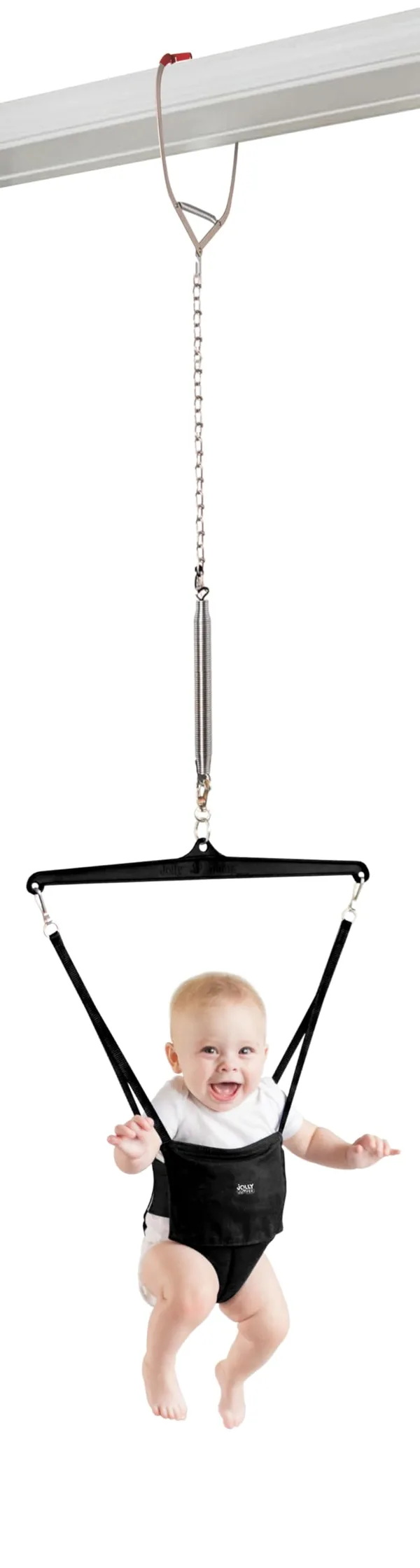
Jolly Jumper Iconic Doorway Baby Jumper
“Simpler, more portable alternative. Trusted for 75+ years, clamps to most door frames with no tools.”
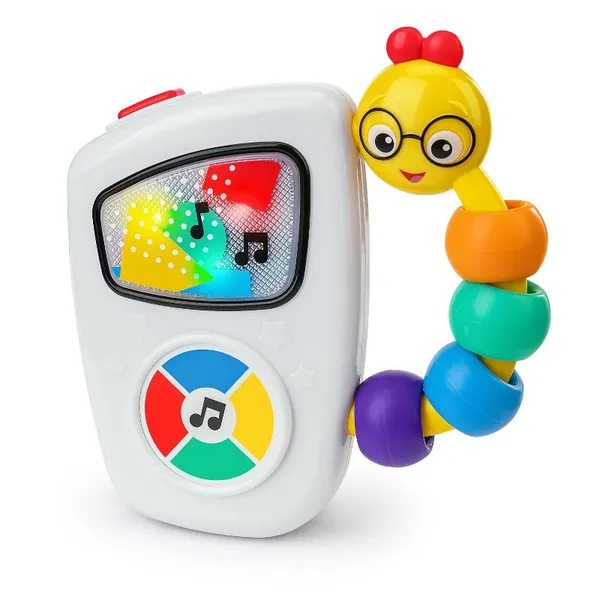
Baby Einstein Take Along Tunes Musical Toy
“Portable musical toy from the same brand. Extends musical play beyond the jumper station.”
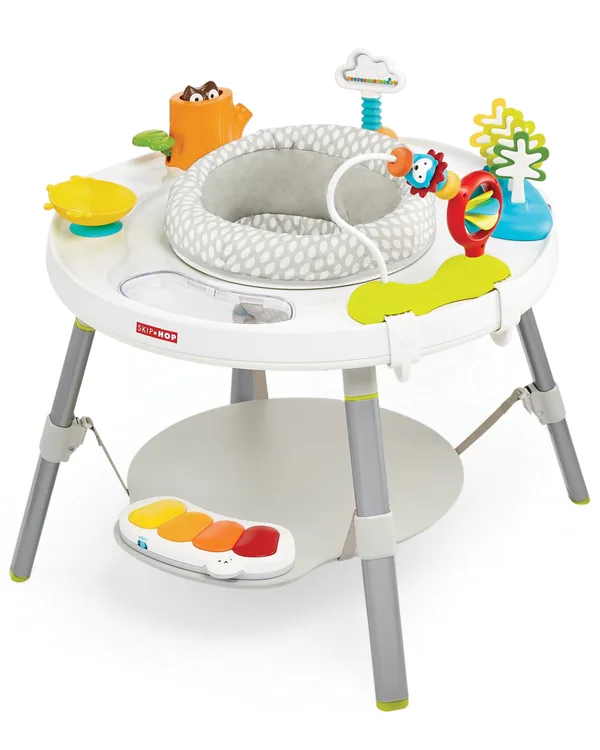
Skip Hop Explore & More 3-Stage Activity Center
“Premium stationary activity center with 3-stage grow-with-me design. More developmental activities.”
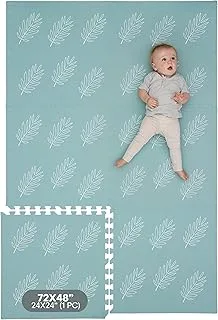
Childlike Behavior Baby Play Mat (6-Piece Interlocking Foam Tiles)
“Protects floors under the jumper and provides cushioning. Waterproof EVA foam, 72x48 inches.”