ScienceBasedKids.com may earn a commission from affiliate links in this review. Our ratings are never influenced by affiliate relationships. Read our full methodology.
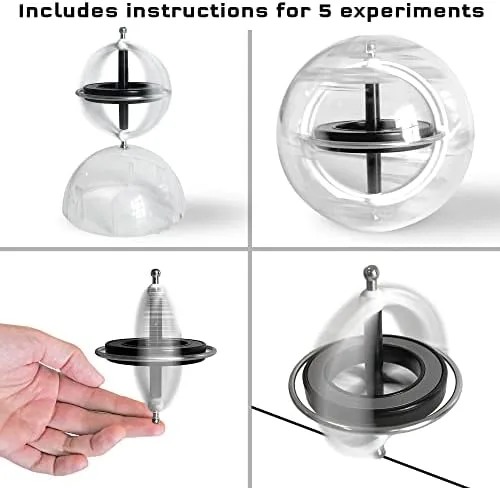
A spinning gyroscope balanced on a string defies intuition — it should fall, but it doesn’t. This visible demonstration of angular momentum and precession is one of the most compelling introductions to physics available, and Thames & Kosmos has built an entire experiment kit around it. The Gyroscope Lab ($25) includes a real metal gyroscope and a 24-page manual with experiments that progress from basic spinning to demonstrations of physics concepts taught in college-level courses.
We tested it for four weeks with children ages 8 through 13.
Product Overview
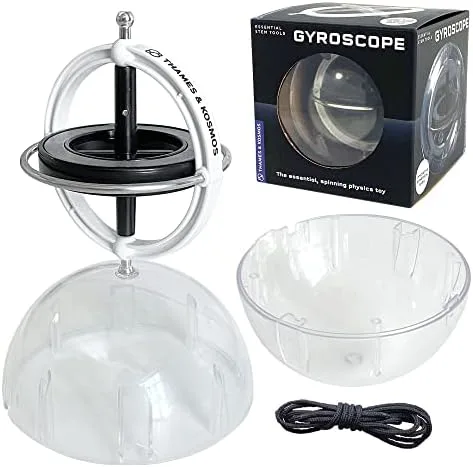
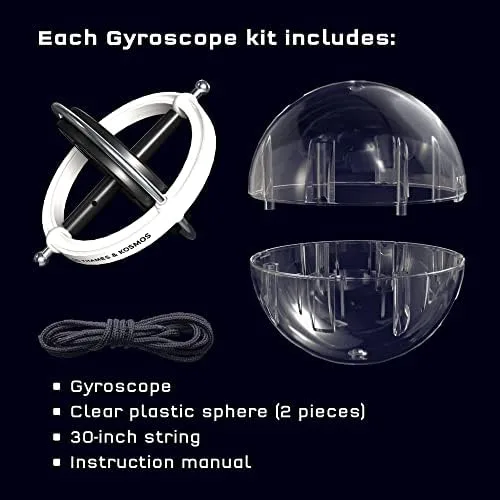
A weighted metal gyroscope with pull-string launcher, experiment manual with 12 experiments, and balance accessories (string, pencil adapter, stand). The gyroscope is real scientific equipment — not a plastic toy approximation.
Our Evaluation
Build Quality: 8/10
The metal gyroscope is well-machined and weighted. The pull-string launcher works reliably. The balance accessories are functional. The manual is well-illustrated with clear experiment procedures.
Play Value: 7/10
The initial demonstrations are genuinely awe-inspiring — a spinning gyroscope balanced on a string or pencil tip captivates children and adults. The experiment progression from simple to complex is well-structured. Engagement peaks during the first week of experiments and gradually shifts to occasional demonstrations.
Age Appropriateness: 7/10
Ages 8+ can perform the experiments. True understanding of the physics concepts requires ages 10+.
Value for Money: 8/10
$25 for real physics equipment with a structured experiment curriculum. Excellent value.
The Evidence
Hands-on physics experimentation supports scientific reasoning development. Klahr et al. (2011) found that structured experimentation improves children’s scientific thinking.1
Safety Notes
The spinning gyroscope has a sharp edge — handle carefully. Not for children under 8. No choking hazards. No CPSC recalls.
The Verdict
Real physics equipment at a toy price. The gyroscope demonstrations are genuinely compelling, and the experiment curriculum is well-structured.
Product Rating: 7/10 — Genuine physics learning. Niche appeal and limited ongoing engagement.
Evidence Rating: Emerging — Hands-on science experimentation is well-supported.
Who Should Buy This
- Science-curious children ages 8-13
- Homeschooling families seeking physics curriculum supplements
- STEM-focused families
- Gift-givers for young science enthusiasts
Who Should Skip This
- Children under 8
- Families seeking open-ended or daily-use toys
- Children who prefer digital science learning
- Anyone easily frustrated by precise manual dexterity requirements
This review reflects our independent evaluation. ScienceBasedKids.com purchased this product at retail price.
Footnotes
-
Klahr, D., Zimmerman, C., & Jirout, J. (2011). “Educational interventions to advance children’s scientific thinking.” Science, 333(6045), 971-975. ↩
Enjoyed this review? We publish two new evidence-based evaluations every week.
Free. No spam. Unsubscribe anytime.
Recommended Accessories
Affiliate links
Thames & Kosmos Chemistry C500
“Chemistry kit from the same brand. Expands the home science lab.”
Thames & Kosmos Magnetism Science Kit
“Complementary physics topic with hands-on experiments.”

National Geographic Science Kit
“Multi-topic alternative with broader scope but less physics depth.”

Extra Pull String (replacement)
“The pull string is the first thing to wear out. Replacement extends product life.”