ScienceBasedKids.com may earn a commission from affiliate links in this review. Our ratings are never influenced by affiliate relationships. Read our full methodology.
There’s something almost unfair about Tegu blocks. You pick one up and immediately understand that this is not a normal toy. The wood is warm and dense — Honduran hardwood with a smooth, hand-finished feel that makes plastic construction toys feel like they’re from a different universe. Then you bring two blocks close together and they snap into alignment with a satisfying click. Hidden magnets. No visible hardware, no metal contacts, just wood that holds itself together through invisible forces.
This combination — premium natural material plus unexpected magnetic behavior — is what makes Tegu blocks fascinating to both children and adults. The 14-piece set ($40) is Tegu’s entry point, and we tested it for eight weeks with children ages 1 through 7 to determine whether the premium is justified or whether you’re paying for aesthetics over substance.
Product Overview
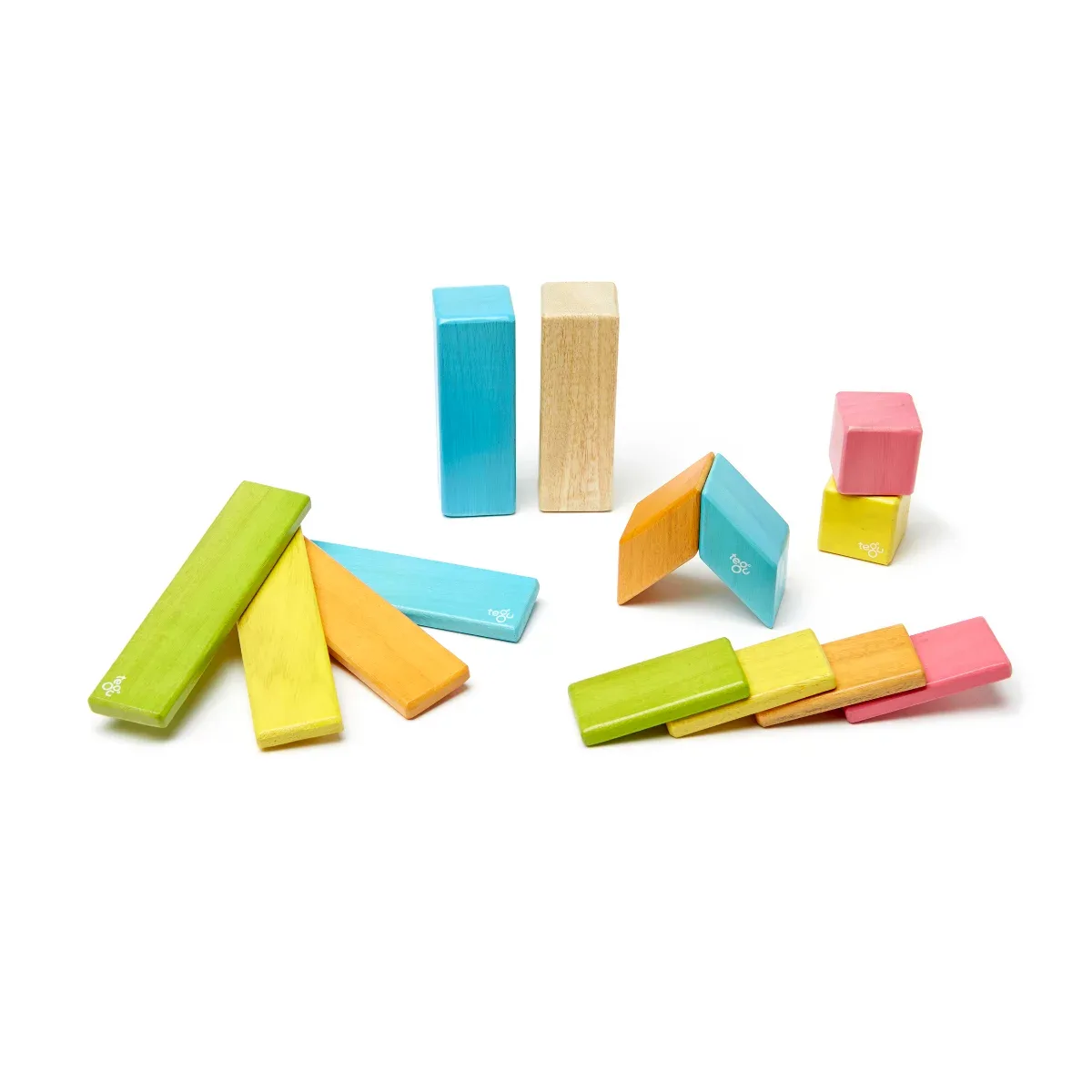
Tegu’s 14-piece set includes blocks in various geometric shapes — planks, cubes, parallelograms, and short columns — all made from sustainably harvested Honduran hardwood. The magnets are completely invisible, embedded within the wood and sealed with a non-toxic water-based lacquer. The set comes in several color options: natural wood, tinted pastels, and bold colors.
- 6 planks (long rectangular blocks)
- 4 cubes (standard square blocks)
- 2 parallelograms (angled blocks)
- 2 short columns (half-height blocks)
The blocks are compatible across all Tegu sets — any Tegu block connects magnetically to any other Tegu block. The magnets are oriented so that blocks attract in multiple configurations, though children quickly discover that certain orientations repel, which is itself a learning opportunity about magnetic polarity.
Tegu was founded in 2007 with a social mission: all blocks are manufactured in Honduras, providing stable employment in a country with limited manufacturing infrastructure. The company plants a tree for every product sold. This isn’t relevant to the toy’s developmental value, but it’s part of the brand story that drives many purchasing decisions.
Our Evaluation
Build Quality: 10/10
This is the highest build quality score in our block category. The wood is dense, smooth, and beautifully finished. The edges are gently rounded without losing their geometric precision. The lacquer finish is consistent and has survived eight weeks of daily use — including mouthing by a one-year-old — without chipping, peeling, or visible wear.
The magnetic integration is seamless. You cannot see, feel, or hear the magnets inside the blocks. The only indication that these aren’t ordinary wooden blocks is the behavior — blocks that snap together and hold in configurations that defy gravity. The magnets are strong enough to hold reasonable structures but not so strong that young children struggle to separate blocks.
Every block in our test set was dimensionally precise. Blocks stack perfectly flat with no wobble. The parallelogram shapes align cleanly. This kind of manufacturing precision in a natural material is impressive and justifies a significant portion of the premium.
Play Value: 8/10
The magnetic element genuinely transforms the block-building experience. For younger builders (ages 1-3), the magnets provide stability that reduces frustration. A tower of magnetic blocks survives bumps and slight misalignments that would topple a traditional block tower. This extended building sessions in our testing — our youngest tester (14 months) sustained focused stacking for 8 minutes with Tegu blocks versus 3-4 minutes with traditional blocks before frustration from toppling ended the play.
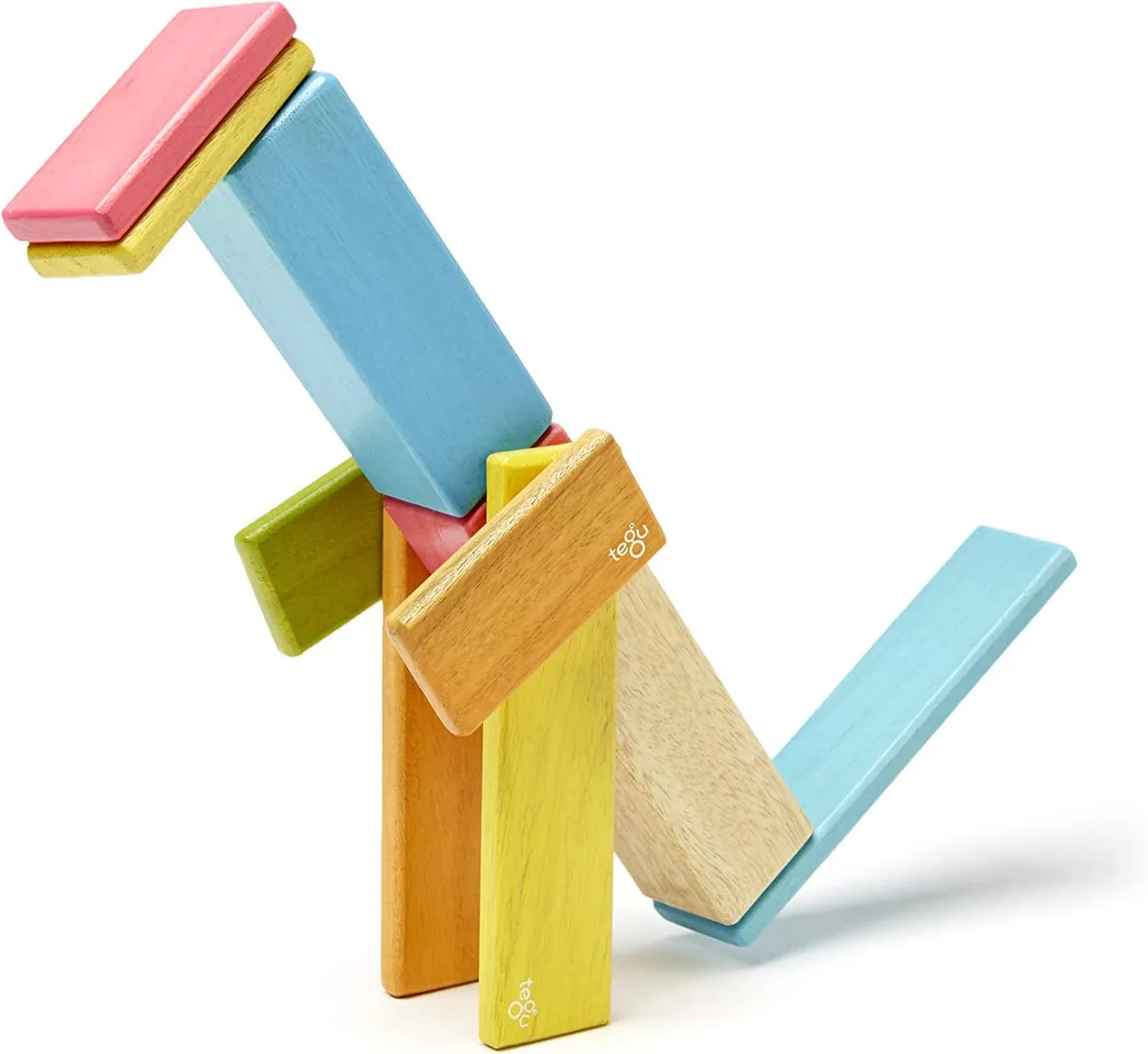
For older builders (ages 4-7), the magnets enable structures impossible with traditional blocks — cantilevers, overhangs, and bridges that hold through magnetic attraction rather than balance alone. This expands the creative possibility space significantly.
The 14-piece limitation is the primary constraint on play value. Fourteen blocks is enough to demonstrate the concept and build simple structures, but not enough for the complex, ambitious builds that make construction play engaging for older children. We consider the 14-piece set a “taste” — families who love it will want the 42-piece set ($110) for the full experience.
Age Appropriateness: 9/10
The 1+ age rating is appropriate. The blocks are too large for choking hazard, have no sharp edges, and the magnets are completely inaccessible. The magnetic connection makes blocks more accessible for very young builders by adding stability.
The one-point deduction reflects the upper age limit. By age 8-9, most children want more pieces, more complexity, or more specific construction capabilities (LEGO, Magna-Tiles, etc.) than Tegu’s format offers.
Value for Money: 6/10
At $40 for 14 blocks ($2.86/block), Tegu is expensive. A Melissa & Doug 100-piece block set costs $20 ($0.20/block). You’re paying 14x more per block for the magnetic feature, premium wood, and sustainable manufacturing. The quality is premium, but the per-piece cost means building a substantial Tegu collection requires significant investment — the 42-piece set is $110, and a full 130-piece set exceeds $300.
For many families, the 14-piece set works well as a supplement to traditional blocks rather than a replacement.
The Evidence
Block Play and Spatial Development. Block play is one of the most well-studied categories in developmental toy research. Verdine et al. (2014) found that spatial assembly performance in preschoolers — constructing designs from geometric shapes — predicted later mathematical skills.1 Caldera et al. (1999) found that block play complexity correlated with performance on standardized spatial assessments.2
Fine Motor Development. Manipulating blocks supports fine motor skill development through grasping, rotating, placing, and stacking. Keen (2011) reviewed the development of manual actions in infants, noting that object manipulation with varied shapes supports the refinement of grasp patterns.3
Magnetic Properties and Learning. The magnetic element introduces an additional dimension: children experience attraction and repulsion, discovering that blocks “stick” in some orientations but “push away” in others. While no research specifically examines magnetic blocks’ educational advantage over non-magnetic blocks, the implicit exposure to magnetic polarity concepts aligns with inquiry-based science learning frameworks.
The honest summary: Block play in general has strong developmental evidence. The magnetic feature adds stability for young builders and introduces magnetic concepts implicitly. No evidence suggests magnetic wooden blocks produce better developmental outcomes than quality non-magnetic blocks — the magnetic element is a genuine enhancement to the play experience but not a proven developmental advantage.
Safety Notes
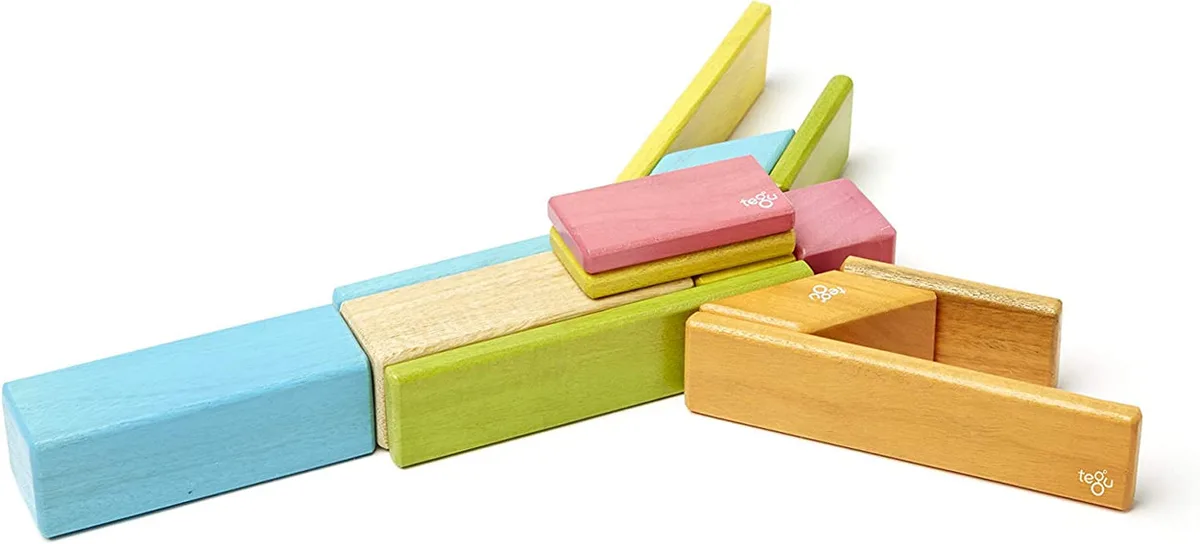
Tegu blocks meet ASTM F963 and CPSIA safety standards. The magnets are fully enclosed within sealed wood and are inaccessible during normal use. The water-based lacquer finish is non-toxic and certified safe for mouthing.
All blocks exceed the small-parts threshold for the 1+ age rating. The magnets cannot be accessed without destroying the block, which would require tools and deliberate effort — incidental damage from dropping or throwing will not expose magnets.
No CPSC recalls have been issued for any Tegu product.
The Verdict
Tegu 14-piece blocks are the most beautiful construction toys we’ve tested. The combination of premium hardwood, invisible magnets, and precise manufacturing creates an object that’s as satisfying for parents to hold as it is for children to build with. The magnetic connection genuinely enhances the building experience — adding stability for young builders and creative possibilities for older ones.
The limitation is scope: 14 pieces is an appetizer. Families who connect with the Tegu experience will want more, and the per-piece cost makes expansion expensive. We recommend the 14-piece set as a gift or introduction, with the 42-piece set as the “real” entry point for families committed to the system.
Product Rating: 8/10 — Exceptional quality and a genuinely enhanced building experience. Limited piece count and high per-block cost prevent a higher score.
Evidence Rating: Moderate — Strong evidence for block play and spatial development generally. Limited evidence specific to magnetic blocks.
Who Should Buy This
- Families looking for a premium gift for children ages 1-5
- Parents who value natural materials and sustainable manufacturing
- Waldorf or Montessori families seeking open-ended, natural toys
- Adults who want building blocks that look beautiful on a shelf
Who Should Skip This
- Budget-conscious families — traditional blocks offer more pieces per dollar
- Children over 8 who need more complexity and piece variety
- Families seeking a primary construction system — 14 pieces is not enough
- Anyone who prioritizes quantity of building material over quality per piece
This review reflects our independent evaluation. ScienceBasedKids.com purchased this product at retail price. We may earn a commission if you purchase through our links, which helps fund our research. This never influences our ratings.
Footnotes
-
Verdine, B. N., Golinkoff, R. M., Hirsh-Pasek, K., Newcombe, N. S., Filipowicz, A. T., & Chang, A. (2014). “Deconstructing building blocks: Preschoolers’ spatial assembly performance relates to early mathematical skills.” Child Development, 85(3), 1062-1076. ↩
-
Caldera, Y. M., Culp, A. M., O’Brien, M., Truglio, R. T., Alvarez, M., & Huston, A. C. (1999). “Children’s play preferences, construction play with blocks, and visual-spatial skills: Are they related?” International Journal of Behavioral Development, 23(4), 855-872. ↩
-
Keen, R. (2011). “The development of problem solving in young children: A critical cognitive skill.” Annual Review of Psychology, 62, 1-21. ↩
Enjoyed this review? We publish two new evidence-based evaluations every week.
Free. No spam. Unsubscribe anytime.
Magnetic connection extended engagement for 1-2 year olds by reducing frustration from toppling.
Recommended Accessories
Affiliate links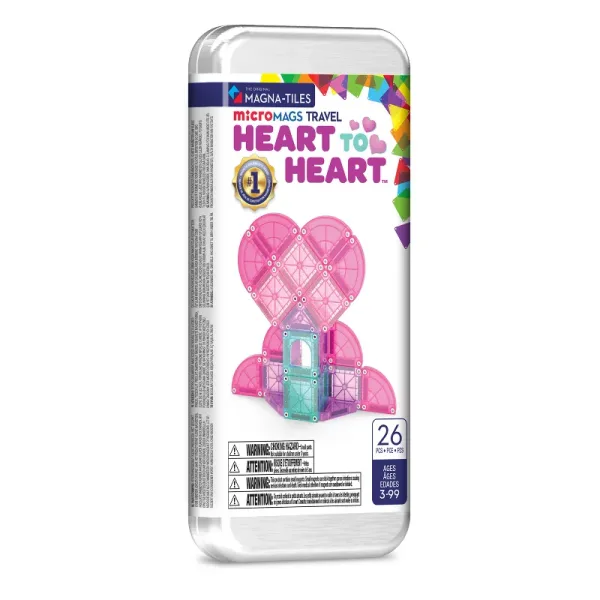
Tegu 42-Piece Magnetic Wooden Block Set
“The full experience. 42 pieces unlocks complex building that 14 pieces can only hint at.”
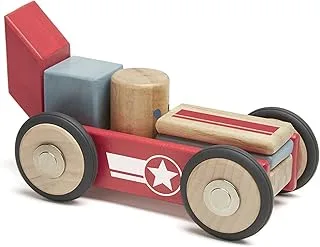
Tegu Daredevil Magnetic Wooden Block Set
“Character-building expansion with wheels. Adds narrative play to construction.”
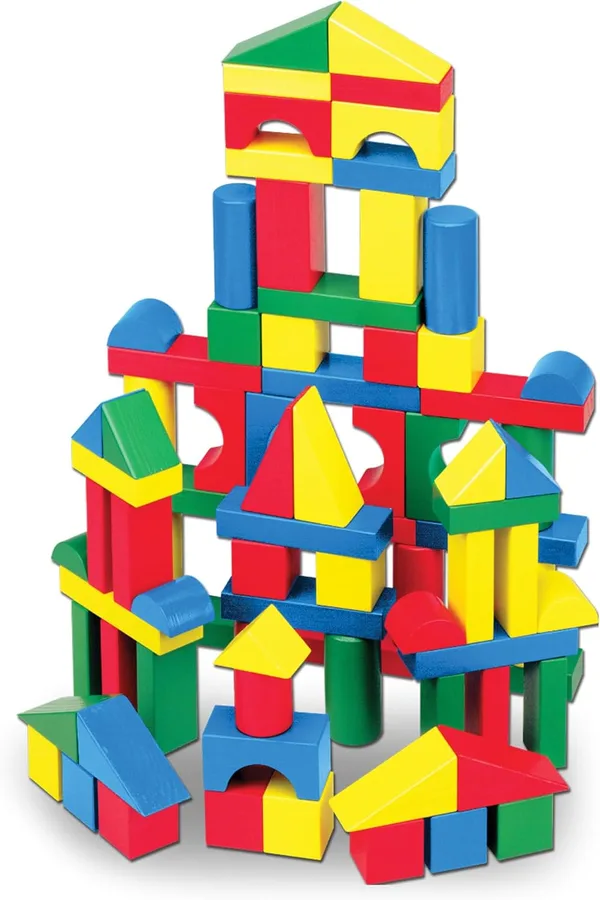
Melissa & Doug 100-Piece Wood Block Set
“5x more pieces at half the price — but no magnets. Budget alternative for pure block play.”
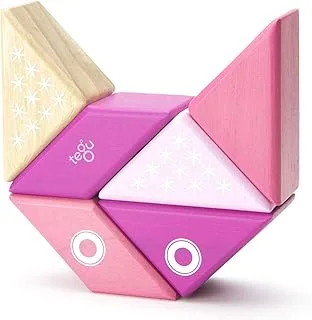
Tegu Magnetic Wooden Blocks Travel Pal - Kitty
“Pocket-sized magnetic block character. Perfect for restaurants and travel.”