ScienceBasedKids.com may earn a commission from affiliate links in this review. Our ratings are never influenced by affiliate relationships. Read our full methodology.
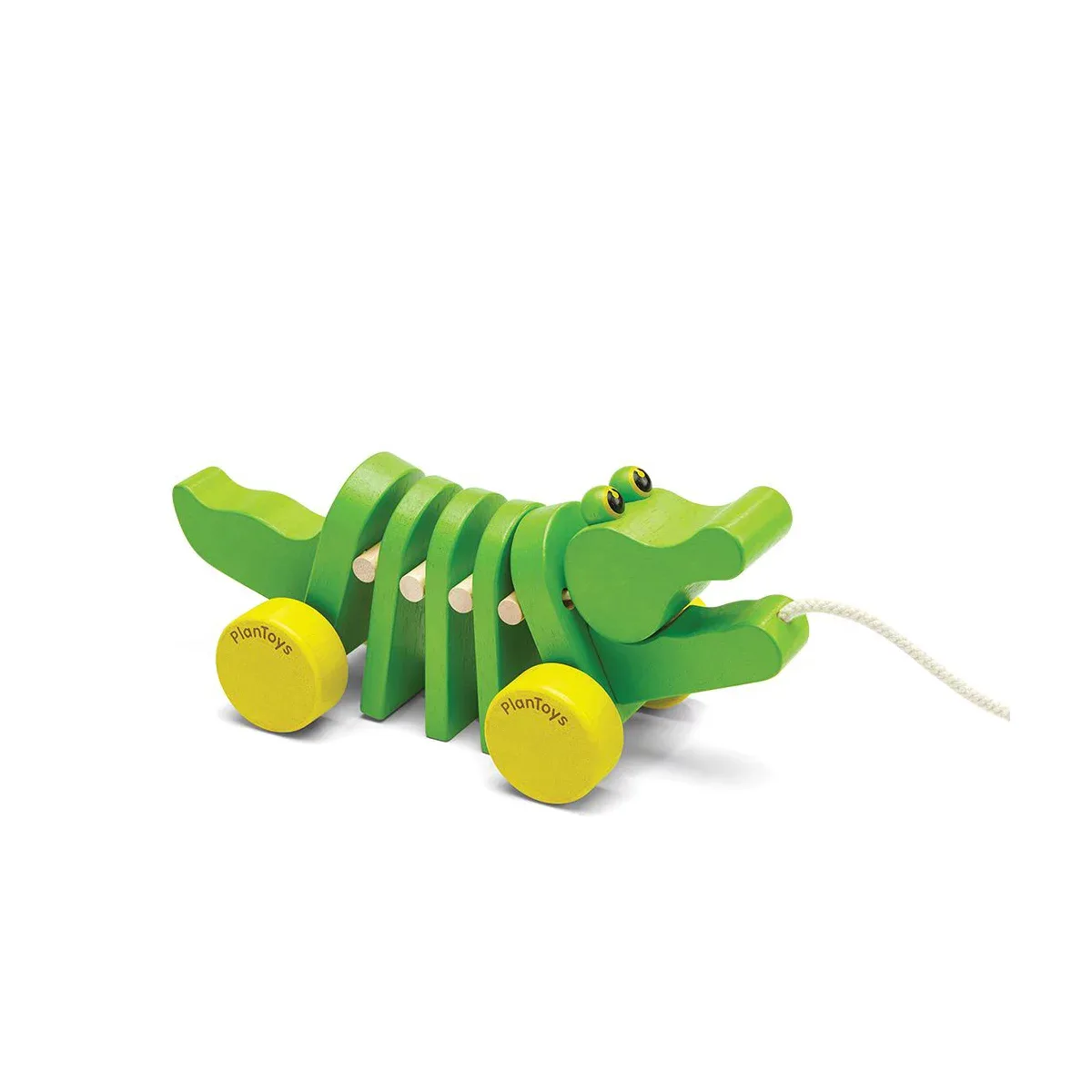
Pull toys are the original walking motivator. Tie a string to an object, hand the string to a toddler, and watch them walk. The PlanToys Dancing Alligator lifts this ancient concept with articulated rubberwood segments that wiggle and click as the alligator is pulled across the floor. The auditory feedback (click-clack-click-clack) and visual feedback (the alligator’s body undulates in a convincing dance) provide continuous motivation for the walking child to keep moving. It’s a simple toy that does one thing beautifully.
We tested the Dancing Alligator across three households with children ages 11 months to 3 years over four weeks.
Product Overview
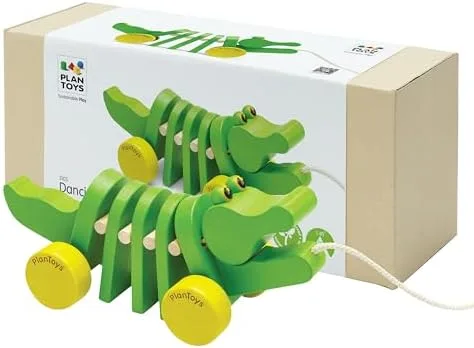
The PlanToys Dancing Alligator ($22) is a wooden pull-along toy:
- Construction: Articulated rubberwood segments connected by pins that allow lateral movement
- Pull cord: Cotton string approximately 24” long with a wooden bead handle
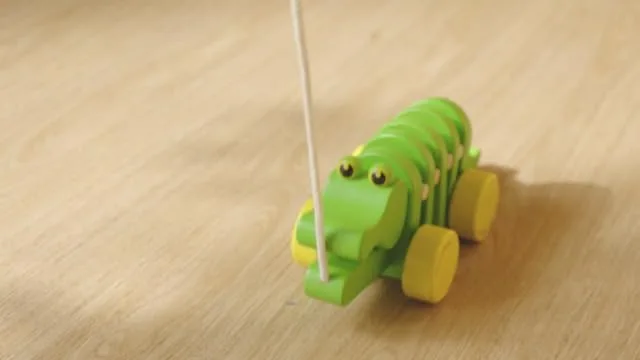
- Movement: Body segments click and wiggle laterally as the toy is pulled forward
- Sound: Click-clack sound produced by segment-to-segment contact during movement
- Material: Rubberwood with organic, non-toxic pigments and E-Zero non-formaldehyde glue
- Size: Approximately 9.5” L × 3.5” W × 3.5” H
PlanToys uses rubberwood — trees that no longer produce latex and would otherwise be burned — as their primary material. The organic pigments are derived from plant extracts. The E-Zero glue is formaldehyde-free. The environmental credentials are genuine and thorough.
Our Evaluation
Build Quality: 9/10
The craftsmanship is outstanding. The rubberwood segments are precision-cut and smooth. The articulation pins allow free lateral movement without looseness. The organic pigment finish is subtle and warm — not as vivid as synthetic paint but beautiful in a natural way. The pull cord is securely attached and the wooden bead handle is sized for toddler grip.
Play Value: 8/10
The Dancing Alligator’s single function — wiggle and click when pulled — is perfectly executed. The auditory feedback is pleasant rather than grating (an important distinction for a toy that will be pulled across floors hundreds of times). The visual wiggle is genuinely entertaining — children in our testing looked back at the alligator frequently while walking, which created its own coordination challenge.
The play value is concentrated in the walking-development window (12-24 months). Children who are confident walkers still enjoy pulling the alligator but do so less frequently. The toy transitions from a walking motivator to an occasional companion rather than a daily engagement.
Age Appropriateness: 8/10
The 12-month minimum requires the child to be walking or very close to walking independently. The pull cord length is appropriate for a toddler’s arm reach. By 24-30 months, the walking motivation function is no longer needed but the toy retains some play value as a companion object.
Durability: 9/10
Rubberwood is extremely durable. The articulation mechanism showed no wear during our testing. The organic pigments don’t chip or peel. The pull cord is the most vulnerable component — cotton can fray over time — but it held up well during our four-week testing period.
Value for Money: 7/10
At $22 for a single-function toy with a 12-18 month active use window, the per-month cost is reasonable but not exceptional. The quality and sustainability story justify the price for values-aligned families.
The Evidence
Pull toys and walking motivation. Pull toys provide external motivation for locomotion during the early walking period. The auditory and visual feedback creates a contingent reward for continued movement, supporting the practice repetitions that refine walking skills.1
Auditory-motor coupling. The rhythmic click-clack sound produced during walking creates an auditory-motor coupling — the sound is contingent on movement, reinforcing the walking rhythm. Rhythmic auditory stimulation has been shown to support motor coordination development.2
The honest summary: Pull toys support walking development through motivation and feedback. The Dancing Alligator’s design provides particularly rich auditory and visual feedback during locomotion.
Safety Notes
Meets ASTM F963, EN-71, and CPSIA standards. The pull cord length (24”) is within safety guidelines but should be supervised to prevent entanglement. Non-toxic organic pigments and formaldehyde-free glue. No CPSC recalls on record.
The Verdict
The PlanToys Dancing Alligator is a beautifully crafted pull toy that does one thing exceptionally well: it motivates toddlers to walk by providing delightful auditory and visual feedback. The sustainability credentials are genuine, the craftsmanship is outstanding, and the wiggle-and-click mechanism has earned its many awards. It’s a concentrated toy experience — focused, finite, and wonderful during its active window.
Product Rating: 8/10 — Outstanding craftsmanship, excellent mechanism design, genuine sustainability. Narrow active use window and single function limit the score.
Evidence Rating: Emerging — Walking motivation through pull toys is well-supported conceptually. Auditory-motor coupling research supports the click-clack feedback design.
Who Should Buy This
- Parents of early walkers (10-15 months) looking for walking encouragement
- Families who value sustainable, non-toxic wooden toys
- Gift-givers seeking a beautiful, award-winning toddler toy
Who Should Skip This
- Families with children already walking confidently
- Parents looking for multi-function toys with longer engagement windows
- Anyone who needs a quiet toy (the click-clack is the point, but it is present)
This review reflects our independent evaluation. ScienceBasedKids.com purchased this product at retail price. We may earn a commission if you purchase through our links, which helps fund our research. This never influences our ratings.
Footnotes
-
Adolph, K. E., & Berger, S. E. (2006). “Motor development.” In D. Kuhn & R. Siegler (Eds.), Handbook of child psychology: Cognition, perception, and language (6th ed., pp. 161-213). Wiley. ↩
-
Thaut, M. H., McIntosh, G. C., & Hoemberg, V. (2015). “Neurobiological foundations of neurologic music therapy: Rhythmic entrainment and the motor system.” Frontiers in Psychology, 5, 1185. ↩
Recommended Accessories
Affiliate links
PlanToys Walk N Roll
“Push-along bird on a stick. Walking motivation from the front rather than behind.”
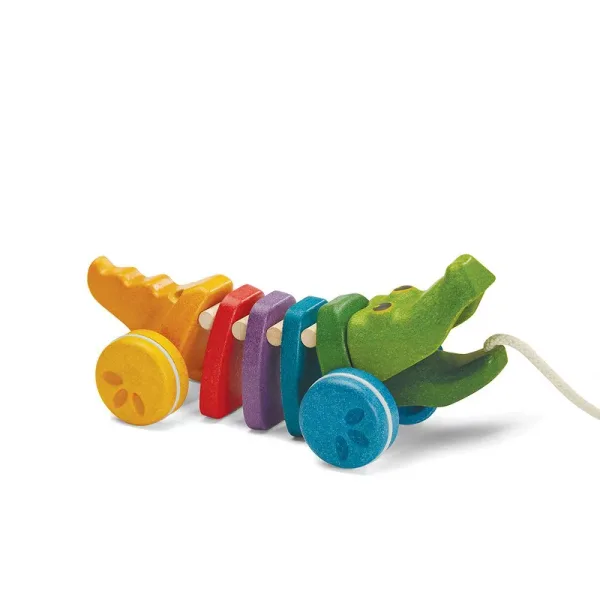
PlanToys Rainbow Alligator
“Same mechanism in a rainbow color palette. More vibrant visual appeal.”
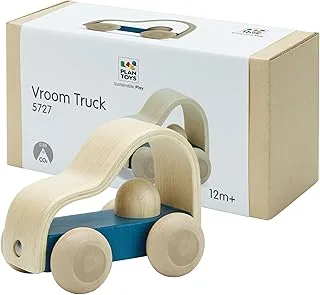
PlanToys Vroom Truck
“Same sustainable construction in a push-along vehicle format.”
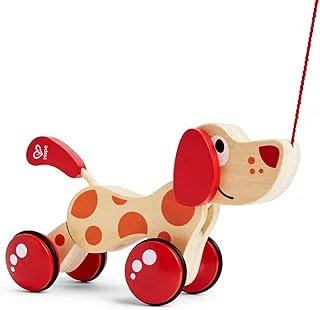
Hape Walk-A-Long Puppy
“Different animal, similar pull-toy concept. Head and tail wag during walking.”