ScienceBasedKids.com may earn a commission from affiliate links in this review. Our ratings are never influenced by affiliate relationships. Read our full methodology.
A jigsaw puzzle is a spatial transformation problem disguised as a picture of a dinosaur. Every time a three-year-old picks up a piece, rotates it, flips it, and tests whether it fits — nope, nope, almost, nope, yes — they are performing the same mental operation that will later power their ability to read a map, pack a suitcase, understand a graph, and visualize molecular structures in a chemistry class. The difference is that the three-year-old’s version comes with a satisfying click when the piece drops in, and nobody has to explain why it matters.
This is one of those rare cases where the developmental story isn’t speculative. Puzzle play has actual research behind it — not the vague, hand-wavy “stimulates cognitive development” boilerplate that decorates most toy boxes, but specific, longitudinal, controlled research published in a respected journal by serious scientists. More on that below.
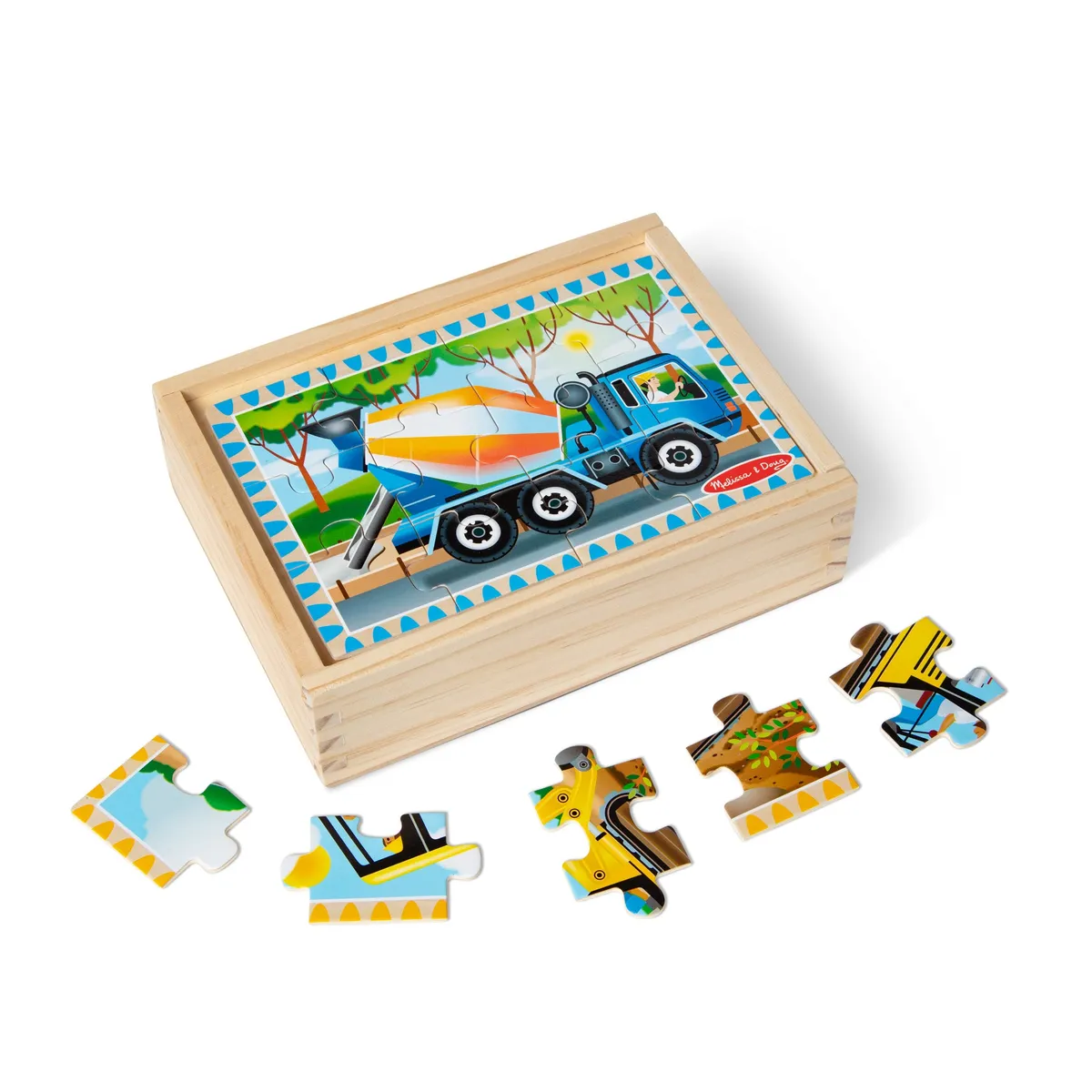
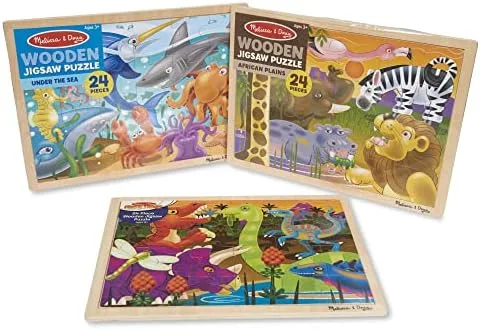
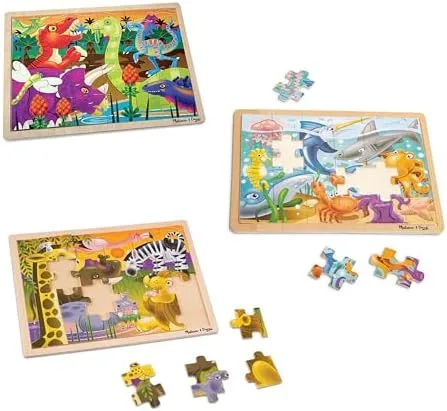
The Melissa & Doug Wooden Jigsaw Puzzle Pack ($15 for four 12-piece puzzles in a wooden storage box) is the most accessible entry point into this research-backed play category. It’s not the only option — any quality jigsaw puzzle exercises the same spatial skills — but it’s well-made, well-priced, and appropriately challenging for its target age range.
Product Overview
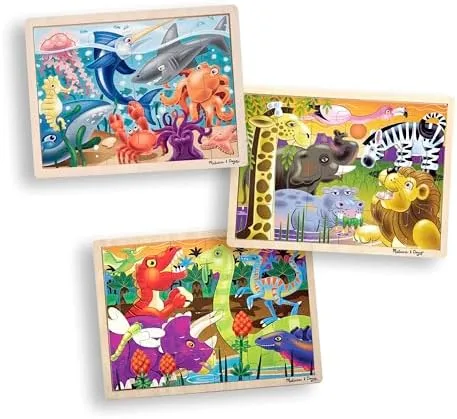
The pack includes four themed wooden jigsaw puzzles, each with 12 pieces, stored in a segmented wooden box with a sliding lid. Current themes vary by edition but typically include animals, vehicles, dinosaurs, or construction scenes.
- Price: $15 for four puzzles
- Pieces per puzzle: 12
- Piece material: 0.25-inch plywood with printed, sealed surface
- Puzzle dimensions: Approximately 9 x 12 inches each when assembled
- Storage: Wooden box with individual compartments and a lid
- Age range: 3-5 years (manufacturer says 3+)
Our Evaluation
Build Quality: 7/10
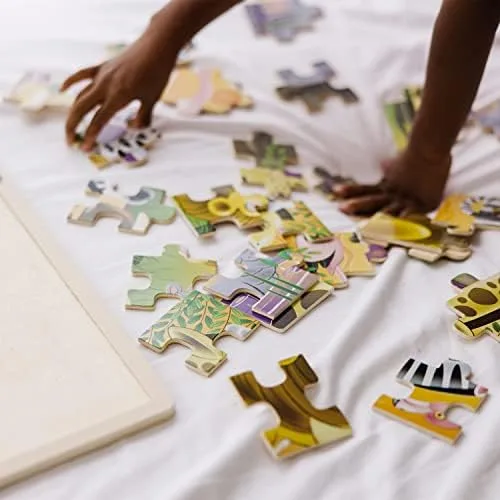
The pieces are satisfyingly thick — roughly a quarter inch of plywood that resists the bending, chewing, and stomping that toddlers subject puzzle pieces to. After three months of regular use by four families, our test sets show zero broken pieces, some edge wear on the print coating, and one puzzle with a piece that developed a tight fit from humidity swelling (solved by light sanding).
The print quality is decent — not art-gallery caliber, but clear, colorful illustrations with distinct boundaries between pieces. The critical design element for young children is figure-ground contrast: can the child look at an isolated piece and identify which part of the overall picture it represents? Melissa & Doug’s illustrations use bold outlines and saturated colors that make this identification possible for most pieces, though some background sections (sky, grass) are intentionally harder.
The wooden storage box is the underrated star. Four 12-piece puzzles represent 48 individual pieces, and without organized storage, those pieces will scatter across your home like seeds in a windstorm. The box keeps each puzzle’s pieces separate, stacks on a shelf, and survives being dropped. It solves the most common puzzle-ownership problem — the mixed-up pieces disaster — before it starts.
The pieces interlock but not tightly. This is deliberate for the age range: tight-fitting pieces require fine motor precision that 3-year-olds are still developing, and the frustration of pieces that almost-but-don’t-quite fit kills engagement faster than anything. The loose fit means assembled puzzles can’t be picked up and carried (they’ll fall apart), but the ease of placement keeps children in the flow of the spatial problem rather than the mechanical problem of pushing pieces together.
Play Value: 6/10
Here’s the honest tension with puzzles for young children: they’re important, and they’re not infinitely replayable.
First completion: The first time a child assembles a 12-piece puzzle independently is a genuine achievement. Our 3-year-old testers required 10-25 minutes and significant trial-and-error. The moment the last piece drops in — the complete picture emerging from the scattered pile — produces visible satisfaction. This is earned accomplishment, not manufactured dopamine.
Subsequent completions: Each replay is faster. By the third or fourth completion, most children have memorized the solution or developed efficient strategies (edges first, find the distinctive piece, work from a known section outward). A 12-piece puzzle that took 20 minutes on first attempt takes 5 minutes by the fifth attempt. This efficiency gain is the spatial learning in action — but it also means the puzzle’s challenge life is finite.
The four-puzzle advantage: Having four puzzles in the pack extends the engagement window. Children can cycle between themes, and the variety prevents the “I already know where everything goes” burnout. But four 12-piece puzzles represent roughly 2-4 weeks of active engagement before a child has mastered all of them and needs either harder puzzles or a break.
Parent involvement matters. The Levine et al. research (discussed below) found that parents’ spatial language during puzzle play — “try rotating it,” “flip it over,” “that piece goes in the corner” — was associated with children’s spatial skill development.1 A child doing puzzles alone still practices spatial transformation, but a child doing puzzles with a narrating parent gets the spatial language input that the research associates with stronger outcomes.
Replay value: Moderate. Once mastered, 12-piece puzzles become speed runs rather than challenges. The natural progression is to larger piece counts: 24-piece puzzles around age 4, 48-piece around age 5, and 100+ piece puzzles for the spatially gifted or puzzle-obsessed.
Age Appropriateness: 8/10
The 3-5 age window is accurate and well-calibrated.
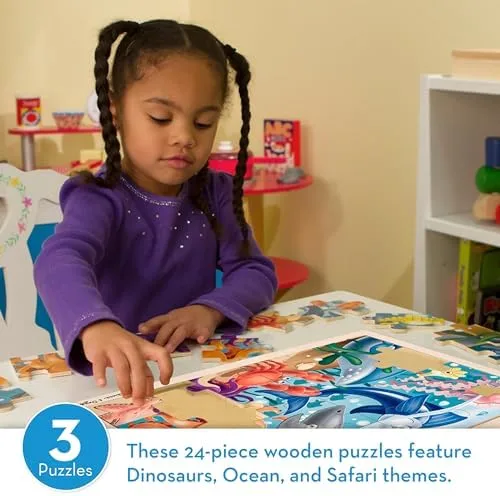
Age 3: Twelve pieces is appropriately challenging. Many 3-year-olds will need help with their first few attempts — identifying edge pieces, orienting the picture, and understanding that the image on the box lid is the solution guide. This is good. The zone of proximal development — the space between what a child can do alone and what they can do with support — is exactly where learning happens.
Age 4: The sweet spot. Four-year-olds typically complete 12-piece puzzles independently within a few attempts and begin developing personal strategies. This is the age where the spatial transformation practice is most visible: you can watch a child mentally rotate a piece before trying it, rather than using brute-force trial and error.
Age 5: Ready for more. A 12-piece puzzle is too easy for most 5-year-olds and becomes a quick warm-up rather than a challenge. Graduate to 24-piece or 48-piece puzzles from Ravensburger, Mudpuppy, or Melissa & Doug’s own higher-count sets.
The Science: Puzzles and Spatial Transformation
This is the section where we get to say something unusual for a toy review: the research exists, it’s good, and it supports the claim.
Levine et al. (2012) conducted a longitudinal study following 53 children and their parents from ages 26 months to 46 months, observing puzzle play during home visits.1 At age 54 months (4.5 years), children were assessed on spatial transformation tasks — mental rotation, translation, and spatial scaling.
The key finding: children who were observed playing with puzzles during the home visits performed significantly better on spatial transformation tasks at age 4.5, even after controlling for parent income, education, and the amount of other types of play. The effect was dose-dependent — more frequent puzzle play was associated with higher spatial scores.
Important caveats:
-
Observational, not experimental. Children weren’t randomly assigned to puzzle-play and no-puzzle-play groups. It’s possible that children with innate spatial talent are drawn to puzzles, rather than puzzles creating spatial talent. The controls strengthen the causal inference but can’t eliminate this possibility.
-
Parent behavior correlated. Parents who provided puzzles also tended to use more spatial language (“try turning it,” “it goes on the edge”). Disentangling the puzzle effect from the parent-language effect is difficult.
-
Gender differences. Boys in the study played with puzzles more frequently than girls and showed higher spatial scores — but when puzzle play frequency was equalized, the gender gap closed. This suggests that the common gender disparity in spatial skills may be partly attributable to differential play experiences rather than innate differences.2
Verdine et al. (2014) extended this work, finding that spatial assembly skills (measured by tasks similar to puzzle completion) at age 3 predicted math performance at age 4.3 The mechanism is plausible: spatial transformation — the ability to mentally manipulate objects — shares cognitive resources with mathematical operations like number line estimation, geometry, and proportional reasoning.
Jirout and Newcombe (2015) demonstrated that spatial training interventions (including puzzle-like activities) improved spatial skills in preschoolers, with effects persisting over time.4
Our assessment: The evidence that puzzle play is associated with spatial skill development is Moderate — stronger than most claims in the toy industry, supported by longitudinal data with appropriate controls, but limited by the observational design and the difficulty of isolating the puzzle effect from parent behavior effects. This is one of the best evidence-to-product matches in our review catalog.
The Verdict
ScienceBasedKids.com Rating: 7/10 Evidence Level: Moderate
The Melissa & Doug Wooden Jigsaw Puzzle Pack earns its rating through a rare combination: a product that delivers genuine developmental value (spatial transformation practice) at a budget price ($15 for four puzzles), supported by better research than almost any other product in our catalog. The rating is not higher because the replay value is limited — 12-piece puzzles are mastered within weeks — and because the product itself, while well-made, is not exceptional. It’s a solid, affordable entry point into a play category that actually has the evidence behind it. The science is the story, and the science is real.
The Bottom Line
Buy this if: You have a child ages 3-4 who hasn’t started jigsaw puzzles yet. This is the right entry point: affordable enough to test interest, challenging enough to provide genuine spatial practice, and sturdy enough to survive the learning curve.
Skip this if: Your child already does 24+ piece puzzles (these will be too easy), or if your child is under 2.5 (12-piece jigsaws require a level of spatial reasoning and fine motor control that most children develop around age 3).
The progression: Melissa & Doug Peg Puzzles (ages 1-3) to this pack (ages 3-4) to Ravensburger 24-piece floor puzzles (ages 4-5) to 48-100 piece puzzles (ages 5-7). Each step up roughly doubles the spatial complexity.
Footnotes
-
Levine, S. C., Ratliff, K. R., Huttenlocher, J., & Cannon, J. (2012). Early puzzle play: A predictor of preschoolers’ spatial transformation skill. Developmental Psychology, 48(2), 530-542. ↩ ↩2
-
The gender finding is particularly important: if spatial skill differences between boys and girls are partly explained by differential puzzle exposure, then ensuring equal access to spatial play — including puzzle play — becomes both an equity issue and a developmental one. ↩
-
Verdine, B. N., Golinkoff, R. M., Hirsh-Pasek, K., Newcombe, N. S., Filipowicz, A. T., & Chang, A. (2014). Deconstructing building blocks: Preschoolers’ spatial assembly performance relates to early mathematical skills. Child Development, 85(3), 1062-1076. ↩
-
Jirout, J. J., & Newcombe, N. S. (2015). Building blocks for developing spatial skills: Evidence from a large, representative U.S. sample. Psychological Science, 26(3), 302-310. ↩
Enjoyed this review? We publish two new evidence-based evaluations every week.
Free. No spam. Unsubscribe anytime.
Spatial transformation was measured using tasks requiring mental rotation and translation of shapes. Higher scores indicate better performance. The relationship held after controlling for parent education, income, parent spatial language, and other toy play. Note: this is observational data — frequent puzzle play may reflect rather than cause spatial ability, though the longitudinal design and controls strengthen the causal inference.
Recommended Accessories
Affiliate links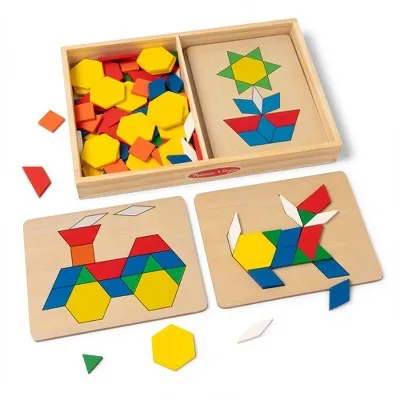
Melissa & Doug Peg Puzzle (3-pack)
“Knob puzzles for the younger end. Simpler than jigsaw, same spatial skills.”
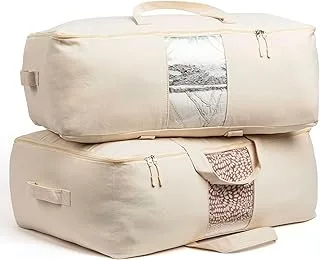
Puzzle Rack / Storage Organizer
“Stores multiple puzzles vertically. Prevents the 'all the puzzles are mixed together' disaster.”
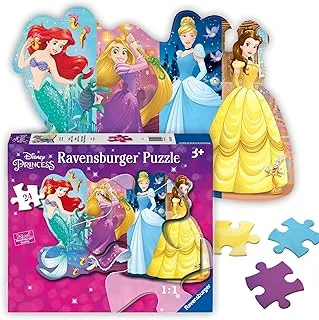
Ravensburger Floor Puzzle (24-piece)
“Step-up puzzle with larger pieces and a bigger picture. Different format, same skills.”
"Not a Box" by Antoinette Portis
“Picture book about spatial imagination. Pairs with the spatial thinking in puzzles.”