ScienceBasedKids.com may earn a commission from affiliate links in this review. Our ratings are never influenced by affiliate relationships. Read our full methodology.
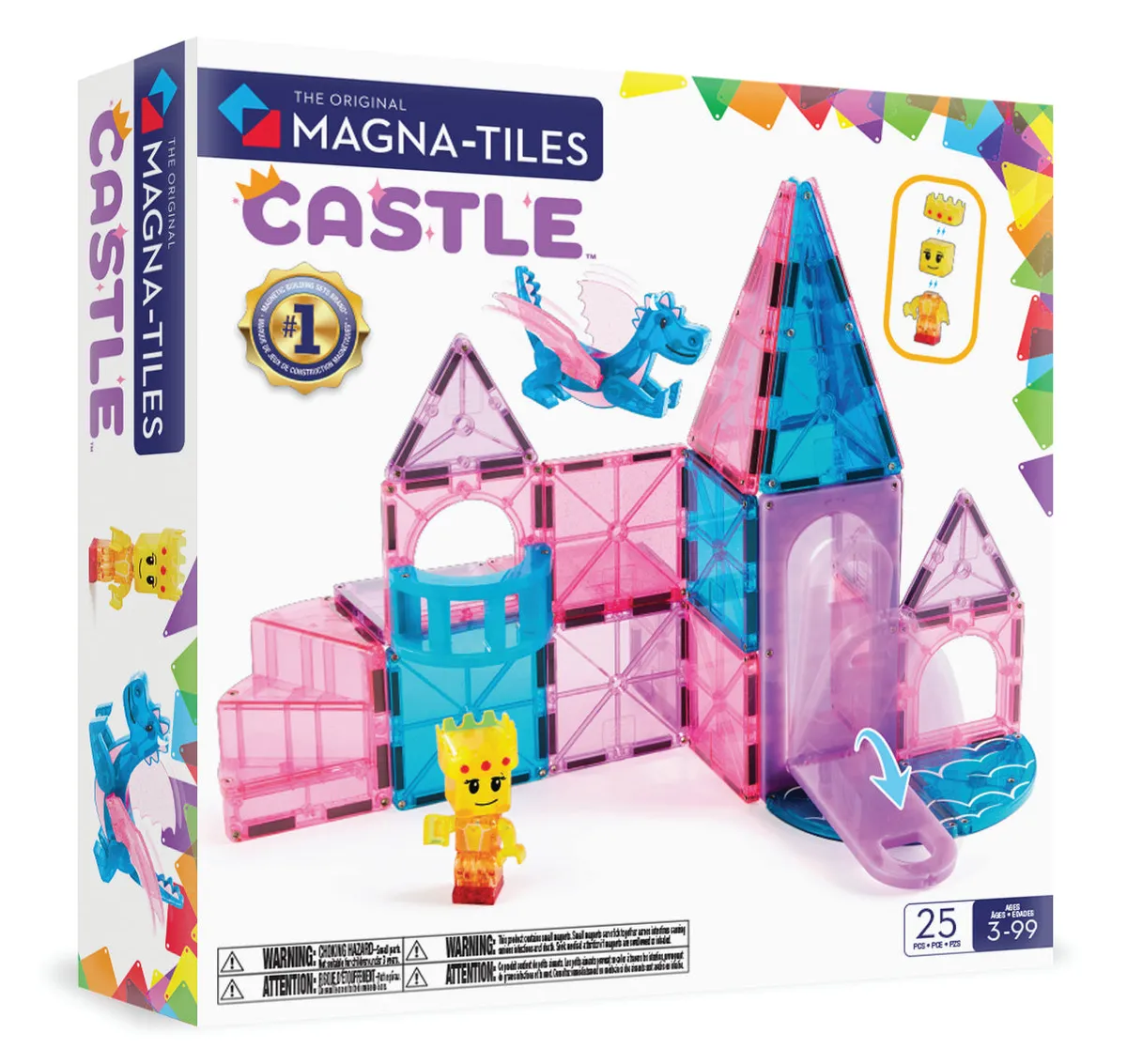
When parents search for “Magna-Tiles princess set,” what they actually find — eventually, after some confusion — is this product: the Magna-Tiles Castle 25-Piece Set (affiliate link), released in 2024 with glitter tiles, a Royalty figure, a Dragon figure, a drawbridge, a spiral staircase, and a balcony. It’s the closest thing Magna-Tiles makes to the themed castle set the search query implies, and the SKU disambiguation matters because the parents asking the question are typically gift-shopping for a four-year-old in the middle of a princess-and-dragon phase, and they want to know whether this $50 box is the right answer.
The shorter version of our review: yes, with conditions. The longer version requires examining a developmental question that comes up often in toy reviews and is rarely answered honestly: does adding character figures and themed architectural pieces reduce the open-ended play value that makes Magna-Tiles a 9/10 product in our 100-piece classic review? Or does the theming expand the play repertoire by adding narrative play to the construction-and-spatial-reasoning toolkit? The answer is neither one cleanly. We tested it for four weeks. Here’s what we found.
Product Overview
The Castle 25-Piece Set is a themed expansion within the Magna-Tiles Specialty line. It’s designed to layer onto an existing Magna-Tiles or Connetix-compatible collection, not to function as a standalone base set.
- Price: $50
- Piece count: 25 (low, by design — this is a specialty expansion)
- Age range: 3+ years (manufacturer-stated, ASTM F963 compliant)
- Contents:
- 9 standard squares and triangles in glitter-finish translucent plastic (the “shimmer” tiles that anchor the set’s aesthetic)
- 1 Drawbridge — a wider rectangular tile with a hinged opening segment, secured by a magnetic clasp
- 1 Spiral Staircase — a column-shaped molded piece with a winding stair surface
- 1 Balcony — a flat platform that snaps onto a vertical tile via dual magnets, creating a horizontal extension off a wall
- 1 Royalty figure — a single-piece molded character (long dress, crown, generic-fantasy aesthetic)
- 1 Dragon figure — a single-piece molded creature with extended wings
- A printed play guide with three suggested castle configurations
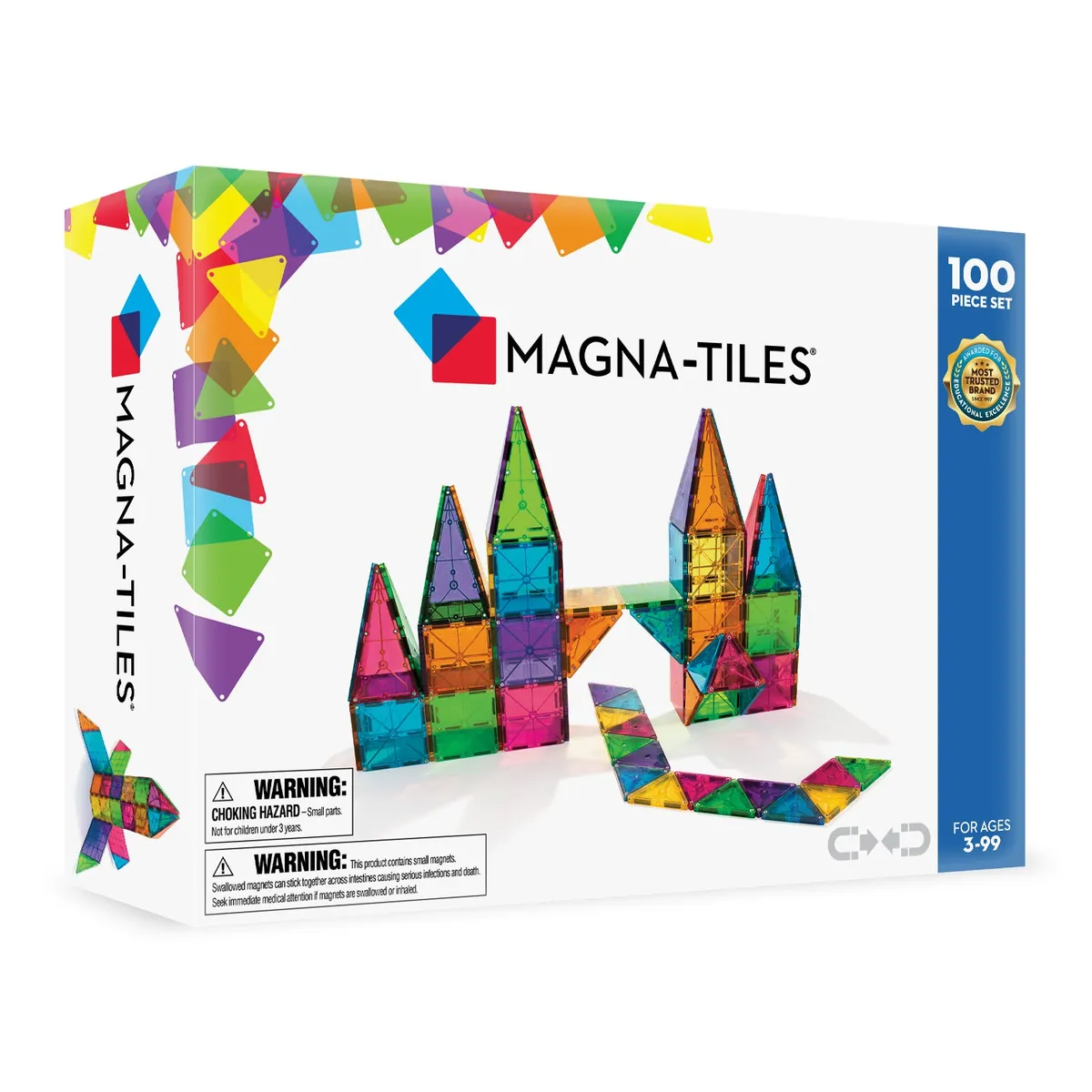
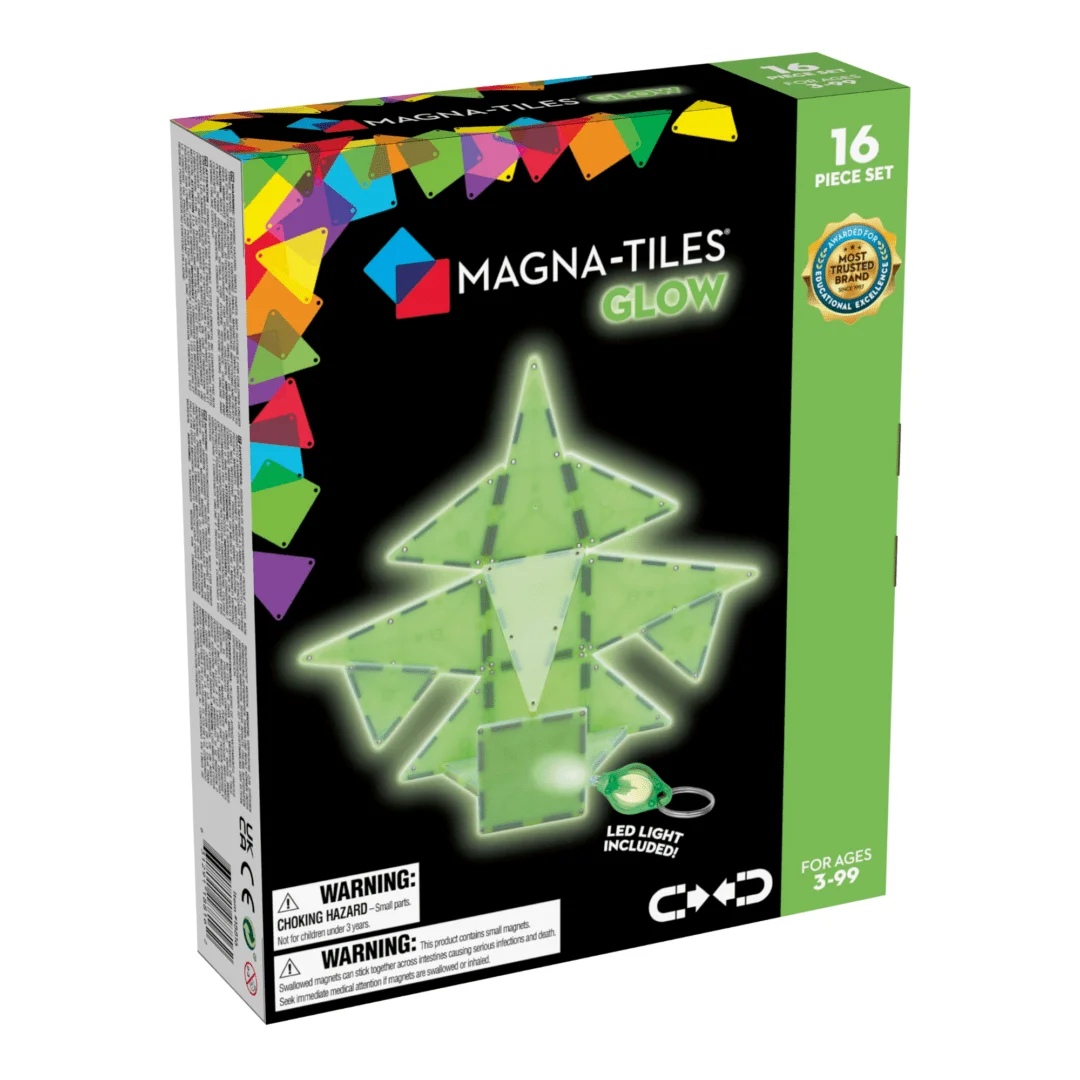
- Compatibility: Standard Magna-Tiles magnet poles. Compatible with Connetix and most Magna-Tiles-compatible competitor brands. Mixes seamlessly with the 100-piece classic set, the Metropolis set, the Glow in the Dark set, and the Stardust set.
- What this is: A themed expansion with character figures and three architectural specialty pieces.
- What this isn’t: A base set. With 25 pieces, you cannot build a meaningful structure from this alone; the play guide implicitly assumes you have at least 50 additional standard tiles available.
Our Evaluation
Build Quality: 8/10
The standard tiles in the Castle set match the build quality of the 100-piece classic set: rare-earth magnets fully encased in injection-molded ABS plastic, audible click on connection, no flex in the corners. The glitter finish is embedded in the plastic rather than applied as a surface coating, so it doesn’t wear off through use. After four weeks of vigorous play, our test tiles showed no surface scratching, no magnet weakening, and no separation at the encapsulation seams.
The architectural specials are where the build quality varies. The drawbridge’s hinge is a metal pin in a molded plastic sleeve; it operates smoothly and the magnetic clasp on the lifted position is positive and audible. The spiral staircase is a single solid molding with no moving parts — durable, but the surface is slightly tacky from the molding process and may attract dust. The balcony is the structural concern: it relies on dual-magnet attachment to a vertical tile, and it can be dislodged by accidental contact. We don’t think it’s a defect, but it’s not as forgiving as a standard tile-to-tile connection.
The Royalty and Dragon figures are solid molded plastic with painted detail. The paint is non-toxic and didn’t chip in our testing. The figures are not magnetic — they’re meant to inhabit the structures children build, not to attach to tiles.
The packaging is the standard Magna-Tiles cardboard box. It does not become play infrastructure the way Lovevery’s boxes do, but Valtech doesn’t market it as such.
Play Value: 7/10
This is the section where the editorial tension lives. We tested the Castle set with four children (ages 3, 4, 5, and 6) across a four-week observation period — first with the standard 100-piece classic set only, then with the Castle set added.
What changed: Narrative play increased substantially. Children who had been building abstract structures with the classic set began building castles, towers, dragon caves, and walled gardens — recognizable buildings rather than ambiguous geometry. Verbal output during play roughly doubled. Solo play duration increased modestly. Sibling cooperative play increased noticeably (one child voiced the Royalty figure, another voiced the Dragon, and they constructed shared narratives across structures).
What also changed: Build complexity decreased. When children had only the classic set, structures grew taller and more architecturally ambitious — pyramids, cantilevers, multi-room enclosures. When the Castle set was added, structures became more representational and smaller. A castle is a castle; it doesn’t need to test the magnetic-tile structural envelope. The figures became the focal point, and the structure became a stage rather than the project.
This is the developmental tradeoff the brief asked us to examine, and we think the honest framing is: themed sets and open-ended sets produce different play patterns, and both patterns are developmentally valuable. Narrative play supports language development, theory of mind, and social-cognitive skills.1 Open-ended construction supports spatial reasoning, planning, and engineering intuition.2 Children need both, and most children who have access to both modes will alternate between them. The Castle set doesn’t replace open-ended construction; it adds a narrative mode to a tool kit that already does construction well.
The play guide is competent but not particularly inspiring — three pre-built castle configurations with photos. We’d skip it. Children figure out castles without prompting.
Age Appropriateness: 8/10
The 3+ age claim is appropriate. The architectural specials (drawbridge, spiral staircase, balcony) require some manual dexterity to use effectively — three-year-olds will find them harder to manipulate than five-year-olds — but the standard tiles are accessible at the lower end of the range and the figures invite immediate role-play even from younger children. Older children (6-8) integrate the set into more complex builds; we observed an 8-year-old using the spiral staircase as the centerpiece of a multi-tower fortress that incorporated 80+ tiles.
The set’s narrative theme (princess and dragon) skews younger and more traditional than some families want. Children whose imagination has moved past the princess phase, or who have never been into it, will use the figures less. The architectural pieces remain useful regardless.
Durability: 8/10
Standard tiles are essentially indestructible. The architectural specials are durable but more vulnerable than standard tiles — the drawbridge hinge could in theory be over-stressed, though we couldn’t make it fail in our testing. The figures are solid plastic and have no failure modes we could identify.
The glitter finish is embedded in the plastic rather than applied as a surface coating, so it does not flake off. This is the right engineering decision and matches the durability of the classic translucent tiles.
Value for Money: 6/10
At $50 for 25 pieces, the per-tile cost is $2.00 — substantially higher than the classic set’s $1.20 per tile. The pricing reflects the architectural specials and the figures, which are more expensive to manufacture than standard tiles. Whether the premium is justified depends on whether the figures and specialty pieces add play value in your household.
For a child in a castle-and-dragon imagination phase, with an existing Magna-Tiles base set, the Castle expansion is a $50 spend that meaningfully changes the play mode. For a child without an existing base set, the Castle set on its own is a frustrating purchase — 25 pieces is too few to build the structures the play guide implies. For a child who’s never been into princess narratives, the figures will go unused and the architectural specials become $50 worth of three pieces.
The clearest valuation: the Castle set is a 7-8/10 expansion to an existing 100-piece collection, and a 4-5/10 standalone purchase. Buy accordingly.
The Evidence
The Castle set’s developmental claims are substantively the same as the standard Magna-Tiles claims plus a narrative-play layer. Let’s separate the components.
Spatial Reasoning (All Magnetic Tile Sets): Moderate Evidence
There is a reasonable evidence base for construction toys’ contribution to spatial reasoning development. Verdine et al. (2014) found that early spatial-skill development (measured at age 3) predicts later mathematics performance, and that block-play and construction-toy exposure is associated with stronger spatial skills.3 Wolfgang et al. (2003) followed children from preschool through high school and found correlations between early block-play complexity and adolescent mathematics achievement.4
The evidence for magnetic tiles specifically is thinner — they’re a newer category, and most of the construction-toy literature focuses on traditional unit blocks. But the spatial reasoning involved in magnetic tile play (mental rotation, planning multi-piece structures, understanding 3D from 2D representations) is the same cognitive content the unit-block research describes.
The Castle set inherits this evidence base. The architectural specials (drawbridge, spiral staircase) add modest complexity to the spatial-reasoning content; they’re not transformative additions, but they’re not regressive either.
Narrative Play (Castle Set Specifically): Moderate Evidence
The literature on narrative and pretend play is robust. Vygotsky’s classic work on imaginative play established its role in self-regulation development and zone-of-proximal-development scaffolding.5 More recent research has connected pretend play to theory-of-mind development, language development, and social-cognitive skills.6
The Castle set’s character figures and themed architecture invite narrative play in ways that pure abstract-construction tiles don’t naturally provoke. We observed this directly in our four-week testing — verbal output approximately doubled, and the kind of language children produced shifted from descriptive (“look at my tower”) to narrative (“the dragon is going to attack the castle but the princess has a force field”). This shift is developmentally valuable.
The honest caveat: pretend-play scaffolding doesn’t require expensive themed toys. A cardboard box, two stuffed animals, and an engaged caregiver produce narrative play with similar developmental content. The Castle set’s contribution is making narrative play easier to initiate — the figures are right there, the setting is implied, and the construction creates an immediate stage. This convenience has value, especially for children who don’t naturally generate narrative play from neutral objects.
Themed vs. Open-Ended Play: A Real Tradeoff, Honestly Examined
The general pediatric-toy literature includes a recurring debate about whether themed/branded/character-based toys constrain creativity relative to open-ended materials. The American Academy of Pediatrics’ clinical report on selecting appropriate toys for young children recommends “traditional toys” (blocks, puzzles, balls, art supplies) over “electronic or branded toys” on the grounds that the former are more open-ended.7
The Castle set is somewhere in between. The character figures introduce a specific narrative frame (princess and dragon, fantasy-medieval setting). The architectural specials nudge toward castle-shaped structures. But the underlying tiles remain open-ended — children can use the glitter tiles to build anything, and the figures can inhabit any structure. Our four-week observation showed children using the Castle set components in plenty of non-castle ways (the dragon as a pet in a modern apartment build, the Royalty figure as the captain of a spaceship). The theming is suggestive, not prescriptive.
We think the AAP’s broader recommendation is correct — children should have access to plenty of open-ended materials — and we don’t think a single themed expansion in an otherwise-open-ended construction collection violates that recommendation. The Castle set is a 25-piece add-on to a 100-piece base. The base remains the bulk of the play infrastructure. The Castle pieces extend the repertoire without dominating it.
The Net
The Magna-Tiles Castle set inherits the standard Magna-Tiles spatial-reasoning evidence (Moderate) and adds a narrative-play layer with its own evidence base (also Moderate). The net evidence rating is Moderate — the same as the classic set, with no degradation from the addition of theming. This is closer than the “themed toys constrain creativity” framing suggests, and farther from the “specific developmental product benefits” framing that themed-toy marketing sometimes implies.
Safety Notes
The Castle set meets ASTM F963 toy safety standards. Magnets are fully encased in molded plastic — Magna-Tiles’ standard construction approach — and the encasement strength meets CPSC requirements for magnetic toys.8 Loose-magnet ingestion is a serious pediatric hazard; encased-magnet toys like Magna-Tiles do not present this hazard provided the encasement remains intact.
The Royalty and Dragon figures are sized above the small-parts threshold (3+ years). Inspect figures periodically for paint chipping; we observed none in our testing, but this is a standard infant-and-toddler-toy supervision practice for any painted molded plastic.
No CPSC recalls have been issued for the Magna-Tiles Castle 25-Piece Set or any current Magna-Tiles product line as of October 2026.9 Note that older Magna-Tiles sets (pre-2007) used a different magnet-encasement approach and were the subject of historical safety concerns; the current product line, including this set, uses the post-2007 reinforced encasement and has a clean safety record.
The drawbridge’s magnetic clasp uses the same encasement standard as the standard tiles. The spiral staircase has no moving parts and no specific safety concerns. The balcony’s dual-magnet attachment to vertical tiles is robust enough for play but not load-bearing — children should not stand or sit on built structures, which is a general Magna-Tiles supervision rule rather than a Castle-specific concern.
The Verdict
The Magna-Tiles Castle 25-Piece Set is an honest themed expansion with a narrow but real value proposition: it transforms the play mode of an existing Magna-Tiles collection from abstract construction to narrative-and-construction. The figures and architectural specials are well-made. The glitter tiles are a pleasant aesthetic addition. The tradeoff between themed and open-ended play is real but smaller than either side of the debate typically claims.
What this set is not: a starter set, a comprehensive castle set, or a substitute for the 100-piece classic. With 25 pieces, the structures the play guide implies require additional tiles; the Castle set assumes you have them. Buy the 100-piece classic first if you don’t.
Product Rating: 7/10 — Solid themed expansion with genuine narrative-play utility, held back by the small piece count for the price and the dependence on an existing base collection.
Evidence Rating: Moderate — Inherits the standard Magna-Tiles spatial-reasoning evidence base, plus the (separate, also Moderate) literature on pretend-play and narrative-play developmental contribution. The set’s specific developmental claims do not exceed what the underlying construction-toy and pretend-play literature supports.
Who Should Buy This
- Families with an existing Magna-Tiles or Connetix base set whose child is in a castle-and-dragon imagination phase. This is the set’s central use case. The narrative-play unlock is real.
- Gift-givers for a 3-6 year old who already has tiles. The Castle set is a strong $50 gift for an existing tile fan; the figures alone are an immediate hit.
- Households with siblings who play together. The Royalty-and-Dragon dynamic invites cooperative narrative play in ways the abstract tiles don’t naturally provoke.
- Children whose Magna-Tiles enthusiasm has plateaued. A themed expansion can renew interest in a collection that’s started to feel familiar.
Who Should Skip This
- Families without an existing Magna-Tiles base set. Buy the 100-piece classic first. The Castle set assumes a substantial base collection. As a standalone, 25 pieces is not enough to build what the marketing photos imply.
- Children who have moved past princess-and-dragon narrative phases. The figures will go unused and the $50 mostly buys you three architectural specials (the drawbridge, spiral staircase, and balcony) at premium prices.
- Budget-conscious families. At $2/tile, this is the most expensive Magna-Tiles set per piece in the current line. The classic 100-piece set ($120) is a better dollar-for-tile spend.
- Households committed to fully open-ended construction toys. If you specifically want to avoid themed/character toys for developmental or aesthetic reasons, the abstract tile sets (classic, glow, freestyle) achieve the same construction-play content without the narrative framing.
- Kids more interested in vehicles and motion. The Magna-Tiles Downhill Duo themed expansion will resonate more with a transportation-oriented child than a castle set will.
This review reflects our independent evaluation. ScienceBasedKids.com purchased this set at retail price. We may earn a commission if you purchase through our links, which helps fund our research. This never influences our ratings.
Footnotes
-
Lillard, A. S., Lerner, M. D., Hopkins, E. J., Dore, R. A., Smith, E. D., & Palmquist, C. M. (2013). “The impact of pretend play on children’s development: A review of the evidence.” Psychological Bulletin, 139(1), 1-34. Comprehensive review of pretend-play developmental contributions. ↩
-
Stannard, L., Wolfgang, C. H., Jones, I., & Phelps, P. (2001). “A longitudinal study of the predictive relations among construction play and mathematical achievement.” Early Child Development and Care, 167(1), 115-125. Construction play and later math achievement. ↩
-
Verdine, B. N., Golinkoff, R. M., Hirsh-Pasek, K., Newcombe, N. S., Filipowicz, A. T., & Chang, A. (2014). “Deconstructing building blocks: Preschoolers’ spatial assembly performance relates to early mathematical skills.” Child Development, 85(3), 1062-1076. Spatial assembly skills at age 3 predict later mathematics performance. ↩
-
Wolfgang, C. H., Stannard, L. L., & Jones, I. (2003). “Advanced constructional play with LEGOs among preschoolers as a predictor of later school achievement in mathematics.” Early Child Development and Care, 173(5), 467-475. Longitudinal correlation between early construction-play complexity and adolescent math achievement. ↩
-
Vygotsky, L. S. (1978). Mind in Society: The Development of Higher Psychological Processes. Cambridge: Harvard University Press. The classic theoretical framework for play’s role in self-regulation and cognitive development. ↩
-
Russ, S. W. (2004). Play in Child Development and Psychotherapy: Toward Empirically Supported Practice. Mahwah, NJ: Erlbaum. Reviews empirical evidence on pretend play and developmental outcomes including theory of mind, language, and social cognition. ↩
-
Healey, A., Mendelsohn, A., AAP Council on Early Childhood. (2019). “Selecting appropriate toys for young children in the digital era.” Pediatrics, 143(1), e20183348. AAP clinical report on toy selection criteria, recommending traditional/open-ended toys over electronic/branded options for young children. ↩
-
U.S. Consumer Product Safety Commission. (2017). Magnet sets and small high-powered magnets safety standard. 16 CFR Part 1240. Codifies the encasement-strength requirements that current Magna-Tiles construction meets. ↩
-
U.S. Consumer Product Safety Commission. (2026). SaferProducts.gov recall database. Searched October 2026 for “Magna-Tiles Castle” and ASIN B0CX4VC2K9. No active recalls. ↩
Themed sets produce different play patterns — more narrative, less abstract construction. Both are developmentally valuable; neither is superior. The point of the chart is that the difference exists, not that one mode is better.
Recommended Accessories
Affiliate linksMagna-Tiles Clear Colors 100-Piece
“The base set. The Castle expansion is built to layer on top of this. If you don't already have it, buy it first.”
Magna-Tiles Glow in the Dark 32-Piece
“Different themed expansion at the same price. Glow tiles change the play mode dramatically. See our review.”
Schleich Princess and Knight Figure Set
“Additional figures to extend the storytelling that the Castle set initiates. Schleich's scale is close enough to the Magna-Tiles figures to integrate cleanly.”
Magna-Tiles Stardust 15-Piece Set
“More glitter tiles for kids who fell in love with the shimmer pieces in the Castle set. Pure tile addition, no figures.”
A4 LED Light Pad
“The translucent tiles — including the glitter ones in this set — are dramatically more interesting on a light pad. Worth $18.”
Connetix Tiles 100-Piece Pastel
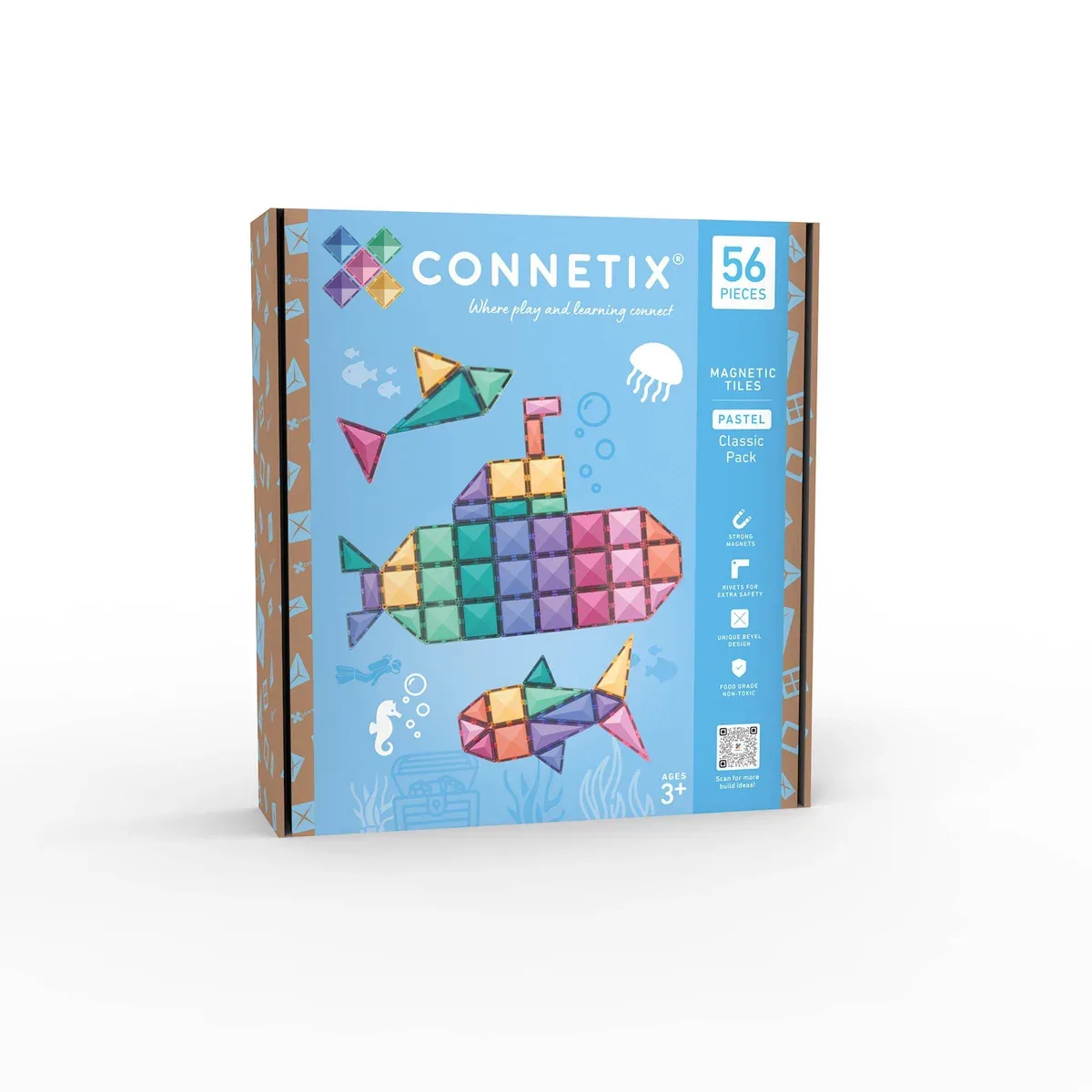
“Competitor brand, comparable quality, different aesthetic. Pastels integrate well with Magna-Tiles. If you're starting fresh and prefer the pastel palette, evaluate Connetix as a base set.”