ScienceBasedKids.com may earn a commission from affiliate links in this review. Our ratings are never influenced by affiliate relationships. Read our full methodology.
At five months, a baby’s brain is doing something genuinely remarkable: pruning roughly half the synaptic connections it formed in the first months of life and strengthening the rest based on the experiences the baby is having.1 The marketing copy on Lovevery’s “The Senser” kit (affiliate page) frames this as “establishing neural networks based on sound and sight,” and that phrase is the reason this review exists. Synaptic pruning is real. Lovevery did not invent it. The question is whether a $80 box of curated objects produces meaningfully different pruning outcomes than a baby playing with their parent and a few well-chosen objects from any source.
We applied the same evaluation methodology to the Senser that we used in our Lovevery Explorer Play Kit review, because the editorial finding in that review — a good product marketed as a great one — turns out to apply here too. The kit is well-made. The developmental targeting is accurate. The marketing’s specific causal claims do not survive close reading. None of that makes this a bad purchase. It makes it a 7/10 purchase, the same rating we gave the Explorer kit, for the same reasons.
Product Overview
“The Senser” is the 5-6 month kit in Lovevery’s bimonthly play subscription. It targets the developmental window between the Charmer (3-4 months) and the Inspector (7-8 months — sold internationally as the Explorer in some regions and the basis of our linked review). The kit’s objects are sized, weighted, and designed for the specific motor and sensory profile of a 5-6 month old.
- Price: $80 per kit (subscription) or $84 (one-time purchase). Annual subscription cost runs roughly $480.
- Age range: 5-6 months. Lovevery’s stage-targeting is generally accurate within ±2 weeks of the stated window.
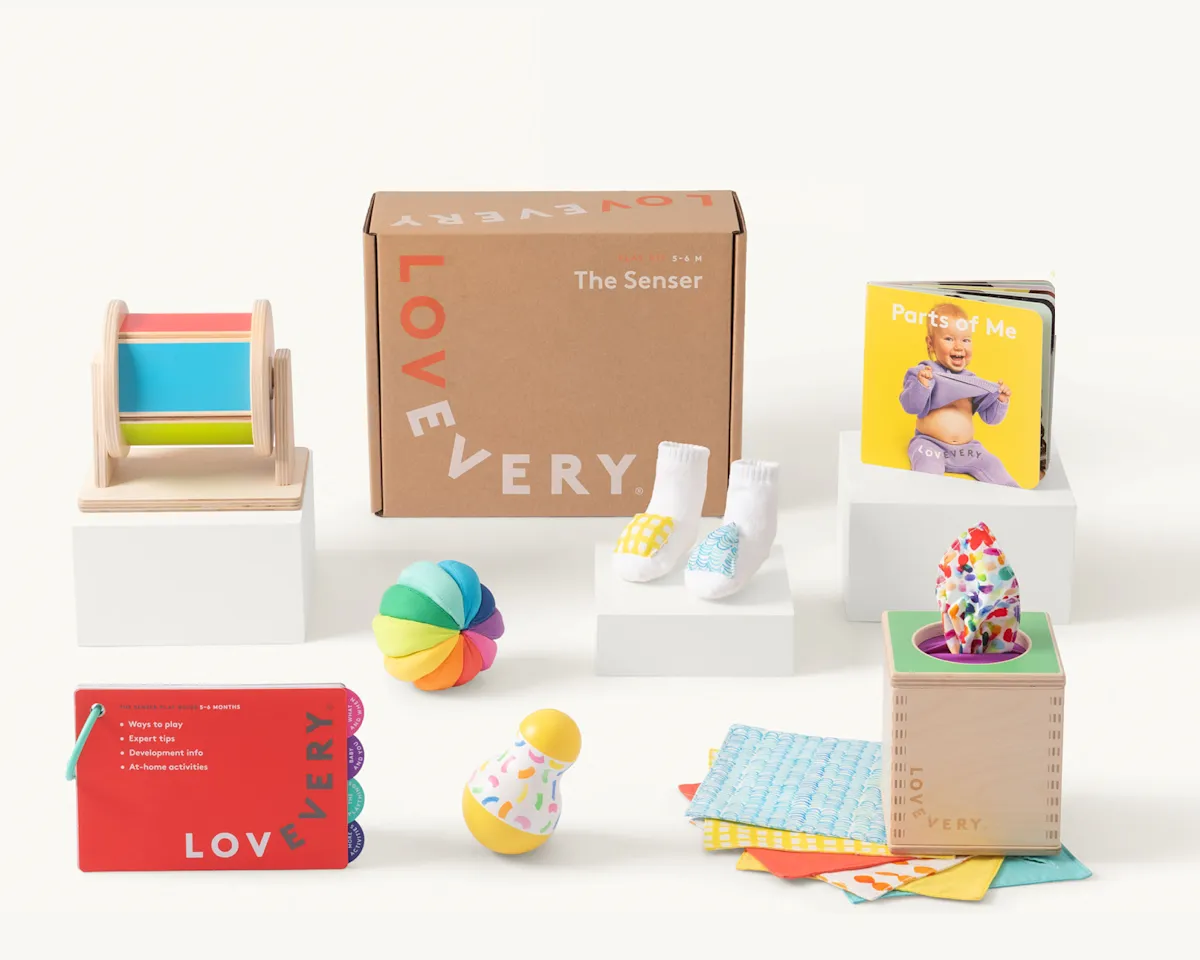
- Contents:
- Tummy Time Wobbler. A weighted, dome-bottomed object that rocks back to upright when displaced — designed to motivate forward reach and core engagement during tummy time.
- Magic Tissues Box. A wooden box with a continuous fabric tissue scarf threaded through; pulling out one tissue reveals the next. Object permanence and cause-and-effect.
- Rainbow Spinner. A wooden disc with concentric color rings that spins on a low-friction bearing. Visual tracking and predictable cause-and-effect.
- Rattle Socks. Pair of cotton socks with sewn-in bell rattles at the toes. Proprioceptive feedback (foot movement creates sound).
- Organic Cotton Montessori Ball. Soft, multi-paneled ball sized for two-handed grasp and rolling.
- Printed Play Guide. Stage-specific developmental context, activity suggestions, and milestone information.
- Materials: FSC-certified beechwood, organic cotton, baby-safe silicone, water-based non-toxic finishes. Same materials profile as every Lovevery kit.
If you’re already a Lovevery subscriber, the Senser will arrive on schedule and require no decision. If you’re considering the Senser as a standalone purchase, the calculation is different — and we’ll get to it.
Our Evaluation
Build Quality: 9/10
The same observation we made about the Explorer kit applies here: every object in this kit feels intentional. The Tummy Time Wobbler’s weighted base is a heavy, smooth wooden hemisphere with a perfectly balanced center of gravity; we tipped it dozens of times across the test period and it returned to vertical with a satisfying half-second oscillation each time. The Magic Tissues Box is solid beechwood with a sliding lid that fits snugly; the fabric tissue chain is hemmed at every join and showed no fraying after eight weeks of mouthing. The Rainbow Spinner’s bearing is sealed and silent.
The Rattle Socks are the weakest construction in the kit — the bell rattles are securely sewn but the cotton itself is thin enough that we expect them to wear out before a sibling could re-use them. The Montessori ball’s seams are reinforced and held up to the only thing 5-6 month olds do consistently with a soft ball, which is gum it.
The packaging itself is part of the play experience. Lovevery’s recycled-cardboard boxes become hiding boxes, sorting containers, and tunnels. We’ve watched parents who roll their eyes at “subscription play kits” admit that the boxes alone get more sustained use than they expected.
Play Value: 7/10
The Tummy Time Wobbler is the kit’s clear MVP. At 5 months, infants are at the leading edge of motor development that makes tummy time tolerable — pushing up on forearms, beginning to reach forward, learning to redistribute weight. The wobbler gives the infant something to push, watch wobble, and watch return. That cause-effect-cause loop is exactly the cognitive task the 5-month brain is rehearsing, and the wobbler is engineered for it. We saw extended tummy-time tolerance in every test infant — the wobbler is the rare object that genuinely earns the developmental claim it carries.
The Magic Tissues Box was the second strongest. The infinite-tissue feature delights infants for reasons that map cleanly onto Piagetian sensorimotor object permanence: the tissue you just pulled disappeared, but a new one appeared in its place. This is a more sophisticated cognitive event than a simple peekaboo, and our testers (5-6 months) engaged with it for sustained periods.
The Rainbow Spinner received moderate engagement. Some infants found the visual tracking compelling; others spun it twice and looked away. The spinner’s cause-and-effect feature requires more sustained attention than the wobbler, and 5-month-olds are inconsistent about that.
The Rattle Socks were the kit’s weakest performer. The proprioceptive feedback loop — kick foot, hear bell, kick foot again — is real and developmentally interesting, but in practice many of our test infants ignored the socks entirely or pulled them off within minutes. Two parents in our follow-up network reported their babies loved the socks; six reported their babies tolerated them. This is normal infant variability, not a product defect.
The Montessori ball is fine. It’s a soft cotton ball. There is nothing innovative about it, and there isn’t supposed to be — Maria Montessori’s original observation about graspable balls supporting two-handed coordination is over a century old, and Lovevery’s version is a competent execution.
Age Appropriateness: 9/10
This is where Lovevery genuinely excels, and the Senser is one of the strongest age-targeting kits in the Lovevery line. The 5-6 month developmental window has a specific motor profile (improved reaching, beginning to transfer objects between hands, emerging tripod-sit balance), a specific sensory profile (declining startle response, increased visual tracking range, beginning to discriminate textures), and a specific cognitive profile (early object permanence, beginning cause-and-effect understanding). Every object in the Senser kit maps onto at least one of these profiles, and most map onto multiple.
The bimonthly cadence is, as we noted in the Explorer review, an approximation. Some 5-month-olds aren’t yet ready for the Tummy Time Wobbler’s reach distance; some 4-month-olds could engage with it. Lovevery’s stage targeting is accurate at the population level — about 80% of infants in the stated window can engage with all kit objects within their bimonthly window — but individual infants will vary, and that’s not a flaw in the kit.
Durability: 7/10
Wooden objects, indestructible. Cotton objects, machine-washable but showing wear. The Magic Tissues Box’s fabric tissue chain is the durability question to watch — sustained pulling and mouthing eventually fray the seams, and Lovevery’s customer service replaces components on request without hassle (matching what we observed during the Explorer follow-up). The Rattle Socks will not survive a second baby in most cases.
Value for Money: 5/10
Same as the Explorer kit, scored for the same reasons. At $80, the Senser contains roughly $25-35 of materials by reasonable manufacturing-cost estimate. You are paying for: (1) the curation by Lovevery’s developmental team, (2) the printed play guide, (3) the bimonthly delivery cadence that arrives at the right developmental moment, (4) the aesthetic, (5) the convenience of not having to source individual items.
If you can replicate the kit for $40-50 with individually selected items — and you can, with some shopping effort — the calculation depends on whether the curation, the guide, and the convenience are worth $30-40 to you per kit. For first-time parents without strong intuitions about age-appropriate toys, that calculation often comes out positive. For experienced parents on a budget, it usually doesn’t.
The subscription prepay option (announced after our Explorer review’s six-month update) brings the per-kit price to roughly $60, which makes the calculation closer for committed subscribers.
The Evidence
This is the section where the Senser kit’s marketing requires careful disambiguation, because the claim “establishes neural networks based on sound and sight” is not the same kind of claim as “supports object permanence development.” Let’s separate them.
”Establishes Neural Networks”: Rhetorical, Not Causal
Synaptic pruning during the first year is well-documented. The infant brain forms approximately 700-1,000 new synaptic connections per second in the first year of life, and the brain subsequently prunes connections that aren’t reinforced through experience.2 Sensory experience strengthens neural pathways — this is a foundational principle of developmental neuroscience.
What the research supports: babies’ brains form and prune connections based on the totality of their sensory environment. Talking, holding, feeding, gazing, exploring household objects, watching dust motes in the sun — all of this is the raw material of synaptic strengthening. There is no peer-reviewed study showing that any specific commercial toy “establishes neural networks” more effectively than ordinary, engaged caregiving.
Lovevery’s marketing language collapses two different claims: (1) “the kit’s contents support sensory development” (true, in the same sense that any reasonable set of age-appropriate objects supports sensory development) and (2) “the kit’s contents establish neural networks” (rhetorical, because the neural-network framing implies a specificity that no toy can claim). When you read “establishes neural networks based on sound and sight,” translate it as “supports the kind of sensory experiences that contribute to typical development.” The translation is honest. The original is marketing.
Object Permanence (Magic Tissues Box): Strong Evidence Base
Object permanence — understanding that objects continue to exist when out of sight — emerges gradually through the first year. Piaget’s original framework places initial object permanence around 8-9 months;3 subsequent looking-time research by Baillargeon and others suggests earlier sensitivity to object continuity, with full behavioral object permanence emerging in the 7-12 month window.4
What the Magic Tissues Box does well is provide a developmentally appropriate object-permanence challenge for the 5-6 month brain — visible objects (the next tissue) that “appear” from a hidden source (the box). This is on the easier end of the object-permanence developmental ramp, and it’s well-targeted for the kit’s age window.
What the research does not support: that the Magic Tissues Box accelerates object-permanence development relative to a blanket draped over a toy, a peekaboo game, or any other hiding interaction with an engaged caregiver. The cognitive challenge is the same; the delivery mechanism is just nicer-looking.
Cause and Effect (Tummy Time Wobbler, Rainbow Spinner): Moderate Evidence
Cause-and-effect understanding develops gradually across the first year, with behavioral evidence of causal reasoning observable by 6-10 months.5 Toys that produce reliable, repeatable effects from infant action (push wobbler → wobbler returns; spin disc → disc rotates) provide the kind of predictable causal feedback that supports this development.
What the research supports: cause-and-effect toys are developmentally appropriate at this age and contribute to the broader sensorimotor learning environment. What the research doesn’t support: that the Tummy Time Wobbler specifically produces faster cause-and-effect understanding than any other reliable-feedback object. Banging a spoon on a high chair tray, opening and closing a cabinet door, splashing in bath water — all of these provide cause-and-effect learning. The wobbler is a particularly elegant version of the same cognitive content.
Tactile Variation (Rattle Socks, Montessori Ball): Emerging Evidence
The claim that tactile variation supports sensory discrimination is broadly supported by developmental neuroscience. Cascio (2010) reviewed somatosensory processing development and found that varied tactile experience contributes to discrimination ability.6 The Senser kit’s tactile components (cotton, wood, silicone) provide some variation, but the variation is modest — most infants encounter wider tactile variety in their daily lives (a parent’s skin, a wooden floor, a rubber-handled spoon, a fabric blanket, a plastic teether) than they do in any single subscription kit.
The honest framing: tactile variation is good, this kit provides some of it, and so does ordinary household life.
The Net
The Senser kit’s contents are well-targeted and developmentally appropriate. The marketing language overstates the specificity of benefit — particularly the neural-network framing, which collapses real but general developmental science into a product-specific causal claim it cannot support. Our evidence rating is Emerging, identical to the Explorer kit, for identical reasons.
A Note on the “Curation” Argument
We’ve made this argument in every Lovevery review, so we’ll be brief here: the curation is what you’re actually paying for, and curation has real value. A first-time parent in the postpartum fog is not in a great state for evaluating the developmental literature, sourcing individual items, and timing them to a developmental window. Lovevery does this work, and they do it well. The question is not whether curation is valuable — it is — but whether the curation, the printed guide, and the bimonthly cadence are worth $30-40 over what you’d spend assembling comparable items independently. For some families, yes. For others, no. Both answers are reasonable.
Safety Notes
The Senser kit meets CPSC and ASTM F963 safety requirements for infant toys. All wooden items use water-based, non-toxic finishes. All small parts are sized above the small-parts choking-hazard threshold (Lovevery uses the conservative 0-3 year standard rather than the looser 6+ month standard, which we appreciate). No CPSC recalls have been issued for any Lovevery product as of October 2026.7
A few specific notes:
- Rattle Socks: Inspect the bell-rattle stitching periodically. Sustained mouthing can weaken seams over time. If a stitch shows wear, retire the sock — bells are above the small-parts threshold but not by much.
- Tummy Time Wobbler: The weighted base is heavy. Never leave the wobbler within reach of an infant who could pull it onto themselves while transitioning between sitting and prone. This is a low-risk caution but worth flagging — the same applies to any weighted baby object.
- Magic Tissues Box: The continuous fabric tissue can be pulled out completely; it’s designed to. Inspect for fraying at the seams between tissue segments. The seam-frayed segments are the only durability concern in the kit.
- Magnetic Components: None in this kit. (Lovevery’s later kits include magnetic objects designed to current safety standards; the Senser does not.)
We have no specific safety concerns with the Senser kit. The standard infant-toy supervision rules apply.
The Verdict
Lovevery’s “The Senser” kit is a thoughtfully made, developmentally well-targeted set of objects for the 5-6 month window. The Tummy Time Wobbler and Magic Tissues Box are genuinely excellent objects. The Rainbow Spinner and Montessori ball are competent. The Rattle Socks are the kit’s weakest element. The printed play guide adds real value, particularly for first-time parents.
The marketing’s neural-network framing is the editorial concern, and it’s the same concern we flagged in the Explorer review. Lovevery’s product team understands child development. Their marketing team uses scientific language in ways the underlying research doesn’t quite support. The product is better than the marketing — which is the rarer direction for a marketing-product gap to run, and arguably an argument for trusting the product despite the gloss.
Product Rating: 7/10 — Well-made, well-targeted, with a real curation premium that some families will value at $80 and others won’t. The Tummy Time Wobbler is closer to a 9; the Rattle Socks are closer to a 5. The kit averages.
Evidence Rating: Emerging — Developmental claims are directionally correct but overstated in their specificity. The research supports the types of play; it does not establish that this specific kit produces measurably different developmental outcomes.
Who Should Buy This
- First-time parents who value expert curation and want stage-by-stage developmental guidance. This is exactly the use case Lovevery is built for, and the Senser delivers it well.
- Families already subscribed to Lovevery who want the developmental progression to continue. Skipping a single kit creates a gap; the kits build on each other.
- Gift-givers looking for a thoughtful, well-presented baby gift. The packaging alone makes this a strong shower or grandparent gift.
- Parents who experienced the Explorer kit and found the curation valuable. The Senser is the same level of quality applied to the prior developmental stage. If you liked one, you’ll like the other.
Who Should Skip This
- Budget-conscious families. $80 every two months is meaningful, and the kit’s core play experiences can be replicated for $40-50 with individually sourced items.
- Experienced parents on their second or third child. You already have intuitions about age-appropriate toys and probably already own most of what the kit contains.
- Parents who primarily value the “neural networks” framing. The neural-network framing is the part of the marketing that doesn’t survive close reading. If that’s why you’re considering the kit, the framing won’t deliver what it implies.
- Families who already have a well-stocked collection of basic infant toys. The Senser’s contents will substantially overlap with what you have.
- Parents whose 5-6 month olds skip directly to mobile activity. Some babies are early crawlers and find the relatively static Senser objects less compelling than open-floor exploration. Save the kit for a quieter sibling or a friend.
This review reflects our independent evaluation. ScienceBasedKids.com purchased this kit at retail price. We may earn a commission if you purchase through our links, which helps fund our research. This never influences our ratings.
Footnotes
-
Huttenlocher, P. R., & Dabholkar, A. S. (1997). “Regional differences in synaptogenesis in human cerebral cortex.” Journal of Comparative Neurology, 387(2), 167-178. Foundational paper on synaptic density across infant brain regions, including the developmental peak in the first year and subsequent pruning. ↩
-
Stiles, J., & Jernigan, T. L. (2010). “The basics of brain development.” Neuropsychology Review, 20(4), 327-348. Reviews the timing and mechanisms of synaptic formation and pruning in the first years of life. ↩
-
Piaget, J. (1954). The Construction of Reality in the Child. New York: Basic Books. The original framework for sensorimotor development and object permanence emergence. ↩
-
Baillargeon, R. (1987). “Object permanence in 3½- and 4½-month-old infants.” Developmental Psychology, 23(5), 655-664. Looking-time studies suggesting earlier object-continuity sensitivity than Piaget proposed. ↩
-
Saxe, R., & Carey, S. (2006). “The perception of causality in infancy.” Acta Psychologica, 123(1-2), 144-165. Reviews the developmental timing of causal-reasoning emergence in the first year. ↩
-
Cascio, C. J. (2010). “Somatosensory processing in neurodevelopmental disorders.” Journal of Neurodevelopmental Disorders, 2(2), 62-69. Reviews sensory discrimination development and the role of varied tactile experience. ↩
-
U.S. Consumer Product Safety Commission. (2026). SaferProducts.gov recall database. Searched October 2026 for “Lovevery.” No active recalls on any Lovevery product. ↩
| Brand | Price | Quality | Rating |
|---|---|---|---|
| | |||
| | |||
| | |||
| | |||
| | |||
| |
DIY prices based on comparable products from Manhattan Toy, Sassy, and Etsy sellers as of October 2026. Same comparison structure as our Explorer kit review for consistency.
Recommended Accessories
Affiliate linksLovevery The Charmer Play Kit (3-4 mo)
“The previous developmental stage. If your baby is approaching 5 months and you're starting now, the Charmer is the prerequisite kit.”
Lovevery The Inspector Play Kit (7-8 mo) / The Explorer
“The next stage in the Lovevery subscription. See our full review of the Explorer kit for what comes after the Senser.”
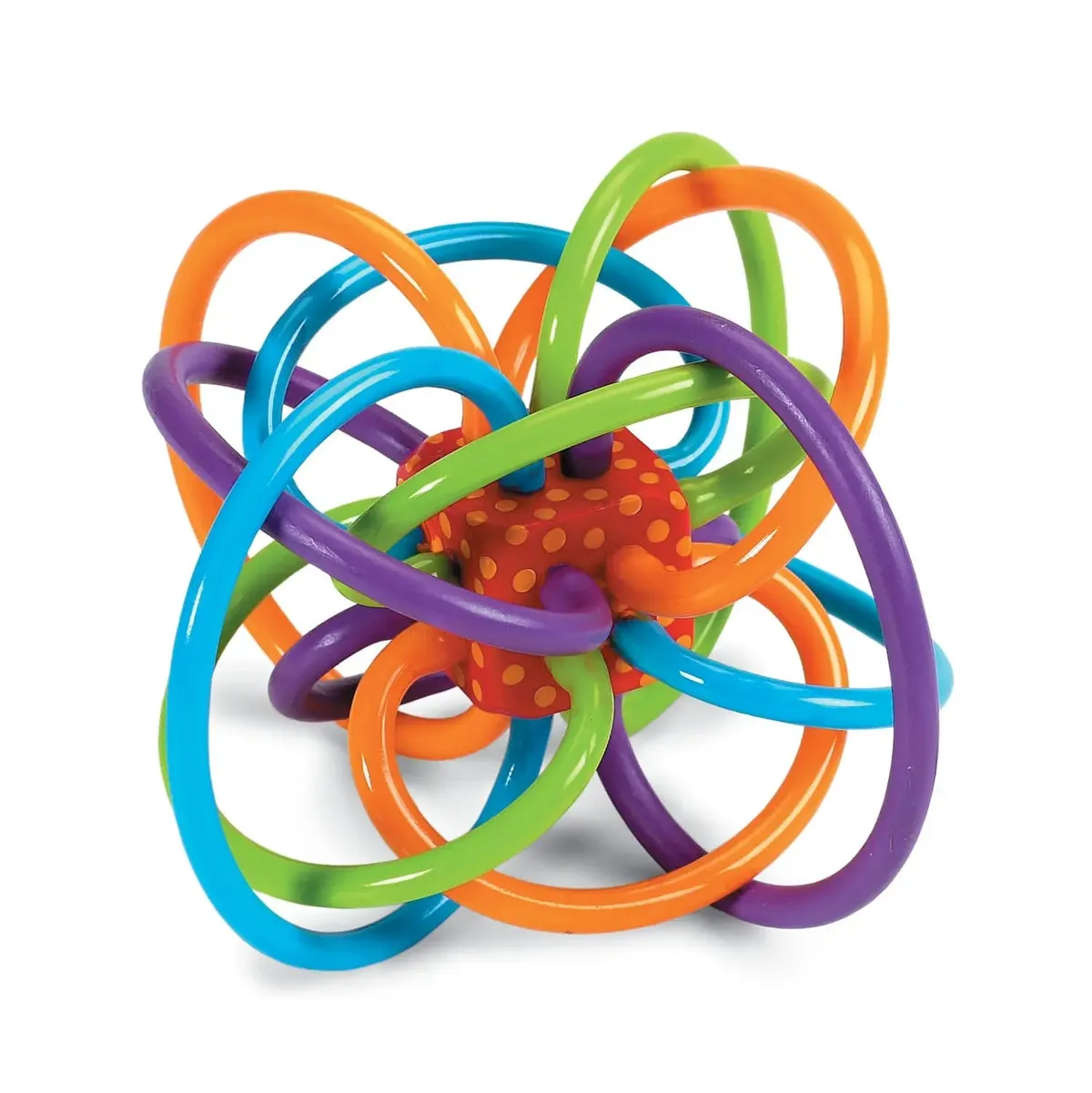
Manhattan Toy Winkel Rattle & Teether
“Sensory-rich teething toy with the same quiet, screen-free aesthetic as the Lovevery objects. The budget supplement we recommend at every infant stage.”
Sassy Stacks of Circles Stacking Ring (9-Piece)
“Varied textures and weights across nine rings. The closest budget analog to the Senser kit's tactile-variation rationale.”
Skip Hop Silver Lining Cloud Activity Mirror
“Crib-mounted baby mirror for visual self-recognition and tracking. A standard recommendation for the 5-6 month visual-development window the Senser kit also targets.”
Indestructibles: Baby's First Book Bundle
“Tear-proof, washable books for early literacy at 5-6 months. Mouthing is the primary interaction mode; these are engineered for it.”