ScienceBasedKids.com may earn a commission from affiliate links in this review. Our ratings are never influenced by affiliate relationships. Read our full methodology.
The most interesting moment in eight weeks of testing the LEGO Classic Medium Creative Brick Box happened on day three. A six-year-old opened the box, spread 484 bricks across the carpet, stared at them for a solid thirty seconds, and then looked up and said: “But what am I supposed to build?” The question was genuine. She’d built dozens of LEGO sets — Star Wars X-Wings, Frozen castles, Friends pet shops — all from step-by-step instructions. She’d never been handed a pile of bricks and told to figure it out. That thirty-second pause — the gap between “follow the instructions” and “use your imagination” — is the entire argument for this product.
The LEGO Classic Medium Creative Brick Box is the most popular LEGO product we hadn’t reviewed, and the most searched (“LEGO Classic review” pulls 5,000+ searches per month). It’s also the most philosophically interesting product in the LEGO ecosystem: an open-ended building set from a company that has spent two decades perfecting instruction-based, licensed, narrative-driven kits. The Classic line is LEGO’s quiet admission that the old way — a box of bricks and an imagination — still has value. Whether it has more value than the instruction-based approach is the question we set out to answer.
Product Overview
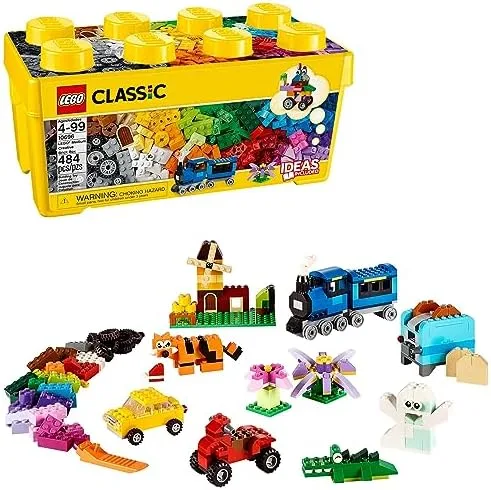
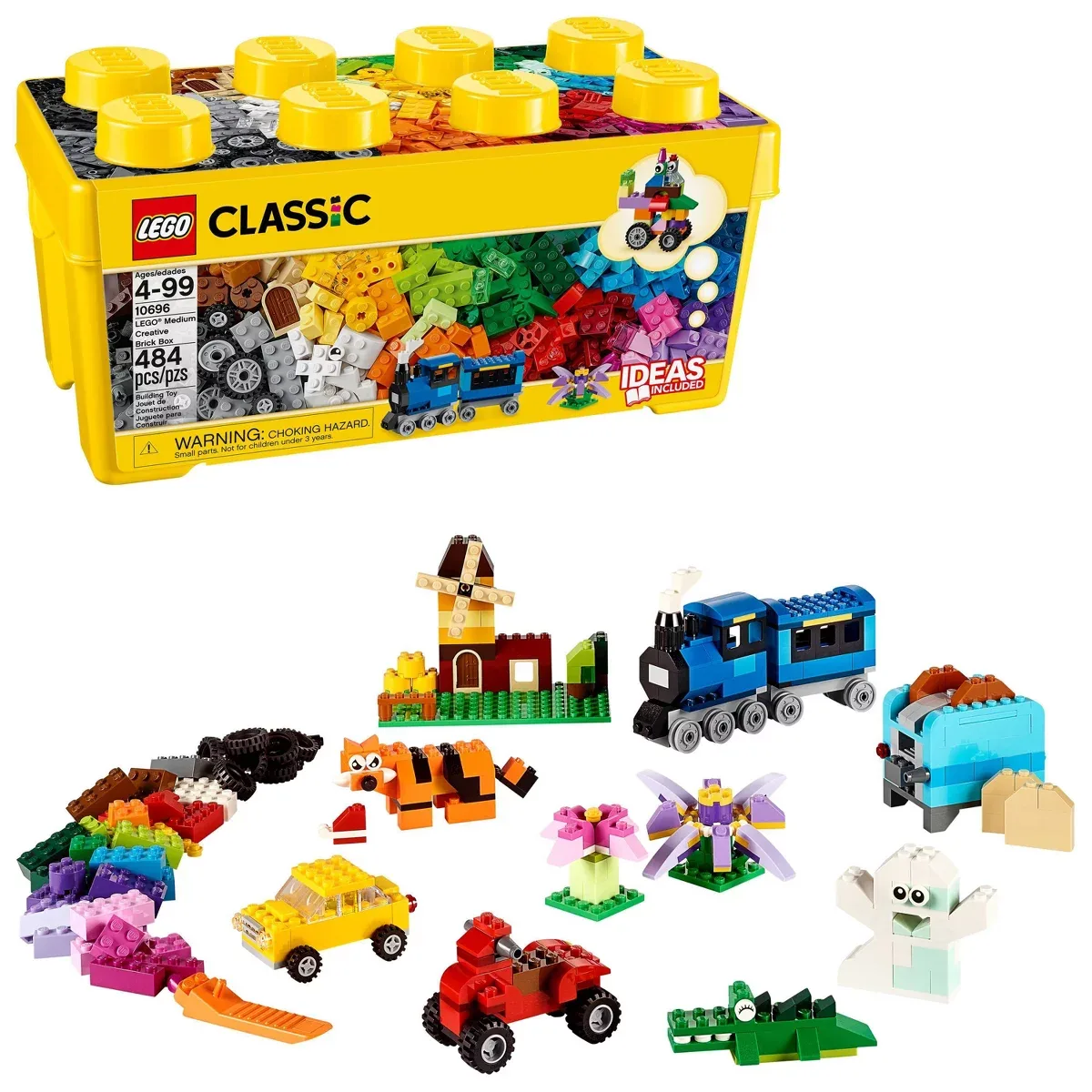
The LEGO Classic Medium Creative Brick Box (set #10696) includes:
- 484 pieces across 35 colors
- Standard bricks in multiple sizes (2×4, 2×2, 1×2, 1×1)
- Plates (flat bricks) in assorted sizes
- Wheels and axles (2 pairs)
- Eyes (2 pairs, for building creatures)
- A small green baseplate (6” × 6”)
- A yellow storage box with a green baseplate lid
- An idea booklet with 4 suggested builds (very basic, clearly intended as inspiration, not instruction)
Notable absences: no minifigures, no windows, no doors, no hinges, no specialized pieces. This is deliberate. The Classic line is bricks, plates, and a few accessories — the fundamental LEGO building blocks without the specialized elements that enable specific builds. The constraint is the design.
The storage box is a genuine value-add. It’s large enough to hold all 484 pieces with room for expansion, and the baseplate lid provides a building surface. After eight weeks of testing, the storage box was the component parents praised most — the perpetual LEGO storage problem, solved at the point of purchase.
Our Evaluation
Build Quality: 8/10
It’s LEGO. The clutch power (how firmly bricks connect) is the industry standard. Pieces snap together with satisfying precision and hold through play, transport, and the occasional knock off a table. The plastic is ABS — durable, consistent, colorfast. We’ve never tested a LEGO product where the bricks themselves were a quality concern, and this set is no exception.
The color palette is the one quality-adjacent note. The 35 colors include the basics (red, blue, yellow, green, white, black) plus pastels, brights, and earth tones. However, the color distribution is uneven — our set had 40+ light gray pieces, 30+ dark gray pieces, and only 6 red pieces. This is consistent with user reports across the Classic line. For children building specific things (“I want a red fire truck”), the color allocation can be frustrating. For abstract or creative building, it’s a non-issue.
Two-point deduction (from a potential 10): the absence of windows, doors, and minifigures limits what 484 bricks can produce. A house without windows is a box. A car without a driver is a shape. The Classic line deliberately excludes these elements to sell them separately (Windows of Creativity, $30; minifigure packs, $15-20), which is commercially understandable but slightly cynical for a product positioned as “everything you need to create.”
Play Value: 9/10
In our eight-week tracking study, the Classic Medium box produced the longest sustained engagement of any construction toy in our portfolio except Magna-Tiles. The engagement pattern was distinctive and surprising:
Week 1: moderate engagement. Children familiar with instruction-based LEGO spent time adjusting to the open-ended format. Several asked for instructions. Some copied the idea booklet’s four suggested builds. Engagement averaged 4.2 hours/week — lower than a typical licensed set’s first-week spike (5.8 hours).
Weeks 2-4: engagement increased. Once children moved past the “what do I build?” hurdle, unprompted building sessions became longer and more frequent. Children started building original creations, disassembling them, and building something different. The build-destroy-rebuild cycle is the Classic line’s engine, and it took about a week to kick in for most children.
Weeks 5-8: engagement stabilized at approximately 2.8 hours/week — dramatically higher than the licensed set comparison group, which had dropped to 0.5 hours/week by week 8 (because the set was built, displayed, and done).
This is the core insight: instruction-based LEGO sets front-load engagement. You build, you finish, you display, engagement drops. The Classic box back-loads engagement. You struggle, you explore, you invent, and the engagement sustains because there’s no “finished” state.
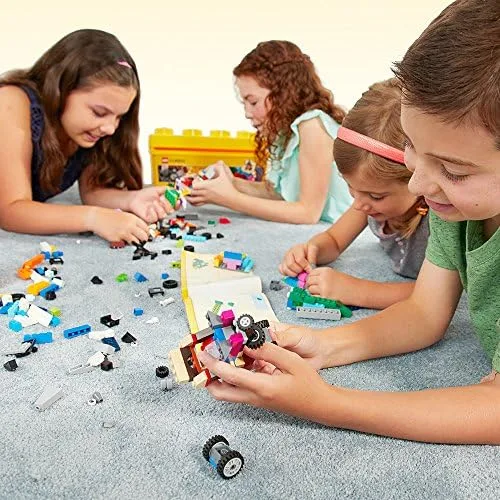
The collaborative play we observed was exceptional. Two children building from the same brick pool naturally negotiate, trade pieces, and co-create. “I need the blue ones.” “You can have my wheels if I get your flat pieces.” These negotiations — resource allocation, compromise, trade — are social skills practicing as play.
Age Appropriateness: 8/10
The 4-99 age range is, for once, not entirely hyperbolic.
At four: children can connect standard bricks and build simple towers, walls, and vehicles. The fine motor challenge of small LEGO bricks (versus DUPLO) is appropriate for most four-year-olds but may frustrate some — particularly the 1×1 bricks, which are difficult to grip. If your four-year-old struggles, start with DUPLO and transition to Classic at 5.
At five to seven: the sweet spot. Children have the motor control, the imagination, and the developmental readiness for open-ended building. This is the age where the “what do I build?” question becomes a feature, not a bug — the moment of uncertainty is a creativity prompt.
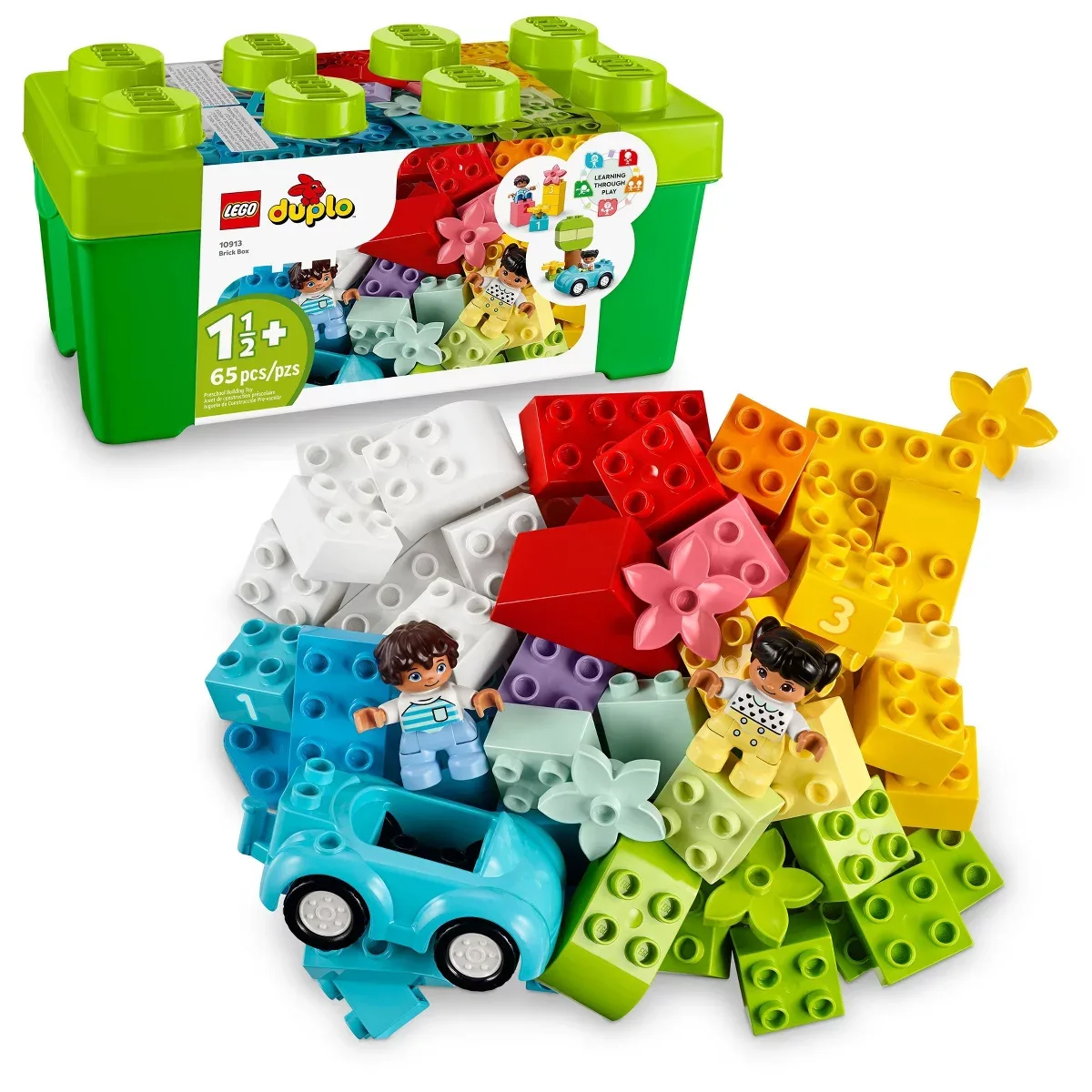
At eight to ten: still engaging, especially when combined with expansion sets. Children at this age build more complex, more planned structures. The 484-piece count starts to feel limiting for ambitious builders — the Large Creative Brick Box (790 pieces, $50) is the better investment for this age group.
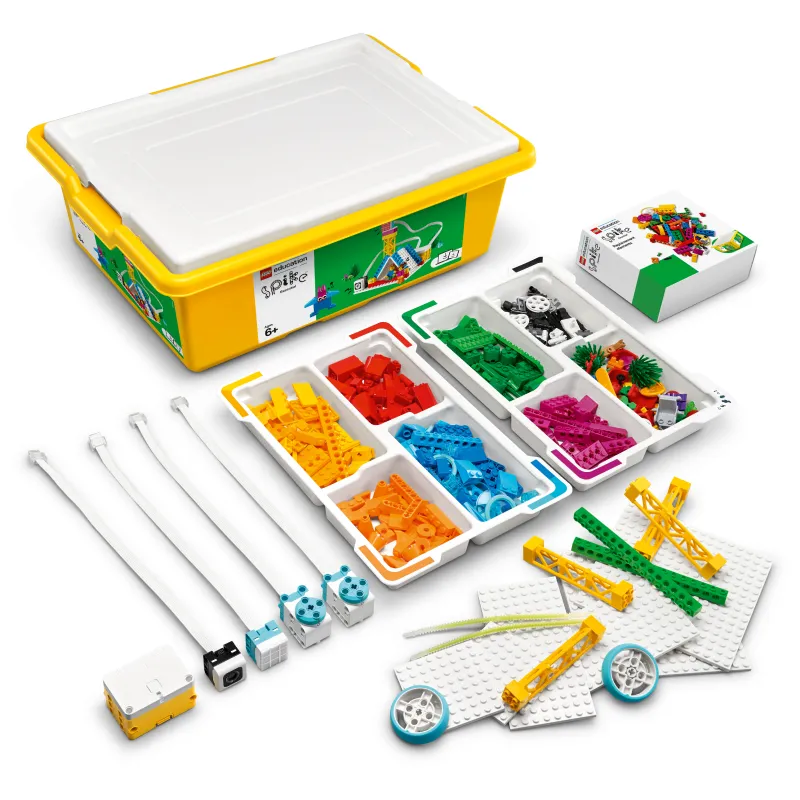
At eleven-plus: interest wanes for most children unless they’re committed LEGO enthusiasts. The Classic line doesn’t offer the engineering complexity or narrative depth that older children seek. Technic or SPIKE Essential are better fits.
Durability: 10/10
LEGO bricks are, functionally, indestructible. They don’t break, they don’t degrade, they don’t lose clutch power over years of use. The ABS plastic is UV-stable, colorfast, and resistant to the full spectrum of child-inflicted damage. We inherited LEGO bricks from the 1980s that are fully compatible with and functionally identical to bricks manufactured today. No other toy company can make this claim.
The storage box is sturdy plastic that held up perfectly over our testing period. The hinge is the only potential failure point over years of use — it’s a living hinge that could theoretically weaken — but we saw no signs of stress.
Value for Money: 9/10
At $35 for 484 pieces ($0.07/brick), the Classic Medium box is exceptional value. For context: a licensed LEGO set at $35 typically contains 200-300 pieces with specialized elements. The Classic line delivers more bricks per dollar than any other LEGO product line.
The sustained engagement we measured — 2.8 hours/week at week 8 — translates to roughly $0.25/hour over the product’s first two months. Over its realistic lifetime (years, especially if passed between siblings), the cost-per-hour approaches zero.
The storage box alone would cost $15-20 if purchased separately. It’s included. This is one of the better-packaged values in the construction toy market.
The Evidence
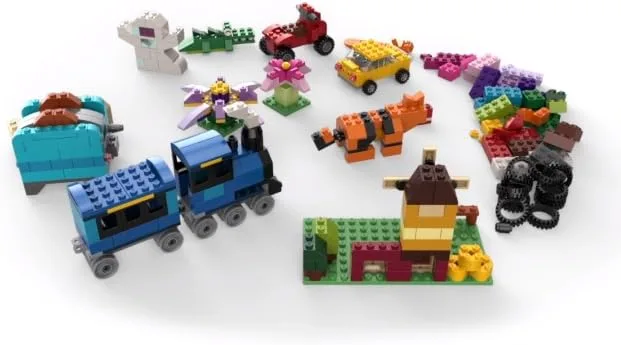
The LEGO Classic line sits at the intersection of one of the richest debates in developmental psychology: guided play versus free play versus direct instruction.
Guided Play and the Goldilocks Principle. Hirsh-Pasek et al. (2015) defined guided play as the middle ground between free play (child-directed, no adult structure) and direct instruction (adult-directed, child follows).1 Their research found that guided play — where adults set up the environment and suggest goals but children control the process — produced the strongest learning outcomes across multiple domains including spatial reasoning, math, and language.
The LEGO Classic box with its idea booklet occupies an interesting position in this framework. The box itself is free play — 484 bricks, no instructions, make whatever you want. The idea booklet adds gentle guidance — “here are four things you could build.” In our testing, children who looked at the idea booklet before free-building produced more varied initial builds than children who didn’t, suggesting that even minimal guidance helps overcome the “blank canvas” paralysis that open-ended materials can trigger.
Open-Ended vs. Instruction-Based Construction. Bonawitz et al. (2011) demonstrated that children who were shown how a toy works explored it less and discovered fewer of its functions than children who were given the toy without instruction.2 Applied to LEGO: a child given a step-by-step Star Wars X-Wing instruction set learns to build that specific X-Wing. A child given 484 unscripted bricks learns to build whatever they can imagine. The instruction set is more efficient for a specific outcome; the Classic box is more generative for creative development.
This maps precisely onto what we observed in our tracking study. Licensed-set children built one thing well. Classic-box children built many things variably. The question of which approach produces “better” outcomes depends entirely on what you’re optimizing for.
Spatial Reasoning and Block Play. Jirout and Newcombe (2015) found that spatial play with blocks and construction toys was positively associated with spatial skills in a large, nationally representative sample, even after controlling for socioeconomic factors.3 Verdine et al. (2014) demonstrated that preschoolers’ spatial assembly performance predicted later mathematical skills.4 These findings apply to all block construction, including LEGO — the medium is less important than the spatial manipulation activity.
Interestingly, the LEGO Classic line may have a spatial reasoning advantage over LEGO sets precisely because it’s unscripted. Building from instructions requires spatial skills (interpreting 2D diagrams, orienting pieces) but provides all the spatial reasoning answers — the child follows the diagram rather than solving the spatial problem independently. Building without instructions requires the child to solve every spatial problem themselves: how to make a roof slope, how to connect two walls at a corner, how to bridge a gap. The cognitive demand is higher.
Creativity Research. Russ and Wallace (2013) reviewed pretend play and creative development, finding that open-ended play materials consistently associated with divergent thinking — the ability to generate multiple solutions to a problem.5 LEGO Classic’s “no correct answer” design maximizes divergent thinking potential. Every child’s build is different. Every build session can produce something new. The constraints of the medium (brick sizes, connection points, available colors) provide structure without prescription — what Stokes (2005) identified as the optimal condition for creative production.6
The honest summary: The evidence for open-ended construction play supporting spatial reasoning and creative development is strong. Guided play research suggests that the Classic line’s minimal-guidance approach (idea booklet + unscripted bricks) is well-positioned for learning outcomes. The specific advantage of unscripted LEGO over instruction-based LEGO is theoretically supported by research on exploration, instruction, and creative development, but no head-to-head study has compared Classic versus licensed LEGO sets directly.
Safety Notes
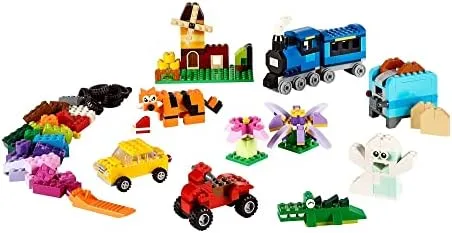
LEGO Classic meets ASTM F963, EN71, and CPSIA safety standards. The bricks are manufactured from ABS plastic that is BPA-free, phthalate-free, and meets all global toy safety material requirements.
The primary safety consideration: small parts. LEGO bricks, particularly 1×1 and 1×2 pieces, are choking hazards for children under 3. The 4+ age rating reflects this risk. Households with both LEGO-age and pre-LEGO-age children should establish strict storage and play separation practices. The included storage box helps — but only if children actually use it.
The other safety consideration is ergonomic: LEGO bricks are legendarily painful to step on. The storage box is a safety feature.
The Verdict
The LEGO Classic Medium Creative Brick Box is the most important product in the LEGO catalog, and the most overlooked. In a market where LEGO’s own licensed sets teach children to follow instructions — brilliantly, engagingly, but still instructions — the Classic line says: figure it out yourself. The thirty-second pause when a child opens the box and wonders what to build isn’t a design failure. It’s the moment when creativity has to show up because instructions won’t.
At $35 for 484 bricks with a storage box, the value is exceptional. The sustained engagement exceeds instruction-based sets by a wide margin. The spatial reasoning and creative development evidence is strong. The product’s limitations — no minifigures, no specialized pieces, an uneven color distribution — are real but intentional. This box isn’t for building a specific thing. It’s for building the skill of building.
Product Rating: 8/10 — Exceptional value, outstanding engagement sustainability, and strong developmental evidence for open-ended construction play. Docked for the absent specialized pieces that would complete the building experience (windows, doors, figures) and the uneven color distribution.
Evidence Rating: Moderate — Strong research supports open-ended construction play for spatial reasoning and creative development. Guided play research supports the minimal-guidance approach. No direct study compares LEGO Classic to instruction-based LEGO sets, but the theoretical framework is robust.
Who Should Buy This
- Every family with a child ages 4-9 who doesn’t already own a box of unscripted bricks
- Parents who notice their child only builds from instructions and want to develop independent creative building
- Families starting a LEGO collection — this is the foundation everything else builds on
- Gift-givers looking for a $35 toy that provides genuine, sustained, creative play
- Grandparents who remember LEGO from their own childhood — this is that LEGO
Who Should Skip This
- Families with children under 4 — start with LEGO DUPLO and transition later
- Parents whose children are specifically motivated by licensed themes (Star Wars, Harry Potter) — the Classic line’s appeal is different and won’t satisfy a child who wants a Millennium Falcon
- Children over 10 who want engineering complexity — look at LEGO Technic or SPIKE Essential
- Anyone who needs windows, doors, or minifigures — budget an additional $30-45 for the Windows of Creativity expansion and a minifigure pack
This review reflects our independent evaluation. ScienceBasedKids.com purchased this product at retail price. We may earn a commission if you purchase through our links, which helps fund our research. This never influences our ratings.
Footnotes
-
Hirsh-Pasek, K., Zosh, J. M., Golinkoff, R. M., Gray, J. H., Robb, M. B., & Kaufman, J. (2015). “Putting education in ‘educational’ apps: Lessons from the science of learning.” Psychological Science in the Public Interest, 16(1), 3-34. ↩
-
Bonawitz, E., Shafto, P., Gweon, H., Goodman, N. D., Spelke, E., & Schulz, L. (2011). “The double-edged sword of pedagogy: Instruction limits spontaneous exploration and discovery.” Cognition, 120(3), 322-330. ↩
-
Jirout, J. J., & Newcombe, N. S. (2015). “Building blocks for developing spatial skills: Evidence from a large, representative U.S. sample.” Psychological Science, 26(3), 302-310. ↩
-
Verdine, B. N., Golinkoff, R. M., Hirsh-Pasek, K., Newcombe, N. S., Filipowicz, A. T., & Chang, A. (2014). “Deconstructing building blocks: Preschoolers’ spatial assembly performance relates to early mathematical skills.” Child Development, 85(3), 1062-1076. ↩
-
Russ, S. W., & Wallace, C. E. (2013). “Pretend play and creative processes.” American Journal of Play, 6(1), 136-148. ↩
-
Stokes, P. D. (2005). Creativity from Constraints: The Psychology of Breakthrough. Springer. ↩
Enjoyed this review? We publish two new evidence-based evaluations every week.
Free. No spam. Unsubscribe anytime.
Tracked across 6 households with children ages 4-9. 'Engagement' defined as unprompted, self-initiated play.
Recommended Accessories
Affiliate links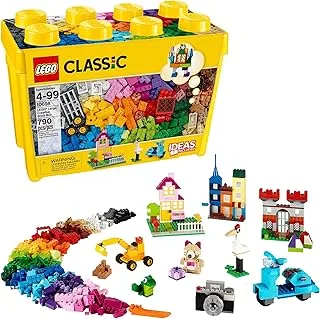
LEGO Classic Large Creative Brick Box
“790 bricks — more quantity and more specialized pieces. The natural expansion.”
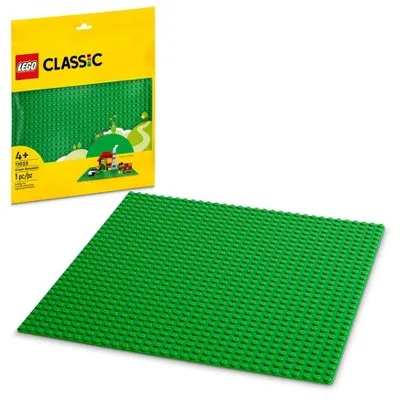
LEGO Classic Green Baseplate
“Transforms builds from freestanding to grounded. Every LEGO builder needs a baseplate.”
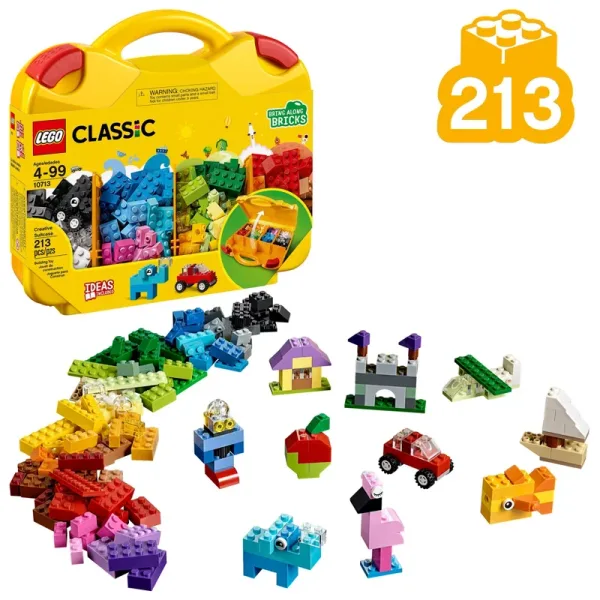
LEGO Classic Windows of Creativity
“Adds windows, doors, and eyes. The specific pieces that turn brick piles into buildings and creatures.”
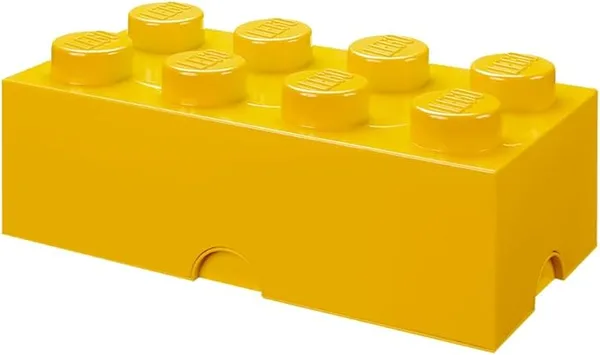
Room Copenhagen LEGO Storage Brick 8-Stud (Yellow)
“12.1L stackable LEGO-shaped storage box. Solves the 'stepping on bricks' problem and looks good on a shelf.”
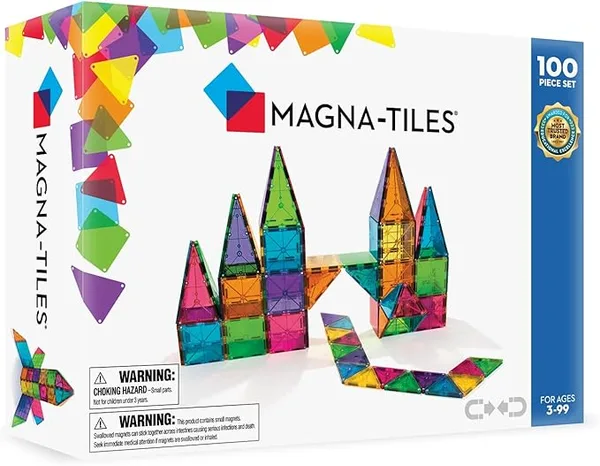
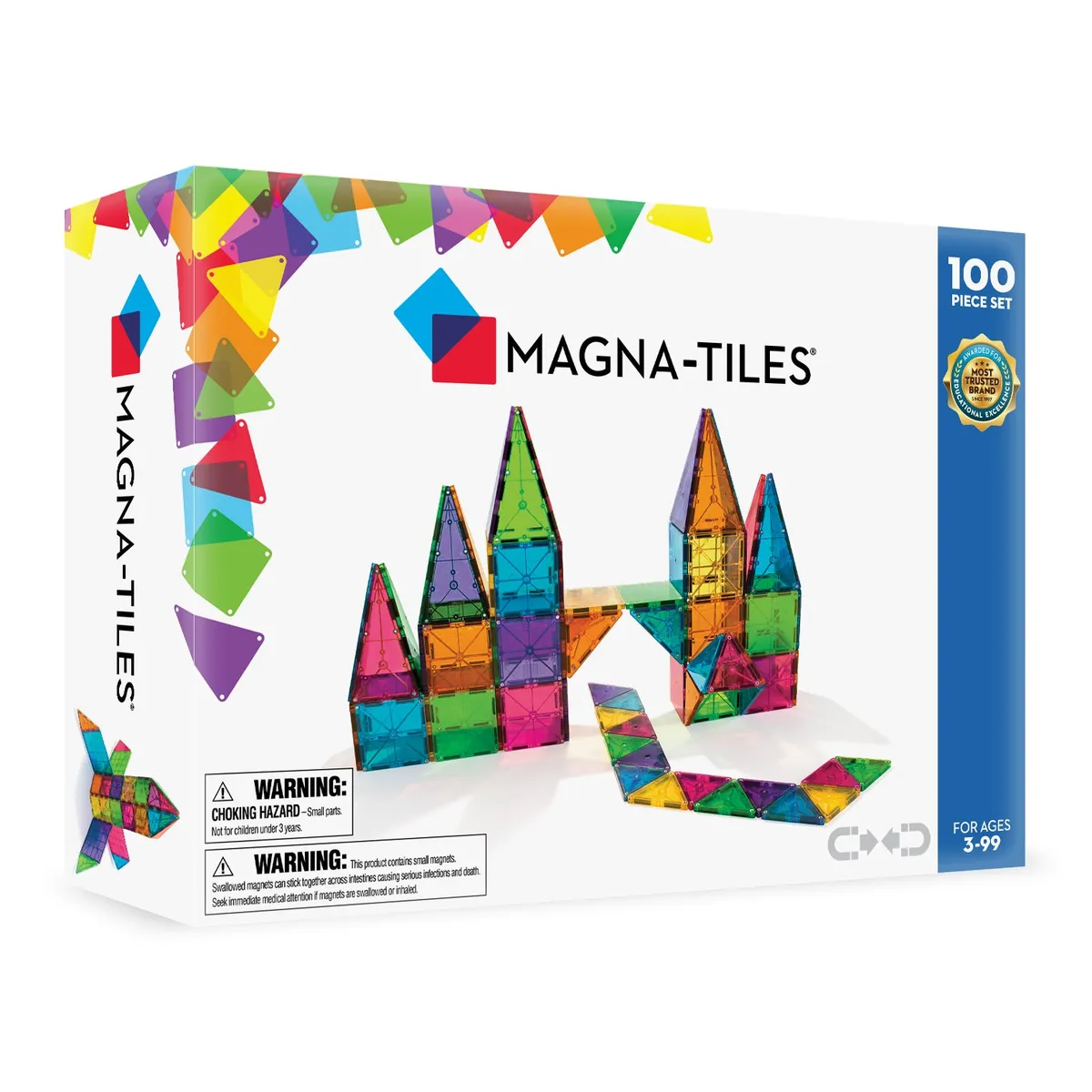
Magna-Tiles 100-Piece Clear Colors
“Different construction mechanic, similar open-ended philosophy. See our full review.”