ScienceBasedKids.com may earn a commission from affiliate links in this review. Our ratings are never influenced by affiliate relationships. Read our full methodology.
Play kitchens occupy a unique position in the toy market: they’re simultaneously among the most researched, most gifted, and most space-consuming toys a family will own. The Hape All-in-1 Kitchen enters this market as a premium option — a $200 full-featured wooden kitchen that competes with KidKraft’s Uptown line on features but distinguishes itself through build quality and design refinement.
We tested the Hape All-in-1 Kitchen in two households with children ages 3 through 7 over eight weeks.
Product Overview
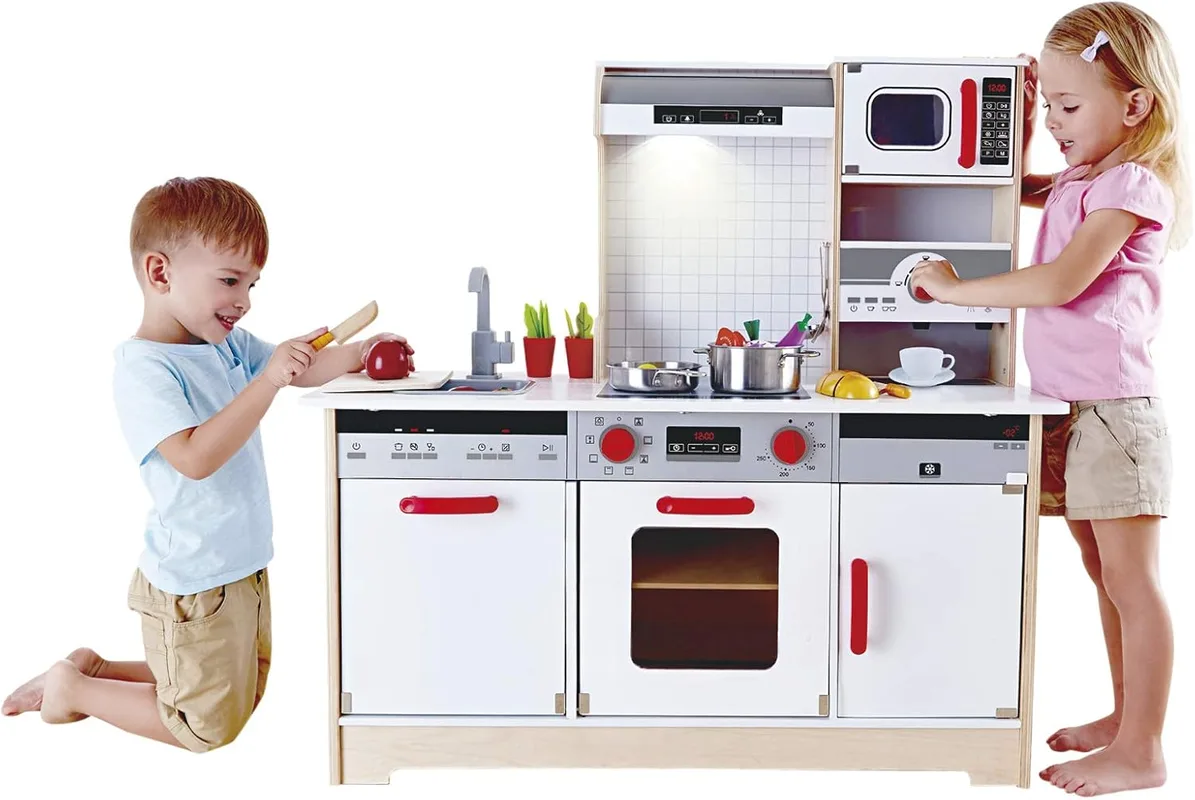
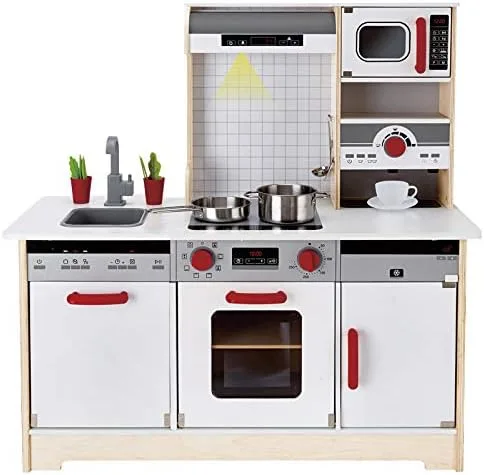
The Hape All-in-1 Kitchen ($200) is a single-unit play kitchen measuring approximately 38” H × 26” W × 14” D:
- Stove top: Four turnable knobs with click-stop positions
- Oven: Opening door with clear window panel
- Microwave: Opening door with interior turntable and electronic “ding” sound
- Sink: Removable basin with turnable faucet handles
- Coffee maker: Replica with removable pot
- Range hood: Controllable lamp (battery powered)
- Storage: Multiple cabinet doors and open shelving
- Construction: Sustainably sourced wood with non-toxic paint
- Assembly: Required. Approximately 60-90 minutes with two adults
Our Evaluation
Build Quality: 9/10
This is where Hape distinguishes itself. The wood is thicker and heavier than KidKraft equivalents. The hardware — hinges, knobs, faucet handles — has a satisfying weight and resistance that feels closer to miniature real appliances than toy approximations. The paint finish is smooth and even. The cabinet doors close with a soft-close mechanism rather than slamming.
The turnable knobs deserve specific mention. Each has distinct click-stop positions that provide tactile and auditory feedback — a small detail that lifts the pretend play experience significantly.
Play Value: 9/10
Play kitchens generate some of the most sustained, complex pretend play of any toy category, and the Hape All-in-1 is a particularly good example. The multiple appliance stations support collaborative play — one child cooking while another prepares coffee, a third washing dishes. The realistic details (the microwave ding, the range hood light) deepen the pretend play narrative.
Children in our testing households used the kitchen daily, with play sessions averaging 25-40 minutes. The play evolved over the eight-week testing period from simple food preparation mimicry to elaborate restaurant scenarios, family dinner productions, and cooking show performances.
Age Appropriateness: 8/10
The 3+ minimum is appropriate. Children younger than 3 can interact with individual elements (opening doors, turning knobs) but lack the pretend play sophistication to fully engage with the kitchen as a whole. The effective upper range extends to 7-8 years, making this one of the longest-lived toy investments a family can make.
Durability: 9/10
The heavy wood construction is built to last. Cabinet hinges showed no loosening during our testing. The paint is chip-resistant. The microwave sound module is the most likely failure point (battery-powered electronics in wooden toys are always a durability question), but it functioned reliably throughout our testing.
Value for Money: 7/10
At $200, the Hape All-in-1 is a significant investment. However, amortized across 4-5 years of daily use, the cost-per-day of engagement is under $0.15. For a toy that occupies a permanent place in your home and sees daily use, this is reasonable.
The Evidence
Pretend play and cognitive development. Dramatic pretend play — including kitchen/cooking scenarios — is among the most well-researched play categories. Lillard et al. (2013) conducted a comprehensive review and found consistent associations between pretend play and development of executive function, social cognition, and language skills.1
Role play and social development. Kitchen play specifically supports social script development. Astington and Jenkins (1995) demonstrated that children who engage in more pretend play show more advanced theory of mind — the ability to understand that other people have different thoughts and knowledge.2
The honest summary: Pretend play research, including kitchen/cooking scenarios, is among the strongest in the developmental toy literature. The Hape kitchen provides an excellent physical platform for this type of play.
Safety Notes
Meets ASTM F963, EN-71, and CPSIA standards. All materials are non-toxic. The microwave sound module requires button batteries secured behind a screwed panel. All cabinet doors and drawers pass finger-pinch tests. No CPSC recalls on record.
The kitchen must be secured to a wall during the first year of use to prevent tipping. Hape includes a wall anchor kit.
The Verdict
The Hape All-in-1 Kitchen is a premium play kitchen that justifies its price through superior build quality, thoughtful design details, and durability that supports years of daily pretend play. It’s not cheap, and the assembly is tedious, but the end result is a piece of play furniture that will serve your family from age 3 through 7 or 8, potentially spanning multiple children.
Product Rating: 8/10 — Excellent build quality, outstanding play value, strong durability. Assembly difficulty and price point prevent a higher score.
Evidence Rating: Moderate — Pretend play is among the most well-researched developmental activities. Strong evidence for cognitive, social, and language benefits.
Who Should Buy This
- Families with children ages 3-5 who have space for a permanent play kitchen
- Parents who value wood construction and design quality over lowest price
- Multi-child families where the kitchen will serve multiple children over years
- Gift-givers pooling resources for a significant, lasting present
Who Should Skip This
- Families with limited floor space (this is a large, permanent fixture)
- Parents looking for a budget play kitchen (KidKraft offers good options at lower prices)
- Single-child families with children over 6 (the remaining engagement window may not justify the investment)
This review reflects our independent evaluation. ScienceBasedKids.com purchased this product at retail price. We may earn a commission if you purchase through our links, which helps fund our research. This never influences our ratings.
Footnotes
-
Lillard, A. S., Lerner, M. D., Hopkins, E. J., Dore, R. A., Smith, E. D., & Palmquist, C. M. (2013). “The impact of pretend play on children’s development: A review of the evidence.” Psychological Bulletin, 139(1), 1-34. ↩
-
Astington, J. W., & Jenkins, J. M. (1995). “Theory of mind development and social understanding.” Cognition & Emotion, 9(2-3), 151-165. ↩
| Brand | Price | Quality | Rating |
|---|---|---|---|
| | |||
| | |||
| | |||
| | |||
| | |||
| |
Recommended Accessories
Affiliate links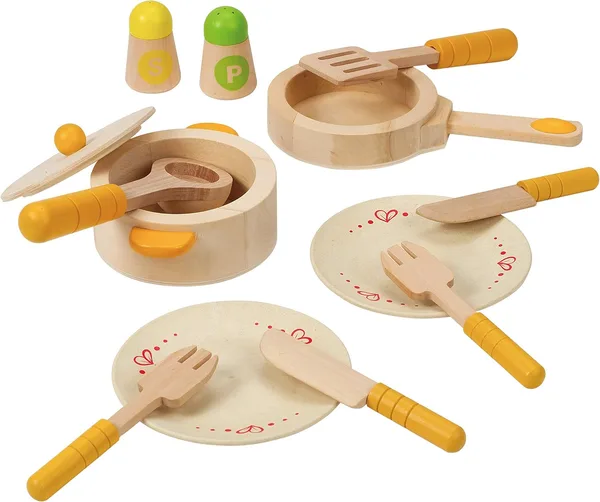
Hape Gourmet Kitchen Starter Accessories (13-piece)
“Plates, cups, utensils, and pot set designed specifically for Hape kitchens.”
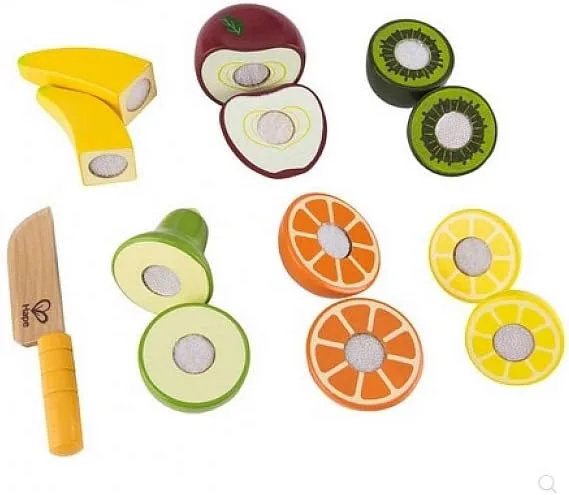
Hape Fresh Fruit Wooden Play Food
“Velcro-cut fruit set. Satisfying slicing action adds to pretend meal prep.”
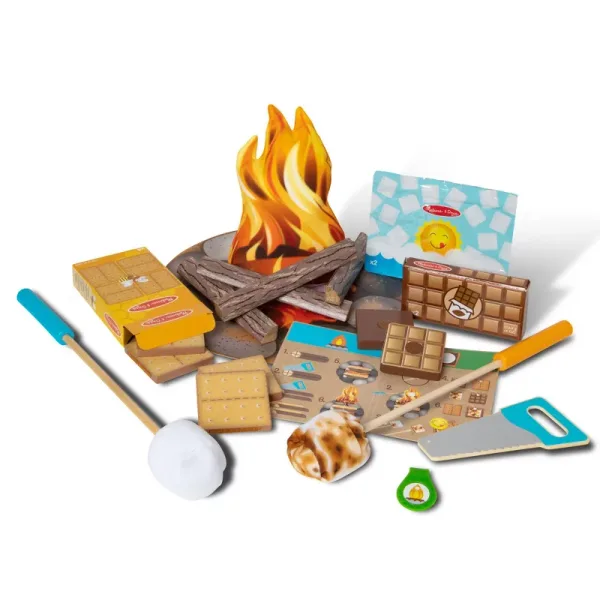
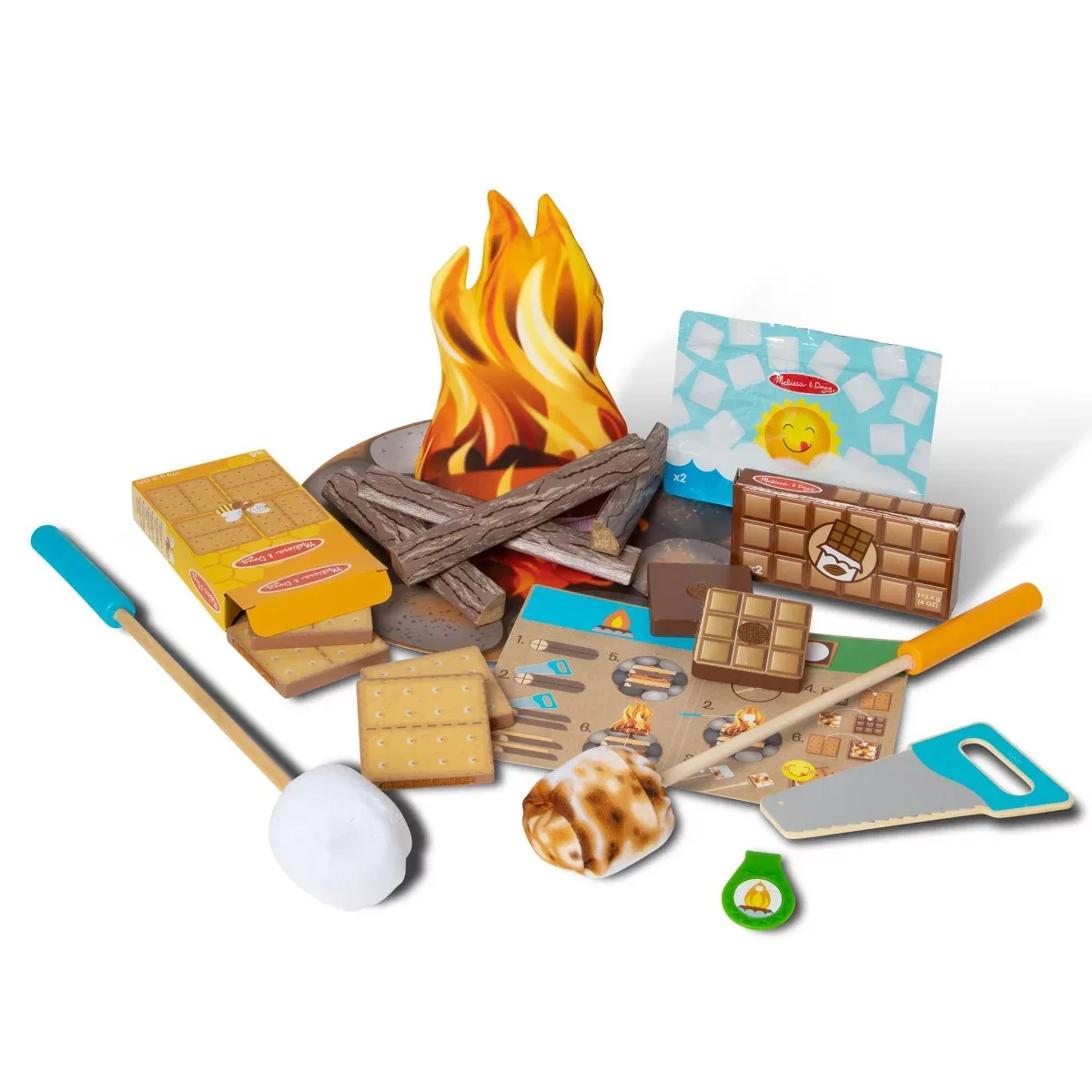
Melissa & Doug Let's Explore Campfire S'mores Play Set
“Extends cooking play beyond the kitchen. Different culinary theme.”
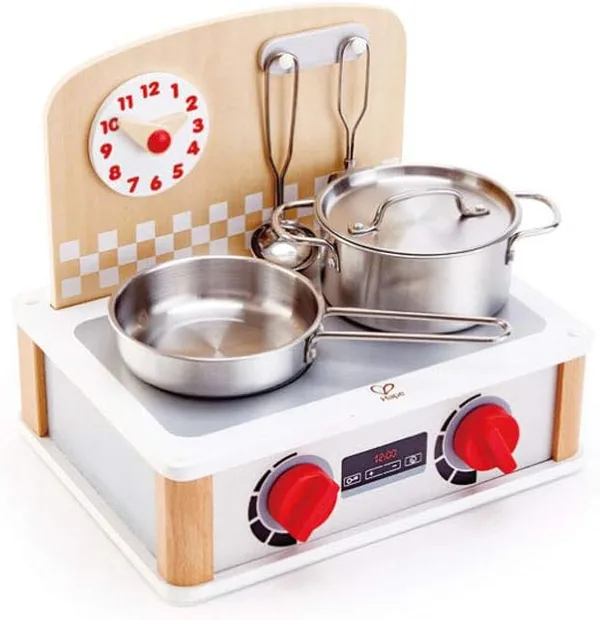
Hape 2-in-1 Kitchen & Grill Set
“Compact tabletop alternative at a quarter of the price. Great for smaller spaces.”