ScienceBasedKids.com may earn a commission from affiliate links in this review. Our ratings are never influenced by affiliate relationships. Read our full methodology.
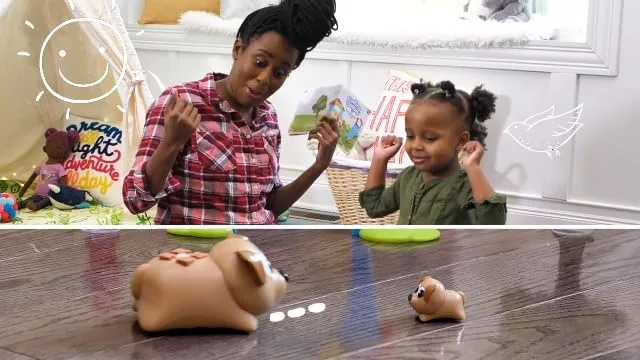
Watch a four-year-old “code” a plastic hedgehog to walk across a playmat and you’ll witness something strange: the child talks to the hedgehog. “Okay, Ranger, go forward. Now turn. Now find the apple.” This isn’t a child executing a program. This is a child telling a story to a friend who happens to follow instructions. And that confusion — between narrative and algorithm, between caring for a pet and programming a robot — is exactly what makes Coding Critters work for the preschool age range that every other coding toy misses.
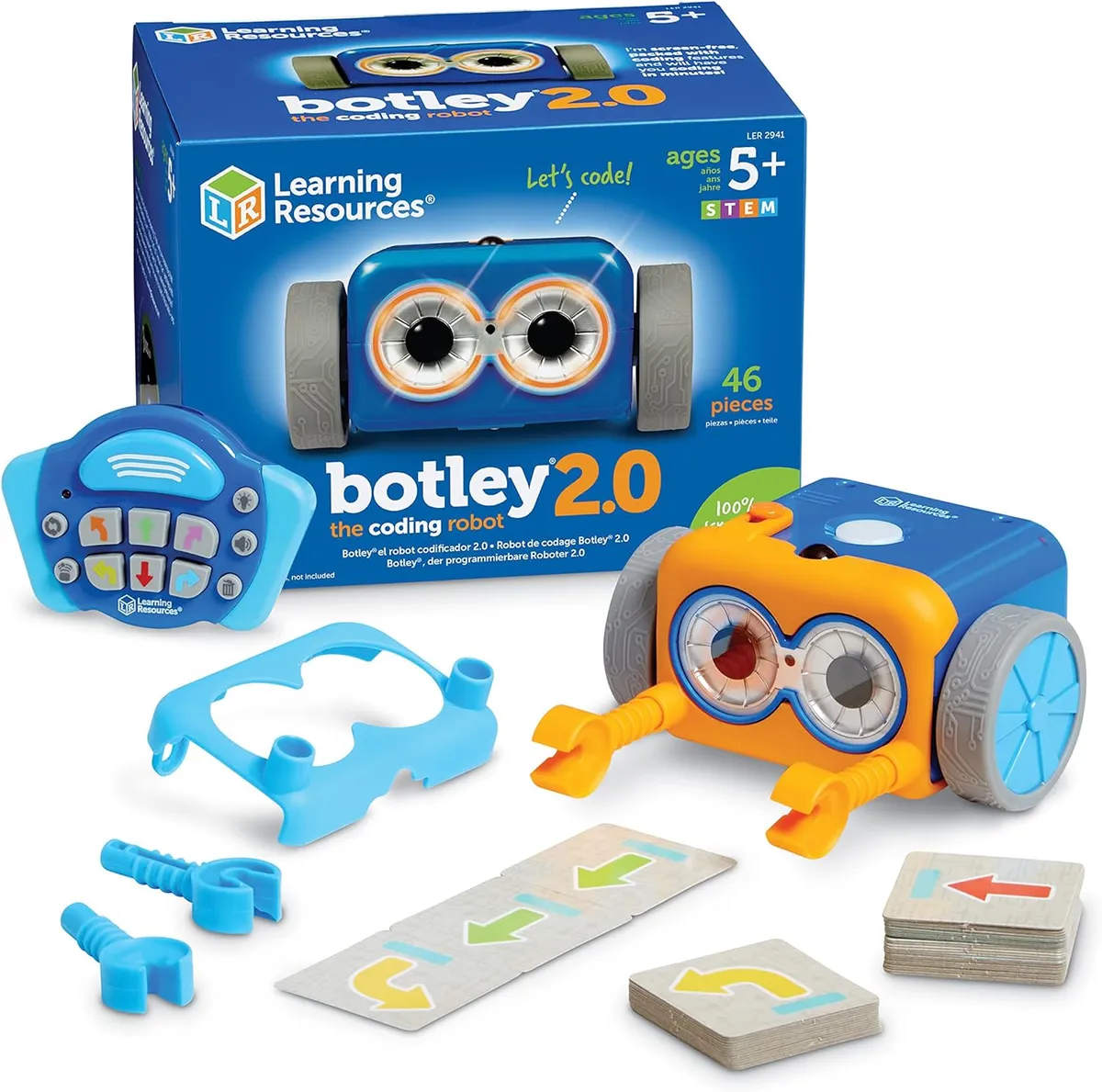
Most screen-free coding toys — Botley 2.0, Cubetto, the Code-a-Pillar — present coding as a purely logical exercise: input a command sequence, press go, watch the output. This is accurate to what coding is. But it’s developmentally mismatched for four-year-olds, who live in a world of narrative, pretend, and emotional connection. Coding Critters meets them there, wrapping sequential logic inside a pet-care story. The question is whether the narrative wrapping supports or obscures the computational thinking underneath.
Product Overview
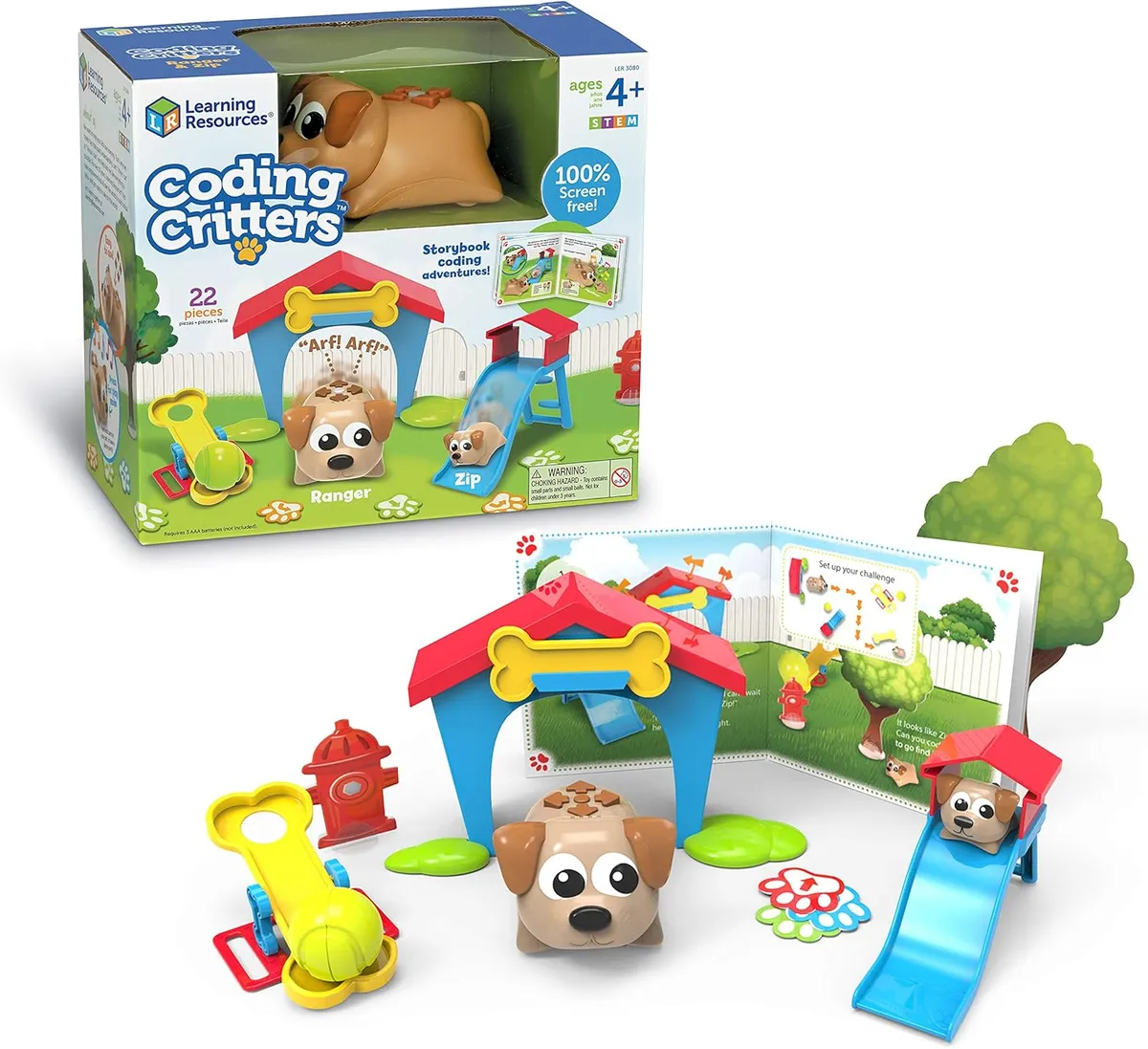
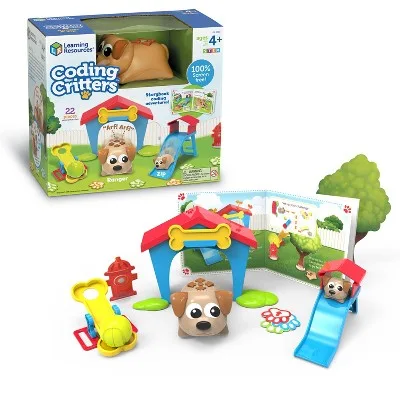
Coding Critters is a screen-free, interactive coding pet for ages 4-7. The set we tested — “Ranger & Zip” — includes:
- Ranger — a motorized hedgehog (approximately 4” tall) with buttons on its back for programming movement sequences
- Zip — a smaller, non-motorized baby hedgehog that attaches to Ranger magnetically
- A storybook coding guide — 20+ guided coding adventures with illustrated narratives
- A coding map — a fold-out playmat with paths, obstacles, and destinations
- 10 play pieces — trees, rocks, food items, and accessories for the playmat
- A coding mode switch — toggles between “Play” mode (pet responds to petting and sounds) and “Code” mode (pet follows programmed sequences)
The programming mechanic: in Code mode, pressing the arrow buttons on Ranger’s back queues a movement sequence. Press the green “Go” button and Ranger executes the sequence. Forward, backward, left turn, right turn — the same directional vocabulary as Botley or Cubetto, but with a pet that chirps, purrs, and responds to touch between coding sequences.
Our Evaluation
Build Quality: 7/10
Ranger is reasonably well-made for a $30 toy. The plastic shell is solid and survived drops from table height without cracking. The wheels are smooth and track straight on hard surfaces (more on carpet performance below). The magnetic attachment between Ranger and Zip is clever — strong enough to hold during movement, weak enough for small fingers to separate.
The buttons on Ranger’s back are where quality concerns emerge. They’re small, slightly recessed, and require a deliberate press. This is fine for ages 5-6 but occasionally frustrating for four-year-olds with less developed fine motor control. We observed several instances of children pressing a button and not registering a command, then being confused when Ranger executed an incomplete sequence. A more tactile click — like the satisfying snap of Botley’s remote buttons — would improve the experience.
The storybook is printed on standard paper stock, not board book material. For a product targeting four-year-olds, this is an oversight. Our copy showed page wear within two weeks. The playmat is laminated and held up well.
Battery life is good — Ranger runs on 3 AAA batteries and lasted approximately 15 hours of intermittent play in our testing.
Play Value: 8/10
This is where Coding Critters earns its recommendation. The dual-mode design — Play mode for pet interaction, Code mode for programming — is surprisingly effective.
In Play mode, Ranger responds to being petted (a sensor on the head), makes happy sounds when fed (holding a food piece near the face), and plays with Zip. Four-year-olds in our testing spent significant time in Play mode before ever touching Code mode, and this wasn’t wasted time. They were building an emotional relationship with the toy that later motivated the coding. “I want Ranger to get the apple” is a more compelling programming goal for a preschooler than “move the robot to coordinates 3,2.”
In Code mode, the storybook adventures provide structured challenges: “Help Ranger find the way to the pond” or “Guide Ranger around the rock to reach Zip.” Each adventure introduces a programming concept — sequences, loops (a repeat button), or branching (choosing between two paths). The narrative framing transforms what would be a dry logic exercise into a story with a character the child already cares about.
The engagement curve surprised us. We expected front-loaded interest (novelty-driven) followed by rapid decline. Instead, we observed a dip after the first week — children got bored with the initial storybook adventures — followed by a resurgence when they began creating their own challenges. “Can Ranger go all the way around the map without stopping?” “What if I put ALL the rocks in the way?” The open-ended phase was actually more engaging than the guided phase for most children in our testing.
The limitation: carpet. Ranger’s small wheels struggle on medium or thick carpet. The toy works best on hard floors or short-pile rugs, and the included playmat doesn’t solve this — it slides on carpet. About a third of the frustration we observed during testing was locomotion-related, not coding-related.
Age Appropriateness: 8/10
The 4+ age rating is well-calibrated. This is one of the few coding toys where the stated minimum age matches observed reality.
At four: children could follow the first 8-10 storybook adventures with light adult support. They grasped the basic mechanic (press buttons, press go, watch what happens) within 5 minutes. Sequential thinking — planning a 2-3 step sequence before pressing “Go” — emerged reliably after 3-4 play sessions. Debugging (recognizing that the sequence was wrong, not the toy) was rare at this age.
At five to six: children worked through the full storybook independently. Sequential thinking extended to 4-6 step sequences. Debugging emerged naturally — “Oh, I needed another forward before the turn.” Some children discovered the repeat function without being shown, which was genuinely delightful to watch.
At seven: most children found the toy too simple and wanted something with more programming vocabulary. This is the natural ceiling, and families should plan for the Botley 2.0 step-up by this age.
Durability: 7/10
Ranger himself is durable — the motorized components and shell withstood regular preschooler use without issues. The magnetic Zip attachment held firm. The playmat, being laminated, resisted spills and rough handling.
The storybook’s paper construction is the durability weak point. The play pieces (small plastic trees, rocks, food items) are fine individually but are prime candidates for getting lost. We’d lost two pieces by week three. Replacement pieces aren’t sold separately.
Value for Money: 9/10
At $30, Coding Critters is among the best values in the preschool STEM toy category. The nearest competitor at this age range — Fisher-Price Code-a-Pillar Twist — is $25 but offers a fundamentally simpler programming model. The next step up — Botley 2.0 at $85 — is almost three times the price and targets an older age range.
Dollar for dollar, Coding Critters delivers more engagement hours per dollar spent than any coding toy we’ve tested for the preschool age group.
The Evidence
“Teaches coding” is a bold claim for a toy targeting four-year-olds who are, in many cases, still learning to count to twenty. Let’s unpack what Coding Critters can and can’t deliver.
Tangible Programming for Pre-Readers. Bers (2018) conducted the most relevant research for this product category, studying tangible programming interfaces — physical objects that represent code — with children as young as four.1 Her lab at Tufts developed ScratchJr and the KIBO robot specifically for this age group, and her findings suggest that children ages 4-7 can successfully engage with programming concepts when those concepts are embedded in physical manipulation rather than screen-based text or blocks. Coding Critters fits this framework: the buttons on Ranger’s back are a tangible programming interface, and the output (Ranger’s movement) is physical and observable.
Bers’ key finding: four-year-olds could reliably learn sequencing (arranging steps in order) and understand cause-and-effect in programming contexts. They struggled with more abstract concepts like conditionals and loops. Coding Critters’ design aligns with this — the core mechanic is sequencing, with loops introduced as an optional advanced feature.
Narrative as Scaffolding. The storybook mechanic isn’t just a marketing wrapper. Zosh et al. (2015) argued that play-based learning is most effective when it includes narrative context, goals, and emotional engagement — what they called “guided play.”2 The Coding Critters storybook provides all three: Ranger is a character (emotional engagement), the adventures have goals (get to the pond, find Zip), and the narrative provides context for why the coding matters. This is a meaningful design advantage over coding toys that present sequences as abstract puzzles.
Research on story-based learning contexts for young children consistently shows improved engagement and retention compared to instruction-based approaches (Dickinson & Smith, 1994).3 Whether Coding Critters’ specific narrative is optimal is untested, but the principle of embedding computational thinking in narrative is evidence-informed.
Computational Thinking vs. Coding. An important distinction: Coding Critters doesn’t teach coding. It teaches computational thinking — specifically, the decomposition of a goal into sequential steps and the debugging of incorrect sequences. Wing (2006) articulated computational thinking as a foundational skill distinct from programming, encompassing pattern recognition, abstraction, and algorithmic thinking.4 For preschoolers, the relevant subset is sequencing and debugging, both of which Coding Critters addresses.
The limitation: there’s no evidence that preschool-age computational thinking practice transfers to later programming proficiency. The assumption that “early sequencing leads to better coding” is intuitively reasonable but empirically unverified for this age group. What is supported is that early exposure to STEM-related thinking patterns correlates with sustained STEM interest (Maltese & Tai, 2011).5
The honest summary: Coding Critters is well-aligned with current research on tangible programming for pre-readers. The storybook mechanic is supported by guided play theory. The product teaches computational thinking — specifically sequencing and cause-effect reasoning — not coding per se. Evidence that preschool computational thinking practice produces measurable long-term outcomes is not yet established, but the theoretical framework is sound.
Safety Notes
Coding Critters meets ASTM F963 and CPSIA safety standards. The product is rated 4+ and contains small play pieces (trees, rocks, food items) that pose a choking hazard for children under 3. Keep away from younger siblings.
The toy contains no sharp edges, no exposed batteries (compartment is screw-secured), and no screen or internet connectivity. The magnetic connection between Ranger and Zip uses weak magnets that are fully encased — no magnet exposure risk.
Sound volume is modest — Ranger’s chirps and purrs are audible but not loud. No volume control is provided, but the sound level is well within safe ranges for young children.
No CPSC recalls have been issued for Coding Critters products.
The Verdict
Coding Critters succeeds by not trying to be a coding toy for adults who happen to be four years old. Instead, it’s a pet toy that secretly teaches sequencing — and that’s exactly the right approach for this age group. The narrative scaffolding works. The dual-mode design (pet play and coding) creates emotional investment that motivates the logical work. The $30 price point makes it one of the best STEM values we’ve tested.
The limitations are real: carpet performance, small losable pieces, a paper storybook that won’t survive heavy preschooler use, and a ceiling that most children hit by age seven. None of these are deal-breakers. They’re the expected trade-offs of a $30 toy designed for a narrow developmental window.
Product Rating: 7/10 — Cleverly designed for an age range most coding toys miss. The pet mechanic and storybook scaffolding are effective, and the value is outstanding. Docked for build quality limitations, carpet issues, and the narrow 4-6 sweet spot.
Evidence Rating: Emerging — Tangible programming research supports the approach. Guided play theory supports the narrative mechanic. Direct evidence for this product’s impact on computational thinking development is not available, but the design is well-aligned with current developmental research.
Who Should Buy This
- Parents of children ages 4-6 interested in introducing computational thinking without a screen
- Families who already own Botley and want something for a younger sibling
- Gift-givers looking for a $30 STEM toy that doesn’t feel like homework
- Preschool or kindergarten teachers wanting a tangible coding tool for classroom use
- Parents who tried Code-a-Pillar and want the next step up in complexity
Who Should Skip This
- Families with children over 7 — they’ll outgrow it within a week (get Botley 2.0 instead)
- Parents who want their child to learn actual programming syntax or concepts — this is pre-coding, not coding
- Families with only thick carpet and no hard-floor play space — the locomotion frustration will overshadow the coding fun
- Parents who lose small pieces easily — the accessories are tiny and not replaceable
This review reflects our independent evaluation. ScienceBasedKids.com purchased this product at retail price. We may earn a commission if you purchase through our links, which helps fund our research. This never influences our ratings.
Footnotes
-
Bers, M. U. (2018). “Coding and computational thinking in early childhood: The impact of ScratchJr in Europe.” European Journal of STEM Education, 3(3), 8. ↩
-
Zosh, J. M., Hopkins, E. J., Jensen, H., Liu, C., Neale, D., Hirsh-Pasek, K., Solis, S. L., & Whitebread, D. (2017). “Learning through play: A review of the evidence.” LEGO Foundation White Paper. ↩
-
Dickinson, D. K., & Smith, M. W. (1994). “Long-term effects of preschool teachers’ book readings on low-income children’s vocabulary and story comprehension.” Reading Research Quarterly, 29(2), 104-122. ↩
-
Wing, J. M. (2006). “Computational thinking.” Communications of the ACM, 49(3), 33-35. ↩
-
Maltese, A. V., & Tai, R. H. (2011). “Pipeline persistence: Examining the association of educational experiences with earned degrees in STEM among U.S. students.” Science Education, 95(5), 877-907. ↩
Enjoyed this review? We publish two new evidence-based evaluations every week.
Free. No spam. Unsubscribe anytime.
Skills rated on a 5-point emergence scale (1 = not observed, 5 = consistently demonstrated). n = 6 children per age group, three 30-minute sessions each.
Recommended Accessories
Affiliate links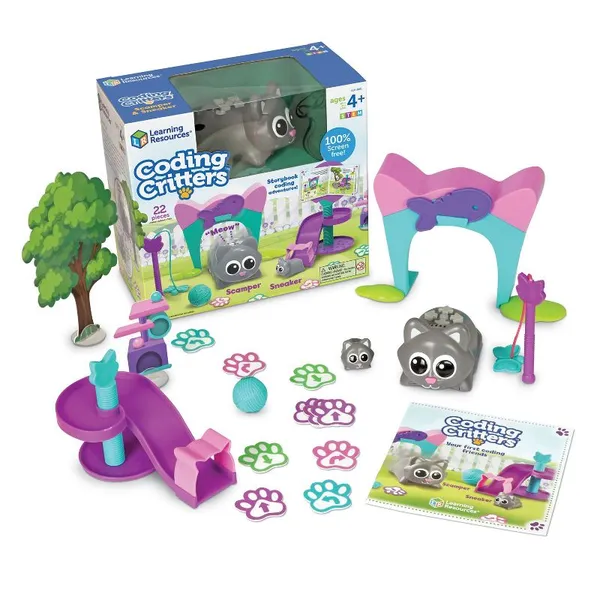
Learning Resources Coding Critters Scamper & Sneaker
“A second Critter with new storybook adventures. Doubles the narrative variety.”
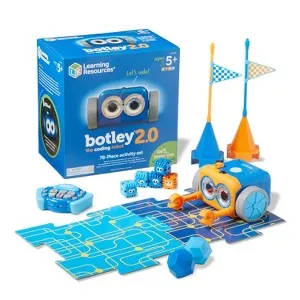
Learning Resources Botley 2.0 Coding Robot Activity Set
“The natural step-up when kids outgrow Critters. Same brand, higher complexity, ages 5-9.”
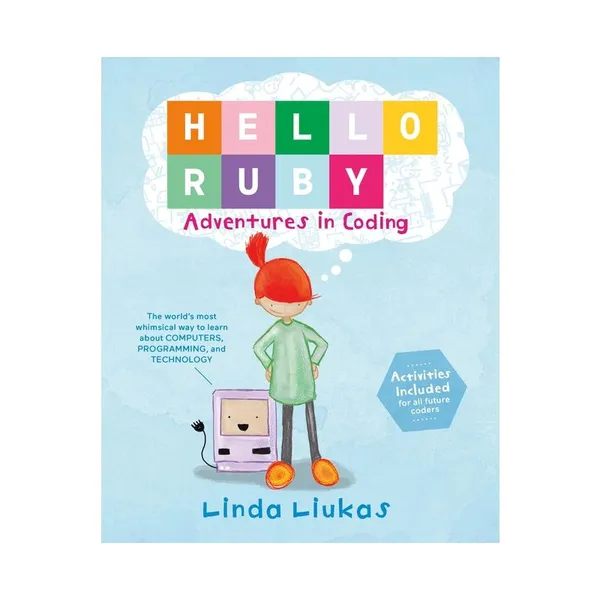
Hello Ruby: Adventures in Coding by Linda Liukas
“Picture book that makes coding concepts into a story. Reinforces what Critters teaches physically.”
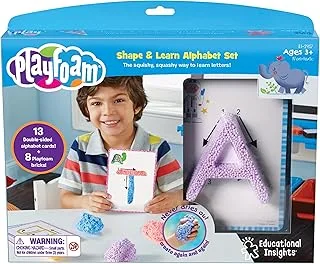
Educational Insights Playfoam Shape & Learn (4-Pack)
“Build obstacle courses for the Critter to navigate. Extends open-ended coding challenges.”
Fisher-Price Think & Learn Code-a-Pillar Twist
“Even simpler coding toy for ages 3+. Fewer features but lower floor for very young coders.”