ScienceBasedKids.com may earn a commission from affiliate links in this article. Our ratings are never influenced by affiliate relationships. Read our full methodology.
Here’s the scene: a three-year-old is sitting on the living room rug, holding a small painted figurine of a lion. She places it on top of a padded cube, and a voice begins telling her a story. She tilts the cube to skip forward. She pats the side to change the volume. No screen. No app. No parental intervention. This is either the Toniebox or the Yoto, depending on whether she placed a figurine or inserted a card — and that small mechanical difference shapes two fundamentally different philosophies about how children should interact with audio content.
The “Toniebox vs Yoto” search gets typed into Google roughly 4,000 times every month, which tells you something about the state of modern parenting: thousands of families standing in the same aisle, holding two boxes, trying to decode which screen-free audio player is worth their money. We’ve tested both extensively — the Toniebox Starter Set ($100), the Yoto Player ($100), and the Yoto Mini ($70) — with children ages 2 through 8 across multiple households. This is our honest, side-by-side comparison.
The Fundamental Difference
Before specs and features, understand this: the Toniebox and Yoto represent different design philosophies, and the “right” choice depends on which philosophy matches your family.
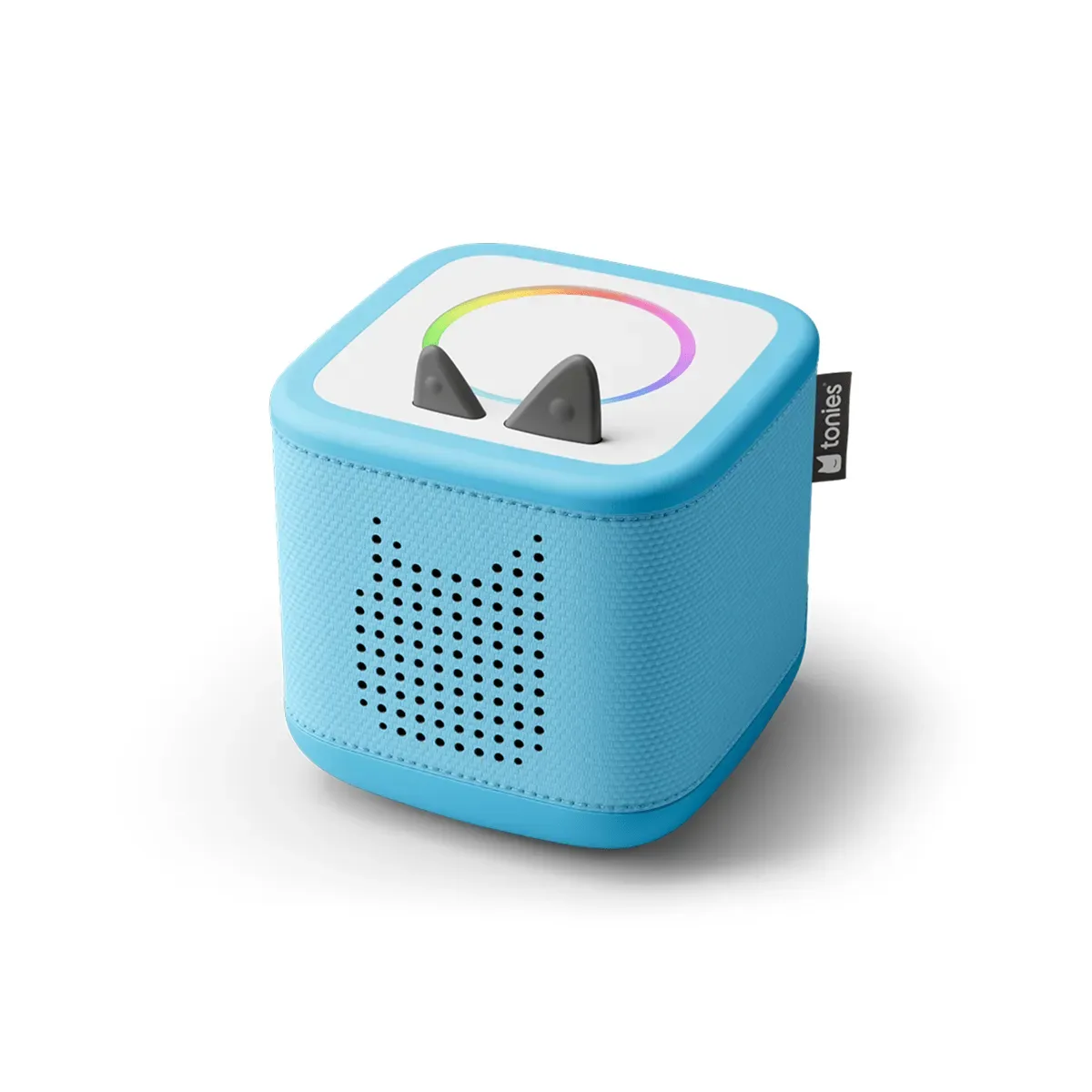
The Toniebox is a toy first, audio player second. It’s a soft, padded cube wrapped in fabric. Content comes on hand-painted figurines called Tonies — a child places a Gruffalo figurine on top of the box, and The Gruffalo plays. The interaction is physical, tangible, collectible. A shelf of Tonies looks like a toy collection. A three-year-old understands immediately what to do.
The Yoto is an audio player first, toy second. It’s a sleek device with a pixel-art display screen (not a video screen — it shows simple illustrations and a clock). Content comes on credit-card-sized cards with NFC chips. Insert a card, audio plays. The interaction is more like using a jukebox than playing with a toy. The content library is vastly larger and the per-story cost is lower.
Neither approach is wrong. But they attract different families for different reasons.
Audio Quality
Both devices deliver surprisingly good sound for children’s products. The Toniebox has a single, front-facing speaker that fills a bedroom adequately. The Yoto Player has a larger speaker driver that produces noticeably fuller sound — richer bass, clearer separation between voice and music. The Yoto Mini, being smaller, sounds thinner than the full Yoto Player but comparable to the Toniebox.
For audiobook listening — which is what most families primarily use these for — all three are perfectly adequate. The difference becomes more apparent with music, where the Yoto Player’s larger driver handles instruments and layered production better. If your child will primarily listen to stories at bedtime, the audio quality gap is a non-factor. If you’re hoping this becomes a first music player, the Yoto Player has an edge.
Volume limiting is handled well by both. The Toniebox maxes out at 85 dB, adjustable via the app. The Yoto defaults to a safe maximum and offers granular app control. Both meet WHO recommendations for children’s listening devices.1
Content Library
This is where the comparison gets interesting — and where the Yoto pulls ahead on paper.
Toniebox Content: Approximately 400+ Tonies figurines are available, each containing one story, album, or audio experience. Individual Tonies cost $12-$17. Popular titles include Disney properties, Julia Donaldson stories, classic fairy tales, and educational content. The “Creative Tonie” ($12) is a blank figurine you can load with up to 90 minutes of custom audio via the app — your own recordings, audiobooks from other sources, or music.
Yoto Content: Over 1,000 cards available, with individual cards starting around $5-$8. The library includes Roald Dahl, David Walliams, audiobook adaptations, podcasts, sleep sounds, and educational content. The “Make Your Own” cards ($12 for a 5-pack) serve the same purpose as Creative Tonies. Critically, Yoto also offers a subscription — the Yoto Club ($10/month) delivers a new card monthly and provides access to a streaming library through the app.
The math matters. A family that buys 20 stories over two years spends approximately $280-$340 on Tonies content versus $100-$160 on Yoto cards. Over the life of the product, the Yoto’s content cost advantage is substantial. The Creative Tonie / Make Your Own card features partially offset this — a resourceful parent can load free audiobook content from the library onto blank media for either platform — but out-of-the-box, Yoto is the better value for voracious listeners.
Content quality is strong on both sides. Tonies benefits from Disney and other premium licensing deals that Yoto lacks. Yoto benefits from a deeper audiobook catalog and more educational / podcast-style content. Neither library will leave you wanting for a child under 8.
The Screen-Free Question
Both products market themselves as “screen-free,” and both are — with a caveat.
The Toniebox is absolutely screen-free. There is no display on the device. A child interacts entirely through physical objects and tactile controls (tilting the box, patting the sides, placing figurines). The companion app is parent-only, used for setup and content management.
The Yoto has a small pixel-art display that shows simple illustrations, a clock, or a sleep timer. It is emphatically not a video screen — the resolution is too low for anything resembling video content, and the illustrations are more like digital picture frames than interactive displays. However, some parents who are strict about screen-free environments feel this crosses a line. In our assessment, the Yoto display is functionally equivalent to an alarm clock display — it adds information without creating the attentional pull of a screen. But reasonable people disagree on this.
For the truly screen-averse family: Toniebox is the safer choice.
For families who are screen-conscious but not screen-absolute: The Yoto’s display is a feature, not a bug. It shows what’s playing, displays the time, and provides a nightlight mode that many families find useful.
Language Development: What the Research Says
This is the section that justifies covering audio players on a site called ScienceBasedKids. Both products are positioned as language development tools, and the underlying research is supportive — though it’s about audio exposure, not these specific devices.
Audiobook exposure and vocabulary. Montag et al. (2015) found that children’s books contain 50% more rare words than typical adult conversation or even prime-time television.2 Audio versions of these same books deliver the same vocabulary richness. A child listening to Charlotte’s Web on a Toniebox or Yoto encounters the same lexical diversity as a child being read to — words like “salutations,” “radiant,” and “humble” that simply don’t appear in everyday speech to children.
Dialogic listening. The research on read-alouds and language development is extensive. Whitehurst et al. (1988) demonstrated that interactive reading — where caregivers pause, ask questions, and discuss the story — produces significant vocabulary gains in young children.3 Audio players can facilitate this if a parent listens alongside the child and pauses for discussion. They cannot replicate it when the child listens alone. This is an important distinction: an audio player is not a substitute for reading with your child. It’s a supplement — and a good one, particularly for car rides, quiet time, and situations where a parent can’t be the narrator.
Phonological awareness. Repeated exposure to rhyme, rhythm, and narrative structure through audio stories supports the phonological awareness that underlies reading readiness. Bus et al. (1995) meta-analyzed the relationship between book exposure and literacy, finding consistent positive effects.4 Audio formats preserve the prosodic features — intonation, stress, pacing — that contribute to this awareness.
The honest assessment: Both the Toniebox and Yoto deliver audio content that supports language development through vocabulary exposure, narrative comprehension, and phonological awareness. The device is a delivery mechanism — the developmental benefit comes from the content and how the family uses it. Neither device is developmentally superior to the other. The Yoto’s larger library means more potential exposure over time; the Toniebox’s tactile interaction means younger children may engage more independently and more often.
Durability
Toniebox: The padded fabric exterior is designed to survive drops, throws, and the general violence of toddlerhood. Our test unit withstood drops from table height onto hardwood without issue. The fabric is removable and washable. The Tonies figurines are solid — hand-painted and sturdy, though the paint can chip with heavy use. The one vulnerability: the NFC sensor on top is under the fabric and can be damaged by a direct, hard impact to the top surface. We didn’t experience this, but it’s reported in parent communities.
Yoto: The plastic casing is solid but less forgiving than the Toniebox’s padded exterior. A drop from table height onto tile would concern us more with the Yoto than the Toniebox. The Yoto Mini, being smaller and lighter, is inherently less drop-risky (less mass, less impact force). The cards are thin and can bend or crack — the same vulnerability as any card-format media. Lost cards are a recurring parent complaint.
Winner: Toniebox, clearly. It was designed to be handled by toddlers, and it shows. The Yoto is durable enough for children 4+, but the Toniebox’s padded construction gives it a meaningful edge for younger users and rougher handlers.
Age Range
Toniebox: Marketed for ages 3+, practically usable from age 2. The figurine-on-top interaction is simple enough for a two-year-old to master. The tactile, cause-and-effect nature of the interaction — place a figure, hear a story — maps onto a toddler’s understanding of how objects work. Our youngest tester (26 months) was placing Tonies and listening within five minutes of unboxing. The upper range extends to about 6-7 before the content library starts to feel young.
Yoto: Marketed for ages 3+, though the Mini is sometimes positioned for ages 3-8 and the full Player for 6-12. In practice, most children under 3 struggle with the card insertion — it requires a fine motor precision that placing a figurine on a flat surface doesn’t. The sweet spot begins at 4. The deeper content library and audiobook catalog extend the useful life further than the Toniebox — a seven or eight-year-old listening to Roald Dahl on a Yoto is genuinely engaged. The Toniebox content starts to age out earlier.
Winner: Depends on age. Under 4, the Toniebox is more accessible. Ages 4-8, the Yoto offers more room to grow.
Price and Long-Term Value
| Toniebox | Yoto Player | Yoto Mini | |
|---|---|---|---|
| Device cost | $100 | $100 | $70 |
| Content cost (per story) | $12-$17 | $5-$8 | $5-$8 |
| Blank media | $12 (1 Creative Tonie, 90 min) | $12 (5 Make Your Own cards) | $12 (5 Make Your Own cards) |
| Subscription option | None | $10/mo (Yoto Club) | $10/mo (Yoto Club) |
| Estimated 2-year content spend | $240-$400 | $100-$200 | $100-$200 |
| Total 2-year cost | $340-$500 | $200-$300 | $170-$270 |
The Yoto Mini at $70 with lower per-story costs is the clear value winner. The Toniebox costs more upfront and per-content-unit, making it the premium choice in a category where “premium” isn’t really about audio quality — it’s about the collectible figurine experience.
For families who will use Creative Tonies and Make Your Own cards extensively (loading library audiobooks, personal recordings), the cost gap narrows. But for families buying official content, the Yoto’s pricing advantage is significant over time.
The Verdict: Who Should Buy What
Buy the Toniebox if:
- Your child is under 3 and you want something they can operate independently right now
- You value a completely screen-free device with no display whatsoever
- Your child is tactile, loves figurines, and would treat Tonies like a toy collection
- Durability is paramount (toddler household, rough handlers)
- You’re comfortable with the higher content cost for the premium tactile experience
- You have a smaller, curated listening diet (fewer titles, played repeatedly)
Buy the Yoto Mini if:
- Your child is 3-8 and you want the best value in screen-free audio
- You want the largest content library and lowest per-story cost
- Portability matters (the Mini is significantly lighter and smaller)
- Your child is or will become an audiobook consumer who goes through stories quickly
- You want the nightlight/clock display as a bonus bedroom feature
- Budget is a primary consideration
Buy the Yoto Player if:
- You want the best audio quality for music listening
- Your child is 5+ and you’re looking for a device that lasts into early tween years
- You want the full-size speaker for filling a room (playroom, kitchen background audio)
Neither is a bad choice.
We want to be direct about this: both the Toniebox and Yoto are solid products with real language development value. The research supports audio exposure for vocabulary growth and phonological awareness, and both devices deliver that effectively. The choice between them is about your child’s age, your family’s screen philosophy, your content budget, and whether figurines or cards feel more natural to your household.
If we had to choose one for a two-year-old’s birthday: Toniebox. For a five-year-old’s birthday: Yoto Mini. For a family that listens to a lot of audio: Yoto Player.
Evidence Rating: Moderate — The research on audio exposure, vocabulary development, and phonological awareness is well-established. Neither device has been studied directly, but the underlying mechanism (rich language exposure through audio stories) has solid support.
For our individual deep-dive reviews, see: Toniebox Starter Set Review | Yoto Player Mini Review
This article reflects our independent evaluation. ScienceBasedKids.com purchased these products at retail price. We may earn commissions through affiliate links, which help fund our research. This never influences our assessments.
Footnotes
-
World Health Organization. (2019). Make Listening Safe. WHO Technical Report. Recommends limiting children’s exposure to sounds above 85 dB and limiting cumulative daily listening time. ↩
-
Montag, J. L., Jones, M. N., & Smith, L. B. (2015). “The words children hear: Picture books and the statistics for language learning.” Psychological Science, 26(9), 1489-1496. ↩
-
Whitehurst, G. J., Falco, F. L., Lonigan, C. J., Fischel, J. E., DeBaryshe, B. D., Valdez-Menchaca, M. C., & Caulfield, M. (1988). “Accelerating language development through picture book reading.” Developmental Psychology, 24(4), 552-559. ↩
-
Bus, A. G., van IJzendoorn, M. H., & Pellegrini, A. D. (1995). “Joint book reading makes for success in learning to read: A meta-analysis on intergenerational transmission of literacy.” Review of Educational Research, 65(1), 1-21. ↩