ScienceBasedKids.com may earn a commission from affiliate links in this article. Our ratings are never influenced by affiliate relationships. Read our full methodology.
What a 3-Year-Old Can Actually Do
At age 3, a typical child:
- Stacks 6–8 blocks (fine motor)
- Pretends and imagines actively
- Follows 2-step instructions
- Is still mouthing objects occasionally (choking-hazard risk until ~4)
- Has attention span of 3–8 minutes per activity
- Does not yet read
- Cannot use an app reliably
This profile rules out most “STEM toys” — structured kits, coding robots, chemistry sets, apps with tutorials. What works: open-ended physical toys that reward stacking, sorting, pouring, building, and pretending.
The Short Answer
| Interest | Pick |
|---|---|
| Building | DUPLO Classic Brick Box — $40 |
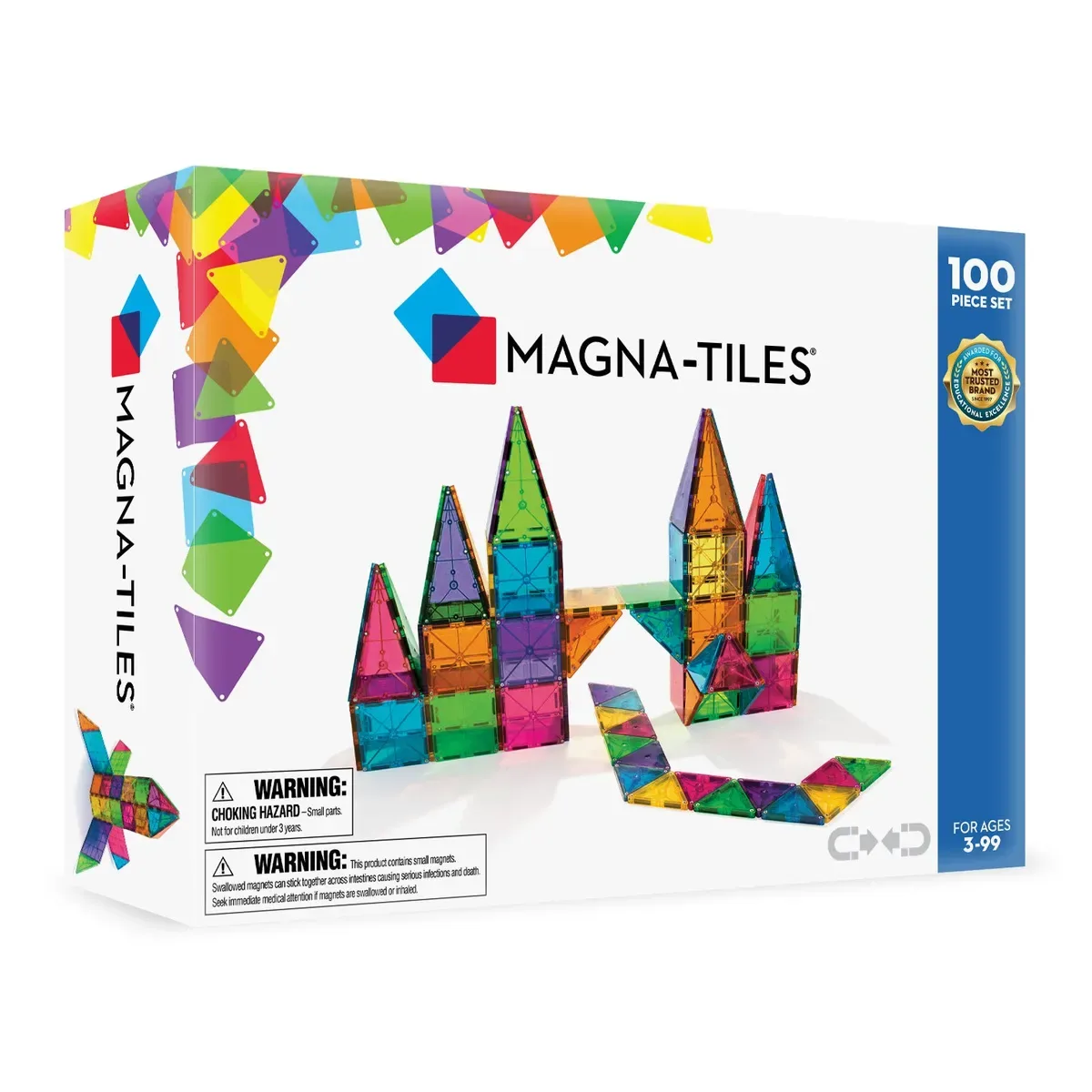
| Magnetic building | Magna-Tiles Clear Colors 32 — $50 |
| Water/sand play | Step2 Rain Showers Splash Pond water table — $90 |
| Puzzles | Melissa & Doug Jumbo Knob puzzles — $13 each |
| Fine motor | Wooden threading beads |
| Outdoor | Plasma Car — $65 (if kid can balance) |
The Picks
1. DUPLO Classic Brick Box — $40
Large, choke-hazard-free LEGO-compatible blocks. Open-ended. No instructions. 65 pieces in a sturdy tub.
Why it lands at 3: Pieces are big enough to grip with whole-hand motor skill, not pincer grip. Classic brick set without a pre-built theme keeps play open-ended.
2. Magna-Tiles Clear Colors 32-piece set — $50
Small starter set. At 3, 32 tiles is the right amount — too many becomes overwhelming. No small parts.
Why it lands at 3: Magnetic assembly succeeds with imprecise placement. The magnets do the fine-motor work. A 3-year-old gets satisfying results from imprecise assembly.
3. Step2 Rain Showers Splash Pond Water Table — $90
Water table with ramps, tracks, and little toys. Water-and-sand play is one of the most research-backed developmental activities for this age.
Why it lands at 3: Supports causal reasoning (water flows downhill, objects sink/float), fine motor (pouring, dumping), and 30–60 minutes of unstructured play.
4. Melissa & Doug Jumbo Knob Puzzles — $13 each
8–12 piece puzzles with large wooden knobs. Classic Melissa & Doug quality.
Why it lands at 3: Large knobs fit toddler grip. 8–12 piece puzzles are the right difficulty. Completion produces genuine satisfaction.
5. Hape Wooden Threading Beads — $15
Lacing large wooden beads onto a string. Classic preschool activity.
Why it lands at 3: Fine-motor development at age-appropriate difficulty. Supports bilateral hand coordination.
6. Plasma Car — $65
A rideable vehicle powered by the kid wiggling the handlebars. Gross-motor + cause-effect.
Why it lands at 3: Physical play; no batteries; genuine physics lesson (kid discovers that wiggling produces motion). Works until age 6–7. Best if the child can already balance and walk confidently.
7. Learning Resources Primary Science Lab Set — $25
Plastic beakers, eyedroppers, safety goggles. “Lab” role-play kit.
Why it lands at 3: Pretend-science role-play. Kid wears goggles and pours water between beakers. Supports imagination + fine motor.
8. Green Toys Recycling Truck — $30
Large plastic truck made from recycled milk jugs. Kid loads and dumps little blocks.
Why it lands at 3: Loading/unloading is a foundational 3-year-old cognitive activity. Green Toys quality is consistently high.
9. Stacking Cups + Rings — $15
Wood or plastic stacking cups. Simple but enduring.
Why it lands at 3: Sorting by size + ordering cognitive skills. Works at bath time too.
10. Large Bristle Blocks — $30
Spiky foam blocks that stick together. No-small-parts alternative to LEGO for very young kids.
Why it lands at 3: Succeeds with imprecise placement. No choking hazard.
What to Avoid at 3
- Anything with small parts. CPSC choking-hazard standard is 1.75” — bigger than you’d think. Most “STEM kits” fail this.
- Apps, screens, and tutorials. Age-inappropriate; 3-year-olds can’t reliably interact with digital interfaces.
- Chemistry sets. Not until age 5–6 minimum; most kits are rated 8+.
- Coding robots. Even “age-3” ones usually require an adult to set up repeatedly.
- Licensing-premium “STEM” kits. A $25 sticker-chart “science kit” is an activity book in disguise.
Books for a 3-Year-Old
Books > toys at this age, calendar-wise:
- The Very Hungry Caterpillar (Carle) — life-cycle
- Press Here (Tullet) — cause and effect
- I Am a Scientist (Stephenson) — picture book about scientific role-play
- The Ultimate Book of Vehicles (Babin) — detail + vocabulary
Budget Combinations
Under $50: DUPLO Classic ($40) + Jumbo Knob Puzzle ($13) Under $100: Magna-Tiles 32 ($50) + Green Toys Recycling Truck ($30) Under $150: Water Table ($90) + Magna-Tiles 32 ($50)
For a Reluctant-Gift Situation
If a 3-year-old is overwhelmed by too many toys, the single best gift is often a one-on-one experience with an adult plus one modest item. A $15 threading-beads set played together is more developmentally valuable than an unused $80 kit.
The Bottom Line
Default gift: DUPLO Classic Brick Box ($40) + any book.
Upgrade: Magna-Tiles 32-piece ($50). Will be played with through age 6+.
Outdoor/gross motor: Plasma Car ($65) if kid can balance.
Resist the impulse to buy “educational” STEM kits at this age. Open-ended toys beat them consistently for both learning and engagement.
For older kids, see STEM Gifts for 5-Year-Olds and 6-Year-Olds.
Every product recommended is age-tested; we note CPSC small-parts compliance where relevant.