ScienceBasedKids.com may earn a commission from affiliate links in this article. Our ratings are never influenced by affiliate relationships. Read our full methodology.
What NGSS Performance Expectations Are
The Next Generation Science Standards define what K–12 students should know and be able to do at each grade level. Each grade’s expectations are organized as Performance Expectations (PEs) — specific, testable statements combining a science practice, a crosscutting concept, and a disciplinary core idea.
Example: 3-LS4-1 (Life Science, grade 3, standard 1): “Analyze and interpret data from fossils to provide evidence of the organisms and the environments in which they lived long ago.” This PE expects students to work with data from fossils, not just see fossils.
A toy that “supports NGSS” shouldn’t just be science-themed — it should give a child experience with the specific science practice, crosscutting concept, or core idea in the PE. Most toys claiming “NGSS alignment” describe surface-level connection (“this is about animals!”). This guide maps our reviewed products to specific PEs at the level of practice they actually reinforce.
How to Use This Guide
Find your child’s grade. Scan the PEs. For each PE, the mapped product is one that, in our review-based observation, gives the child actual practice with the expectation — not just thematic connection.
Kindergarten (K)
K-PS2 Motion and Stability
K-PS2-1: Plan and conduct an investigation to compare the effects of different strengths or different directions of pushes and pulls on the motion of an object.
- Plasma Car — A child pushes and pulls on the handlebars, and the car moves forward. Direct practice with the core idea.
- Stomp Rocket Original — Harder stomp = higher rocket. Variable force, observable effect.
K-LS1 From Molecules to Organisms
K-LS1-1: Use observations to describe patterns of what plants and animals (including humans) need to survive.
- Not a direct toy match; best approached through garden/pet observation and picture books.
K-ESS2 Earth’s Systems
K-ESS2-1: Use and share observations of local weather conditions to describe patterns over time.
- Weather journal (supply: a simple notebook + weather chart printout). Not a product per se; no kit required. Build a weather station (rain gauge from a clear container, wind flag from a straw).
K-ESS3 Earth and Human Activity
K-ESS3-1: Use a model to represent the relationship between the needs of different plants or animals (including humans) and the places they live.
- Picture books + simple diorama activities. Magna-Tiles can scaffold “build the habitat” play.
Grade 1
1-PS4 Waves
1-PS4-1: Plan and conduct investigations to provide evidence that vibrating materials can make sound, and that sound can make materials vibrate.
- Rice-on-plastic-wrap experiment (see our Halloween science guide #8). Rice dances when sound hits the surface.
- Kala Ukulele — Pluck a string, hear the sound; dampening the string changes the note. Direct practice.
1-LS1 From Molecules to Organisms
1-LS1-1: Use materials to design a solution to a human problem by mimicking how plants and/or animals use their external parts to help them survive, grow, and meet their needs.
- Building toys for “design a solution” activities. Magna-Tiles 100 for designing animal habitats; KEVA Planks for designing bird feeders.
1-ESS1 Earth’s Place in the Universe
1-ESS1-1: Use observations of the sun, moon, and stars to describe patterns that can be predicted.
- Moon phase journal (see our Perseid Meteor Shower guide for more astronomy-for-kids framings). Binoculars or naked-eye observation.
Grade 2
2-PS1 Matter and Its Interactions
2-PS1-1: Plan and conduct an investigation to describe and classify different kinds of materials by their observable properties.
- Thames & Kosmos Kids First Chemistry — classification of reagents (powders, liquids, colors, solubility).
- Rainbow Counting Bears — color and size classification at a more concrete level.
2-PS1-2: Analyze data obtained from testing different materials to determine which materials have the properties that are best suited for an intended purpose.
- Bridge-building activities (paper bridges test, see our 3rd-grade science fair guide #7 — appropriate for motivated 2nd graders too).
- Thinkfun Gravity Maze — designing a solution with available materials; core “intended purpose” practice.
2-LS4 Biological Evolution
2-LS4-1: Make observations of plants and animals to compare the diversity of life in different habitats.
- Nature-walk observation journal + basic field guide. No product required.
Grade 3
3-PS2 Motion and Stability
3-PS2-1: Plan and conduct an investigation to provide evidence of the effects of balanced and unbalanced forces on the motion of an object.
- Rush Hour Jr. — while it’s primarily a logic puzzle, the physical pushing of cars through tight positions gives practice with force-motion relationships.
- Bridge-loading experiments (see our 3rd grade science fair projects guide #7).
3-PS2-2: Make observations and/or measurements of an object’s motion to provide evidence that a pattern can be used to predict future motion.
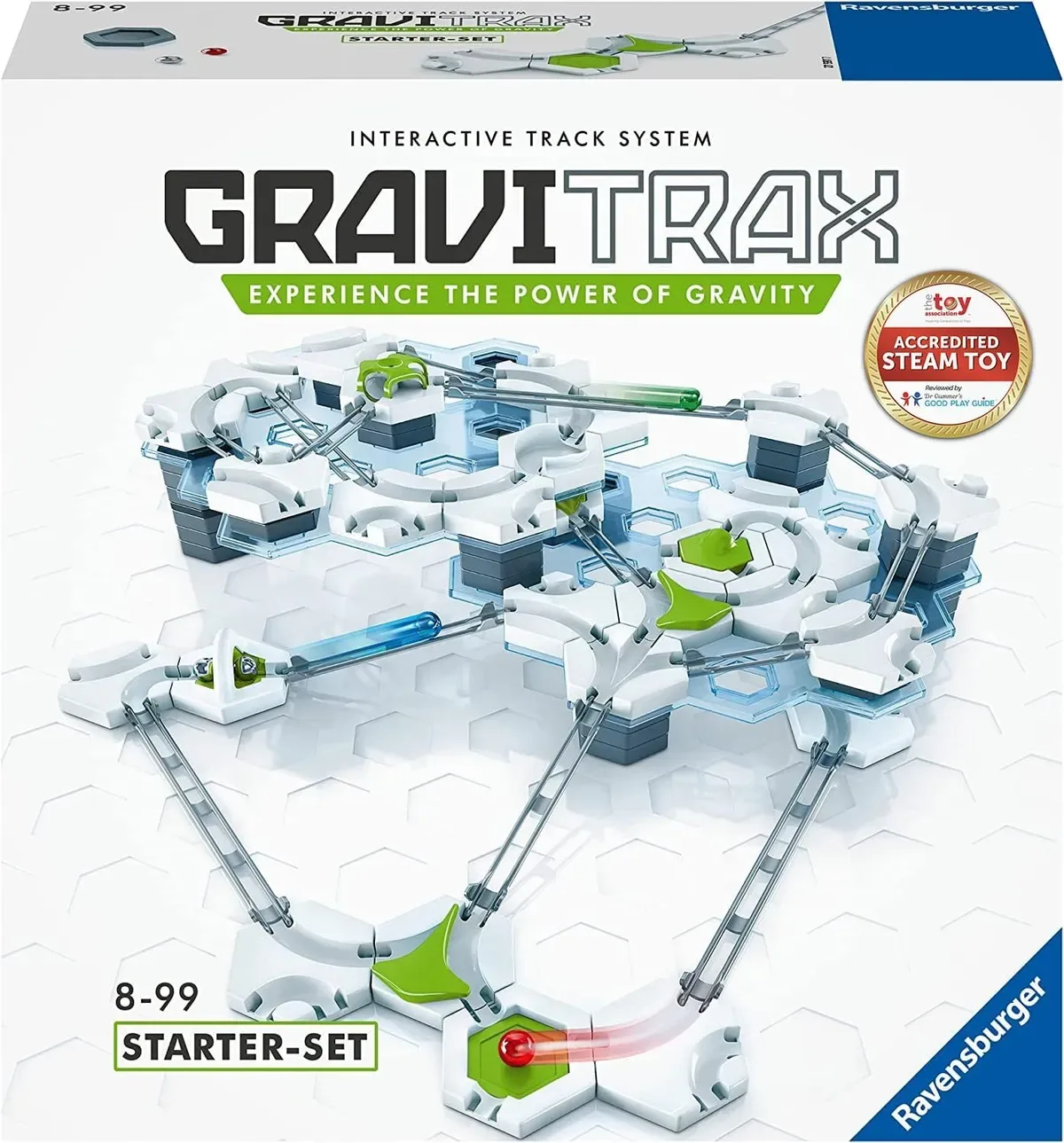
- GraviTrax Starter Set — marble motion is highly predictable once a track is built; children predict “where will it go?” before releasing.
- Stomp Rocket Original — launch angle and force correlate predictably with distance and height.
3-LS4 Biological Evolution
3-LS4-1: Analyze and interpret data from fossils to provide evidence of the organisms and the environments in which they lived long ago.
- Fossil kits (not currently in our review archive) + museum visits. National Geographic Outdoor Explorer Set has tangentially relevant materials.
3-ESS2 Earth’s Systems
3-ESS2-1: Represent data in tables and graphical displays to describe typical weather conditions expected during a particular season.
- Weather-journal + chart-making. Tools: simple notebooks, printable weather charts, access to a thermometer.
Grade 4
4-PS3 Energy
4-PS3-1: Use evidence to construct an explanation relating the speed of an object to the energy of that object.
- GraviTrax — marble at top of ramp vs bottom; potential energy vs kinetic energy.
- Snap Circuits Classic SC-300 — circuits at different voltages produce different brightness/speed; direct practice with energy transfer.
4-PS3-2: Make observations to provide evidence that energy can be transferred from place to place by sound, light, heat, and electric currents.
- Snap Circuits Classic — the flagship product for this PE. Build a circuit that converts electricity → light → detected by photoresistor.
- Kala Ukulele — sound transfer demonstration.
- Ice-melting experiments (see our sensory-friendly STEM guide) — heat transfer.
4-PS3-4: Apply scientific ideas to design, test, and refine a device that converts energy from one form to another.
- Snap Circuits Classic SC-300 — direct practice. A circuit that converts battery energy → fan spin. Modifying components changes the conversion efficiency.
- GraviTrax — tracks that convert potential to kinetic to (via magnetic cannons) kinetic again.
4-LS1 From Molecules to Organisms
4-LS1-1: Construct an argument that plants and animals have internal and external structures that function to support survival, growth, behavior, and reproduction.
- Not directly toy-supported. Best through books + nature observation.
4-ESS1 Earth’s Place in the Universe
4-ESS1-1: Identify evidence from patterns in rock formations and fossils in rock layers to support an explanation for changes in a landscape over time.
- Not directly toy-supported. Geology-themed kits could support; none in our current archive.
Grade 5
5-PS1 Matter and Its Interactions
5-PS1-1: Develop a model to describe that matter is made of particles too small to be seen.
- Thames & Kosmos Chem C500 — at age 10+, kids can work with the concept of molecules while doing experiments. The reactions reveal particle-level interactions indirectly.
5-PS1-2: Measure and graph quantities to provide evidence that regardless of the type of change that occurs when heating, cooling, or mixing substances, the total weight of matter is conserved.
- Kitchen chemistry with a kitchen scale. Weigh ingredients before and after reactions.
5-PS1-3: Make observations and measurements to identify materials based on their properties.
- Thames & Kosmos Kids First Chemistry or C500 — both support property-based material identification.
5-PS1-4: Conduct an investigation to determine whether the mixing of two or more substances results in new substances.
- Vinegar + baking soda (classic acid-base reaction). See our non-toxic chemistry set guide for age-appropriate reagent handling.
5-LS2 Ecosystems
5-LS2-1: Develop a model to describe the movement of matter among plants, animals, decomposers, and the environment.
- Not directly toy-supported. Best through garden/ecosystem observation.
5-ESS1 Earth’s Place in the Universe
5-ESS1-1: Support an argument that differences in the apparent brightness of the sun compared to other stars is due to their relative distances from the Earth.
- Basic binoculars + night-sky observation (see our Perseid Meteor Shower guide). Compare the brightness of Jupiter, Mars, and distant stars.
5-ESS1-2: Represent data in graphical displays to reveal patterns of daily changes in length and direction of shadows, day and night, and the seasonal appearance of some stars in the night sky.
- Shadow-tracking experiments (see our sensory-friendly STEM guide #3). Free, no product needed.
The Meta-Lesson: What NGSS Alignment Means
Many “STEM toys” claim NGSS alignment without matching any specific PE at the practice level. When evaluating a toy’s NGSS claim:
- Ask which specific PE it supports. Not “life science” broadly — the specific PE code.
- Ask what the child does that reinforces that PE. Surface-level connection (“this toy is about animals!”) is not alignment.
- Check whether the toy gives practice with the science practice. Does it involve planning an investigation? Analyzing data? Constructing an explanation?
Our assessment: toys that genuinely align with multiple specific PEs at the practice level include Snap Circuits Classic SC-300, GraviTrax Starter Set, Thames & Kosmos Kids First Chemistry, Magna-Tiles 100, and ThinkFun Gravity Maze. These products give practice with the practices of science — investigating, measuring, modeling, constructing explanations — at levels appropriate for multiple grade bands.
Tools That Are NGSS-Adjacent But Not Mapped
Some products in our archive are educationally valuable without direct NGSS alignment:
- Botley 2.0 Coding Robot — computer science, not NGSS (CSTA standards apply).
- Rush Hour Jr. — logic/reasoning. Math Common Core alignment, not NGSS.
- Kingdomino — strategy/math. Common Core math alignment.
These support learning but not NGSS specifically.
For Homeschool Families
Homeschool parents using secular curricula can use this map as a cross-reference: each week’s curriculum topic can be supplemented with toys that give hands-on practice with the same PE. Curriculum covers the conceptual; toys give practice-based reinforcement. The combination is meaningfully stronger than either alone.
For Teachers
Classroom teachers can use this as a supply-list reference: which kits in the budget give the most practice with which PEs? Thames & Kosmos Kids First Chemistry ($40, ASTM F963 compliant — see our chemistry-set safety guide) provides 5 reusable kits’ worth of PE-aligned lab for multiple grades.
Sources
- NGSS Performance Expectations: nextgenscience.org
- NRC Framework for K-12 Science Education (2012): National Academies Press
- National Science Teaching Association resources: nsta.org
This guide covers K–5 mapping. Middle-school (6–8) PEs will be covered in a separate future piece as our product archive expands into that age range.