ScienceBasedKids.com may earn a commission from affiliate links in this article. Our ratings are never influenced by affiliate relationships. Read our full methodology.
The Framing Problem
Parent-facing content about Montessori vs “traditional” toys often presents a false binary: either you subscribe to the Montessori philosophy (open-ended, child-led, minimalist materials) or you use conventional scripted kits (step-by-step instructions, specific outcomes, adult-directed). The actual research doesn’t support this binary — both approaches have documented developmental benefits, and they target different skills.
This guide breaks down when each approach fits, which products in our archive best represent each philosophy, and why most families benefit from having both in rotation.
The Two Philosophies, Briefly
Montessori-philosophy materials share several characteristics:
- One conceptual skill per material (graded cylinders target size discrimination; pink tower targets visual scaling)
- Self-correcting design (the child knows when they’ve succeeded without adult feedback)
- Open-ended use (the child decides what to do; the material supports rather than directs)
- Minimalist aesthetic (solid colors, natural materials, no sensory overstimulation)
- Designed for extended concentration (“normalization” in Montessori terminology)
Scripted science kits share a different set:
- Multi-concept content in a single package
- Step-by-step instructions that direct the child’s activity
- Defined outcomes (“build this circuit, observe the light turn on”)
- Varied stimulation (multiple colors, varied components, clear “success” markers)
- Designed for moderately-paced engagement rather than deep concentration
These are not good vs bad — they’re different developmental tools targeting different skills.
What Each Builds
Montessori materials develop:
- Sustained concentration. The child works with a single material for long stretches. Research on attention span and early executive function supports this framework.1
- Self-direction. The child chooses materials, decides when to switch, evaluates their own work. This agency builds metacognition — thinking about thinking.
- Divergent thinking. Open-ended materials invite “what else could I do with this?” Creative problem-solving develops through the absence of “right” answers.
- Fine motor refinement through repetition. A child placing graded cylinders 50 times in an afternoon builds fine motor precision that scripted projects don’t provide.
Scripted kits develop:
- Procedural reasoning. Following a sequence of steps, recognizing cause-effect, completing goal-directed sequences. The transferable skill for later programming, cooking, lab work.
- Content knowledge. A chemistry kit teaches chemistry. A circuit kit teaches circuit theory. Scripted kits can deliver specific disciplinary content that open-ended materials don’t target.
- Convergent thinking. Given a specific problem, finding the specific correct solution. This is the counterpart to divergent thinking and is equally important for scientific reasoning.
- Hypothesis-testing. “What happens if I swap this component?” — scripted kits provide the scaffold within which a child can learn to run experiments.
Neither skill set is complete without the other. A child who only does Montessori materials may never develop procedural reasoning or content knowledge. A child who only does scripted kits may never develop self-direction or divergent thinking.
Products in Our Archive: Montessori-Aligned
Cubetto Coding Robot — $225 — 7/10
Explicitly Montessori-branded. Physical wooden programming blocks on a physical board; no screen. The coding happens through block placement that the child self-directs. One of the cleanest Montessori-philosophy STEM products at any price point.
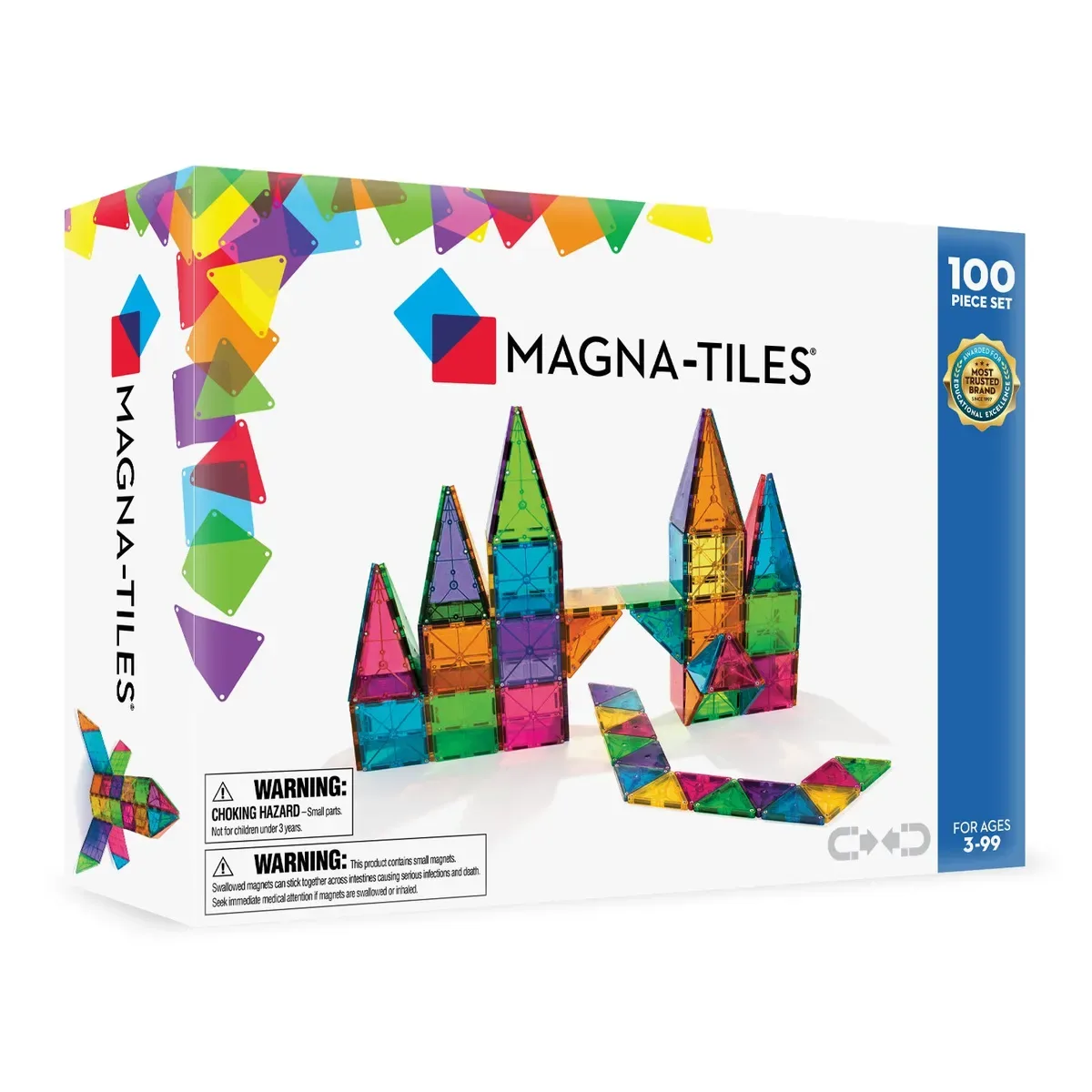
Magna-Tiles 100-Piece Clear Colors Set — $120 — 9/10
Not explicitly Montessori-branded but shares philosophy characteristics: one material (magnetic tiles), open-ended use, self-correcting (structures that don’t balance fall down), and designed for sustained concentration. Our highest-rated open-ended building toy.
KEVA Planks 200-Piece Set — $50 — 8/10
Simple wooden planks, no instructions. Maximally open-ended. A child experiments with balance, gravity, and engineering through pure trial and learning.
Rainbow Counting Bears
Color/size sorting materials that support Montessori-style grading activities. Useful for ages 3–5.
Grimm’s Large Rainbow — $60
Wooden stacking rainbow — an iconic Montessori-aligned material. Supports open-ended exploration of color, balance, shape, and creative construction.
Open-Ended Playsilks
Colorful fabric squares with no prescribed use. Classic Waldorf/Montessori-adjacent material — becomes whatever the child decides (cape, tent, water, flag).
Melissa & Doug Shape Sorting Cube
Self-correcting shape-sorter for young children. Closer to the Montessori style than most commercial shape-sorters because of the simplicity and durable construction.
Products in Our Archive: Scripted-Kit Aligned
Snap Circuits Jr. SC-100 / Classic SC-300 — $35 / $45
Illustrated project manuals guide kids through 100–300 specific circuits. Step-by-step, defined outcomes, clear success markers. Highly scripted and one of the strongest content-delivery products in the STEM toy market.
Thames & Kosmos Kids First Chemistry — $40
24 experiments with specific procedures and expected results. Scripted chemistry delivered in bite-sized units. The full C-series extends scripted chemistry through the C3000 at age 13+.
GraviTrax Starter Set — $60
Hybrid: the starter set includes cards with specific track challenges (scripted), but the same components support open-ended design (Montessori-aligned). One of the most versatile products in our archive for this exact reason.
ThinkFun Gravity Maze — $35
60 printed challenges with specific solutions. Classic scripted puzzle format.
Botley 2.0 Coding Robot — $65
Primarily scripted — the included challenge cards give the child specific problems to solve. Can be used more open-endedly but the core use is structured.
KiwiCo Kiwi Crate Subscription
Entirely scripted. Each monthly crate delivers 2–3 specific projects with instructions. See our full review.
The Hybrid Products
A few products blur the line and deserve call-out:
- GraviTrax — Ships with scripted challenges but supports extensive open-ended play with the same components.
- LEGO SPIKE Essential — Can be used for scripted projects (detailed guide included) or for purely open-ended building.
- Magna-Tiles — Marketed as open-ended but Thames & Kosmos and others produce “challenge books” that make them quasi-scripted.
These hybrid products may be the most adaptable — they can flex to match the specific developmental goal at a given moment.
When to Choose Montessori-Aligned
- For a child who is frequently restless and moving between activities. Montessori materials’ design for sustained concentration is therapeutic for a child who jumps between short activities constantly.
- For a child who struggles with “wrong” answers. Open-ended materials eliminate the binary success/failure framework that can stress some children.
- For building foundational executive function skills in ages 2–5. The early-childhood Montessori research base is particularly strong for this age.2
- For creative-play dominated households. If your household already uses lots of scripted activities (schoolwork, piano lessons, etc.), Montessori materials balance the overall diet.
When to Choose Scripted Kits
- For building content knowledge in a specific domain. If your child wants to learn chemistry, a chemistry kit delivers chemistry. Open-ended materials don’t.
- For procedural-reasoning practice. Following steps, recognizing order, completing sequences — these are real transferable skills that scripted kits build.
- For a child who struggles with “what should I do?” Some children thrive with clear direction and disengage from fully open-ended materials. Matching the format to the child matters.
- For motivated project completion. The satisfaction of finishing a specific thing is real, and scripted kits deliver this satisfaction reliably.
The Research
Lillard’s book Montessori: The Science Behind the Genius is the definitive modern review of research supporting Montessori pedagogy, particularly for ages 2–6.3 The evidence supports benefits for executive function, academic outcomes, and creativity in children who spent time in high-fidelity Montessori environments.
On the scripted-kit side, the broader literature on procedural learning, inquiry-based instruction, and project-based learning supports scripted approaches for specific outcomes.4
Both research bases are legitimate. Neither overturns the other. The children who benefit most have access to both types of materials in their developmental environment.
For Parents Who Must Choose (Budget-Constrained)
If budget requires picking one style for the primary toy, the practical recommendation is:
- Ages 2–5: Lean Montessori-aligned. Foundational executive function and self-direction development in this window is particularly well-supported by open-ended materials.
- Ages 5–8: Balance. Add a scripted kit (Magna-Tiles with challenge cards, Snap Circuits Jr, Thames & Kosmos Kids First Chemistry) to complement existing open-ended materials.
- Ages 8+: Lean scripted. Content-specific learning becomes more valuable as cognitive capacity increases; the best scripted kits (Snap Circuits Classic, Thames & Kosmos C1000) deliver substantive subject-matter content.
This isn’t a strict rule — a specific child’s preferences matter more than age averages. But for a “no strong signal from the child” starting point, this progression works.
The Bottom Line
The either/or framing is a marketing construct, not a research-supported choice. Both Montessori-aligned and scripted approaches have documented developmental benefits for different skills. The better question is “what does my child need more of right now?” and answering that honestly.
Montessori-primary household: Add a scripted kit or two for content-specific learning and procedural-reasoning practice.
Scripted-primary household: Add one or two high-quality open-ended materials (Magna-Tiles, KEVA Planks) for divergent-thinking and sustained-concentration practice.
Every product recommended has been reviewed in depth by our team.
Footnotes
-
Diamond, A., & Lee, K. (2011). “Interventions shown to aid executive function development in children 4 to 12 years old.” Science, 333(6045), 959–964. ↩
-
Lillard, A. S., & Else-Quest, N. (2006). “Evaluating Montessori education.” Science, 313(5795), 1893–1894. ↩
-
Lillard, A. S. (2017). Montessori: The Science Behind the Genius (3rd ed.). Oxford University Press. ↩
-
Furtak, E. M., Seidel, T., Iverson, H., & Briggs, D. C. (2012). “Experimental and quasi-experimental studies of inquiry-based science teaching: A meta-analysis.” Review of Educational Research, 82(3), 300–329. ↩