ScienceBasedKids.com may earn a commission from affiliate links in this comparison. Our ratings are never influenced by affiliate relationships. Read our full methodology.
The Fundamental Difference
Both products use magnets to connect shapes. That’s where the similarity ends.
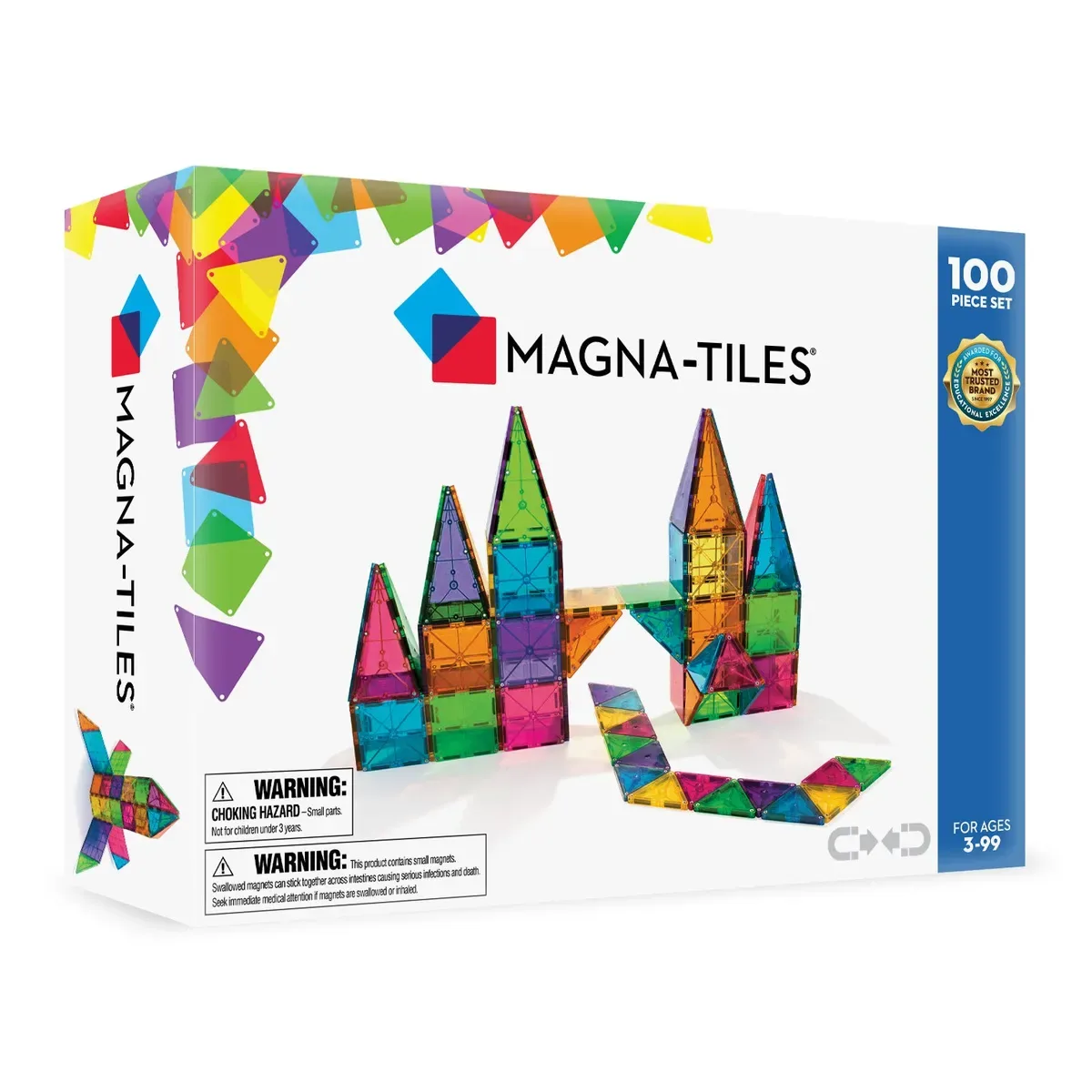
Magnetic Tiles (Magna-Tiles, Connetix, PicassoTiles, Playmags) are flat geometric shapes — mostly squares and triangles — with magnets embedded along each edge. Builds typically start as 2D patterns laid flat, then “fold up” into 3D structures as edges magnetize together. The final builds look like architecture: houses, castles, city blocks, geometric art.
Magformers are geometric frames (not solid tiles — just the outline of each shape) with stronger magnets embedded along the edges. The hollow nature and stronger magnets let Magformers build more mechanically-complex 3D structures — cars with wheels, robots with articulating joints, spherical builds. The final builds look like mechanical objects.
These are different build vocabularies. A child who loves architecture and pattern-making gravitates to magnetic tiles. A child who loves machines and vehicles gravitates to Magformers. Many children happily play with both if both are available, but if you can only buy one, the decision depends on the child.
The Short Answer
| Situation | Choose |
|---|---|
| First magnetic toy purchase | Magnetic tiles (Magna-Tiles) |
| Child loves cars, vehicles, robots | Magformers |
| Child loves houses, castles, patterns | Magnetic tiles |
| Budget-conscious | PicassoTiles (see 4-brand comparison) |
| Already has magnetic tiles, want different vocabulary | Magformers |
| Ages 2–4 | Magnetic tiles (larger, less small-part, more forgiving magnet strength for small hands) |
| Ages 6–10 engineering-inclined | Magformers (stronger magnets support more ambitious kinetic builds) |
Magnetic Tiles: What They Do Well
Our Magna-Tiles 100-Piece Clear Colors review gives the baseline
- Open-ended 2D-to-3D transformation. A child lays flat pieces in a pattern, then folds the edges up — and the structure stands. This is the pedagogical “magic moment” that research on spatial reasoning specifically supports.1
- Forgiving for young builders. The magnetic attraction is weaker than Magformers’, which actually helps young kids — structures don’t snap together so forcefully that 3-year-olds can’t manipulate them.
- Beautiful translucent palette. Held to light, the tiles glow; placed on a light pad, they look like stained glass. See our light-pad accessory recommendation in the Magna-Tiles 100 review.
- Extensive product line. Magna-Tiles alone has 10+ expansion sets (Freestyle, Metropolis, Glow in the Dark, Ice Princess, Downhill Duo, etc.), each adding specific build vocabulary. See our individual reviews for Freestyle, Metropolis, Glow Dark, Downhill Duo.
- 4-brand competitive market. Magna-Tiles, PicassoTiles, Playmags, and Connetix all produce compatible tiles at different price/quality points. See our full 4-brand comparison.
Magformers: What They Do Well
- Stronger magnets for mechanical builds. Magformers’ magnets are genuinely stronger than Magna-Tiles’. Structures hold together against torsion and mechanical stress in ways tile-based builds can’t match. This enables cars that actually roll, rotating robots, pendulums.
- Wheel and articulation accessories. Magformers sells accessory sets — wheels, magnetic balls, articulating joints — that attach to standard Magformers pieces. You can build a car and it rolls. You can build a robot and its arms swing. Magnetic tiles don’t have this vocabulary.
- Mechanical-engineering build vocabulary. A child who wants to build a “working” thing — a car, a windmill, a crane — gets more runway with Magformers than with magnetic tiles. Magnetic tiles build architecture; Magformers build machines.
- Smaller form factor. Magformers pieces are typically smaller than Magna-Tiles, which means more pieces per dollar. For a large build (say, a 50-piece structure), Magformers reaches further.
Magformers: What’s Limited
- Stronger magnets aren’t always a feature. For a 3-year-old, the magnet strength can be frustrating — pieces snap together too forcefully for small hands to manipulate cleanly. Magna-Tiles’ weaker connection is often better for this age.
- Less forgiving for young builders. Magformers’ hollow-frame structure is more sensitive to placement than magnetic tiles’ flat-against-flat design. Getting the pieces to connect “right” requires more precision.
- Less aesthetically arresting. Magformers builds look like mechanical objects rather than architectural ones. Kids who value the visual result (the beautiful castle, the glowing tower) tend to prefer tiles. Kids who value the functional result (the car that rolls, the robot that spins) tend to prefer Magformers.
- Fewer individual reviews in our archive: We have Magformers 30-piece review with a 7/10 rating, but the Magna-Tiles ecosystem is more thoroughly covered in our content.
- Research support is less direct. The spatial reasoning research base supporting magnetic tiles applies less cleanly to Magformers’ mechanical-framework builds. The category (construction play broadly) has research support; the specific Magformers build pattern is less studied.
Price Comparison
| Magna-Tiles 100 | Magformers 30 | Connetix 100 | |
|---|---|---|---|
| Price | $120 | $50 | $120 |
| Piece count | 100 | 30 | 100 |
| Cost per piece | $1.20 | $1.67 | $1.20 |
| Realistic build scale | Large architecture | Small mechanical builds | Large architecture |
Magformers pieces cost more per unit. For a household investing in one building toy, magnetic tiles deliver more piece-count-per-dollar. For a household adding a second vocabulary (cars, machines) to an existing tile collection, Magformers’ smaller piece count at $50 is a reasonable add-on.
Age Fit
Magnetic Tiles: Best fit is ages 3–8. Younger kids (2–3) engage with stacking and basic 2D patterns. Older kids (6–8) attempt full 3D architectural builds. By 9–10, most kids outgrow magnetic tiles in favor of more engineering-focused products like GraviTrax or LEGO SPIKE.
Magformers: Best fit is ages 5–10. Under 5, the precise placement required and stronger magnets frustrate most kids. 5–7 is peak engagement for Magformers’ build vocabulary. 8–10 kids often pair Magformers with other mechanical-building products (LEGO Technic, etc.) to build larger functional objects.
What the Research Says
The spatial reasoning research base supporting construction play broadly supports both product categories. Verdine et al. (2014) and Jirout and Newcombe (2015) both document positive associations between construction play and spatial skills in early childhood.12 These studies were conducted with traditional blocks, not specifically with either magnetic tiles or Magformers — so the category-level evidence transfers, but product-specific claims about relative developmental benefit can’t be made from the current research.
In our direct observation, children engaged with both products develop spatial reasoning in slightly different directions: magnetic-tile play emphasizes pattern recognition and 2D-to-3D transformation; Magformers play emphasizes joint articulation and mechanical-frame thinking. Both are useful; neither is strictly better.
Which Do You Buy?
Primary purchase for most households: Magnetic tiles (Magna-Tiles 100 if budget allows, PicassoTiles 100 for budget-conscious).
Secondary purchase, complementary: Magformers 30 or 60-piece set. Good for a child who has already loved magnetic tiles and wants more mechanical-feeling builds.
Don’t buy both simultaneously as a first purchase. The magnetic-tile ecosystem is deep enough that most families get years of play out of it without expanding to Magformers. Add Magformers as a second-birthday or second-Christmas gift once the child has established they engage with magnetic building.
The Bottom Line
First magnetic-toy purchase, most 3-to-8-year-olds: Magna-Tiles 100 at $120. Better age range, research-supported, ecosystem depth. Our 4-brand tile comparison covers budget alternatives.
Adding a second magnetic-build vocabulary: Magformers 30 at $50. Different mechanism, mechanical-build vocabulary, complements (doesn’t replace) magnetic tiles.
For the specifically engineering-inclined 5-to-10-year-old: Magformers or GraviTrax (more engineering-focused). If the child’s interests are specifically “how machines work,” GraviTrax may deliver more than Magformers.
Every product recommended has been reviewed in depth by our team. The Magna-Tiles ecosystem is the most-covered single product line in our review archive; the Magformers coverage is lighter (our Magformers 30 review is the primary entry).
Footnotes
-
Verdine, B. N., Golinkoff, R. M., Hirsh-Pasek, K., Newcombe, N. S., Filipowicz, A. T., & Chang, A. (2014). “Deconstructing building blocks: Preschoolers’ spatial assembly performance relates to early mathematical skills.” Child Development, 85(3), 1062–1076. ↩ ↩2
-
Jirout, J. J., & Newcombe, N. S. (2015). “Building blocks for developing spatial skills: Evidence from a large, representative U.S. sample.” Psychological Science, 26(3), 302–310. ↩