ScienceBasedKids.com may earn a commission from affiliate links in this article. Our ratings are never influenced by affiliate relationships. Read our full methodology.
Editorial Note
This article draws on our full KiwiCo Kiwi Crate review (6-month subscription), March 2026 evaluations of CrunchLabs and Little Passports (partial data), and published product documentation for the other subscriptions covered. Full 12-month reviews of CrunchLabs, Little Passports, and Mel Chemistry are in progress. Where we report first-hand experience vs external documentation, we say so.
Why Age 8 Specifically
Eight-year-olds sit at the center of several subscription target ranges:
- KiwiCo Kiwi Crate: ages 5–8 (8 is the upper end)
- KiwiCo Tinker Crate: ages 9–14+ (8 is marginal)
- CrunchLabs Build Box: ages 8–14 (8 is the lower end)
- Mel Chemistry: ages 10–16 (8 is below the range)
- Little Passports World Edition: ages 6–10 (8 is sweet spot)
This means the optimal subscription differs meaningfully from age 7 or age 10. This guide is specifically for age 8.
The Short Answer
| Context | Choose |
|---|---|
| Default recommendation | KiwiCo Kiwi Crate ($20/mo annual) |
| Already-interested engineering/Mark Rober fan | CrunchLabs Build Box ($30/mo) |
| Geography-curious, collector personality | Little Passports World Edition ($20/mo) |
| Strong chemistry interest, committed supervision | Wait 2 years for Mel Chemistry |
| Multi-child household (ages 5, 8, 11) | KiwiCo (line breadth across ages) |
The Contenders
KiwiCo Kiwi Crate — $19.95/mo (annual) / $24.95/mo (monthly)
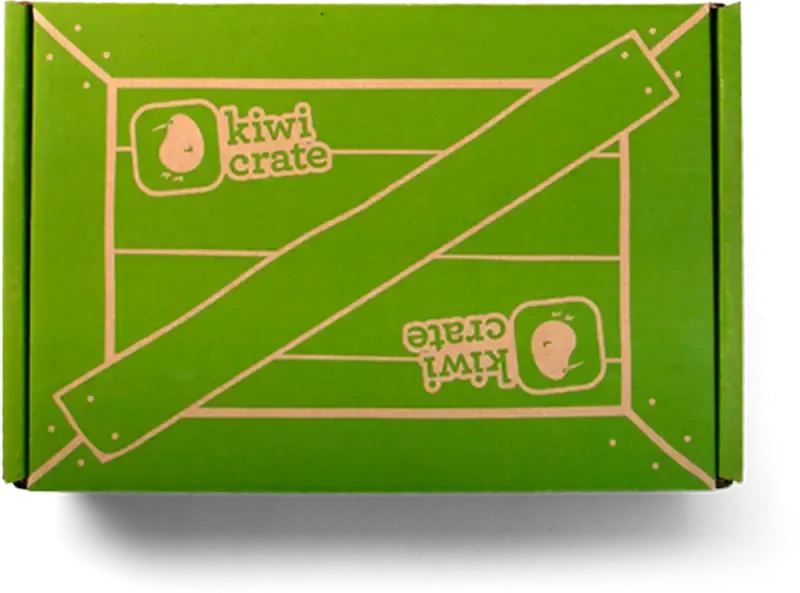
At age 8, Kiwi Crate is in its sweet spot. The projects are age-calibrated, the reading level matches an 8-year-old’s fluency, and the craft materials are sized for 8-year-old hand dexterity.
What a typical month delivers: 2–3 themed projects (e.g., “pinball machine” theme with a cardboard pinball game build, a smaller desk gadget, plus a tie-in magazine). Each project is 30–60 minutes of work.
Why it’s the default: Operational maturity, age-fit, broad line (Panda/Koala/Kiwi/Atlas/Tinker/etc. means multi-child households work). See our full review.
What’s limited: Month-to-month engagement can wane at months 4–6 (a documented subscription-fatigue pattern). Our is-it-worth-it-at-6 piece walks through the decision framework (most of that piece applies at 8 too).
CrunchLabs Build Box — $29.99/mo
At 8, this is the lower end of CrunchLabs’ age range. The Build Box projects lean toward 10–12; an 8-year-old does them with parent scaffolding more often than solo. The project count is fewer but each project is bigger — a single engineering challenge per month vs KiwiCo’s 2–3 projects.
What a typical month delivers: 1 larger engineering project (a rubber-band launcher, a desktop fan from scratch, a mechanical clock) + Mark Rober video.
Why to choose it: Brand cachet matters at 8. If the child already watches Mark Rober, CrunchLabs has the highest engagement rate of any subscription we’ve tracked in this age.
What’s limited: At $30/mo = $360/year vs KiwiCo’s ~$240. For the Mark Rober fan the premium is worth it; for a random 8-year-old it’s not. See our KiwiCo vs CrunchLabs piece.
Little Passports World Edition — $19.95/mo
For the 8-year-old interested in geography, cultures, or international travel-adjacent content, Little Passports delivers what no other subscription does: a monthly “mail from another country” experience with stickers, maps, and small cultural items.
What a typical month delivers: Letter from a country, photos, stickers, 1 small souvenir, short activity sheets.
Why to choose it: Unique format. At 8, the passport and collection items compound into a real artifact.
What’s limited: Craft content is thin compared to KiwiCo. For an 8-year-old whose primary interest is making things, not learning about places, Little Passports is a miss. See our KiwiCo vs Little Passports comparison.
Mel Chemistry — $44.90/mo (10+)
Below the age range. An 8-year-old handling Mel Chemistry’s reagents is developmentally inappropriate regardless of supervision. Wait until 10. For chemistry at age 8, Thames & Kosmos Kids First Chemistry ($40 one-time) is the age-appropriate product.
KiwiCo Atlas Crate — $19.95/mo (ages 6–11)
If the child is specifically interested in geography (like Little Passports), Atlas Crate delivers country-themed craft projects instead of collection items. Deeper on craft, lighter on cultural exposure. See our KiwiCo Atlas vs Little Passports comparison for the full head-to-head.
KiwiCo Doodle Crate — $24.95/mo (ages 14+)
Explicitly too old for 8.
CrunchLabs Hack Pack — $24.99/mo
Electronics-focused. Slightly too advanced for most 8-year-olds; better fit for 11+.
12-Month Cost Comparison
| Annual Cost (12 months) | Per-box cost | Verdict on value | |
|---|---|---|---|
| KiwiCo Kiwi Crate | $239 | $20 | Best per-dollar content |
| KiwiCo Atlas Crate | $239 | $20 | Solid if geography-themed wins |
| Little Passports World | $239 | $20 | Thin content per box |
| CrunchLabs Build Box | $359 | $30 | Premium for brand + depth |
| Mel Chemistry | n/a (wait 2 years) | — | — |
The One-Time Alternative
A recurring theme across our subscription guides: for many 8-year-olds, a library of carefully chosen one-time kits outperforms any subscription over a year. Our KiwiCo Alternatives article walks through this math specifically for the 8-year-old age band. The highlights:
- Magna-Tiles 100 ($120) = 5 months of KiwiCo but a toy that lasts 3+ years
- Snap Circuits Jr SC-100 ($35) + GraviTrax Starter Set ($60) = $95 total, covers electronics and engineering, multi-year value
- ThinkFun Gravity Maze ($35) + Rush Hour Jr. ($20) = $55, logic games used for years
For an 8-year-old with no existing STEM collection, a $150 one-time spend on the above gives more per-dollar engagement than a $240 year of KiwiCo.
The subscription wins when:
- The household’s operating pattern is “we buy things online monthly; the arrival is the event”
- The child responds to monthly novelty more than to “a pile of options”
- The parents value curation above all else (KiwiCo saves real time)
- Gifting context (grandparent, aunt, etc. wants a recurring presence)
Gift Subscription Notes
If you’re giving a subscription as a gift rather than starting one:
- Gift subscription for 3 or 6 months ($60 or $120 for KiwiCo), not 12. This lets the family evaluate fit without committing to a year.
- Include a note with the first box details. The excitement is about what arrives; the gift-giver making the first month a visible event increases engagement.
- Confirm with parents. Some families have existing subscriptions or deliberately don’t subscribe; gifting without checking risks landing on already-covered ground.
What to Avoid in Subscription Decisions
- “Try them all at once.” Simultaneously subscribing to 3 subscriptions means the child completes none. Pick one, test for 3 months, commit or cancel.
- Subscriptions marketed as “ages 5–12.” Too broad a range means the content is calibrated for the middle (ages 7–9), which is fine at 8 but means boxes aren’t age-specific.
- Generic Amazon subscription boxes. Many “kids STEM subscription” services on Amazon are repackaged craft supplies without the design-and-curation that KiwiCo or CrunchLabs invest in.
The Research Angle
Subscription-based learning engagement has not been directly studied vs library-based learning engagement in children’s STEM. The general engagement-patterns literature on children suggests that novelty and intermittent reinforcement support sustained interest — both favor subscriptions. But the same literature suggests that depth of engagement with a single material (Magna-Tiles for months) produces more durable skill development than shallow engagement across many materials.1
The practical implication: subscriptions are good for sustained novelty; one-time purchases are better for sustained depth. Which matters more depends on the specific child.
The Bottom Line
Best subscription for most 8-year-olds: KiwiCo Kiwi Crate at ~$20/mo on annual plan. Age-perfect fit, operational maturity, broad ecosystem.
Best subscription for Mark Rober-engaged 8-year-olds: CrunchLabs Build Box at $30/mo. Premium worth it for the engagement pull.
Best non-subscription alternative: Start with Magna-Tiles 100 + Snap Circuits Jr as one-time purchases (~$155 combined). If the child burns through these in 6 months and asks for more, THEN subscribe. Most families find they don’t need to.
Full 12-month reviews of CrunchLabs and Little Passports are in progress. This article will update when that data is available.
Footnotes
-
Dweck, C. S. (2017). Mindset: The New Psychology of Success (Updated ed.). Ballantine Books. Chapter on sustained engagement and deep-learning patterns. ↩