ScienceBasedKids.com may earn a commission from affiliate links in this article. Our ratings are never influenced by affiliate relationships. Read our full methodology.
The Short Answer
| Age | Top Pick |
|---|---|
| 3–4 | Simple wooden marble drop (under $30) |
| 4–7 | Hape Marble Run ($40) |
| 6–9 (bridging) | Hape Marble Run + a GraviTrax expansion |
| 8+ | GraviTrax Starter Set ($60) |
| 10+ serious engineering | GraviTrax + PRO expansion ($100 combined) |
| Classroom / coop | GraviTrax Starter + expansions for shared use |
Why Marble Runs Matter Developmentally
Marble runs combine three developmental threads that most building toys don’t hit simultaneously:
- Spatial engineering. The child designs a path the marble travels — planning ahead, accounting for gravity, predicting outcomes.
- Cause-and-effect reasoning. The marble either reaches the end or it doesn’t. Instant feedback for every design decision.
- Iteration and debugging. When the marble fails to reach the end, the child investigates why and adjusts. This is debugging, pre-code.
The feedback loop is unusually tight for a physical toy. A child places 8 pieces, releases a marble, sees what happens, and learns something concrete about their design. Few other toys provide this level of iterative engagement.
Age 3–4: Any Solid Wooden Marble Drop
At 3–4, marble-run complexity is too much. The developmental fit is a simpler “marble goes in the top, rolls down the visible track, ends at the bottom” toy — a marble drop rather than a configurable run.
Good sub-$30 picks at this age:
- Hape Wind and Sea Fun Marble Run ($28) — simplified toddler-friendly marble track
- Melissa & Doug Ball-Drop Tower ($25) — ball-drop not technically marble but same concept
Avoid: Marble runs marketed “ages 3+” but actually requiring connector-assembly (most are really age-5+). Check reviews for whether a child at 3 can actually assemble the set.
Age 4–7: Hape Marble Run — $40
Hape’s marble run is our top pick for this age band. Wooden pieces, friction-fit connections, age-appropriate complexity.
What it does well:
- Wooden quality vs plastic feels better for this age
- Connections are forgiving — slight misalignments still work
- Set-up time matches attention span (20–30 minutes for a full run)
- Marbles are large enough to avoid choking concerns at the upper end of this age
- Can be built freestanding or against a wall
What’s limited:
- Not expandable in the way GraviTrax is
- Engineering challenge is lower — few “surprise” elements to test predictions
- Replay value peaks at 4–6, declines at 7 (kids outgrow it)
Budget alternative: Various wooden marble runs at $25–$35. Quality varies — read reviews for specific brands; the principle is “solid wood, friction-fit connectors, no plastic gears that break.”
Age 8+: GraviTrax Starter Set — $60
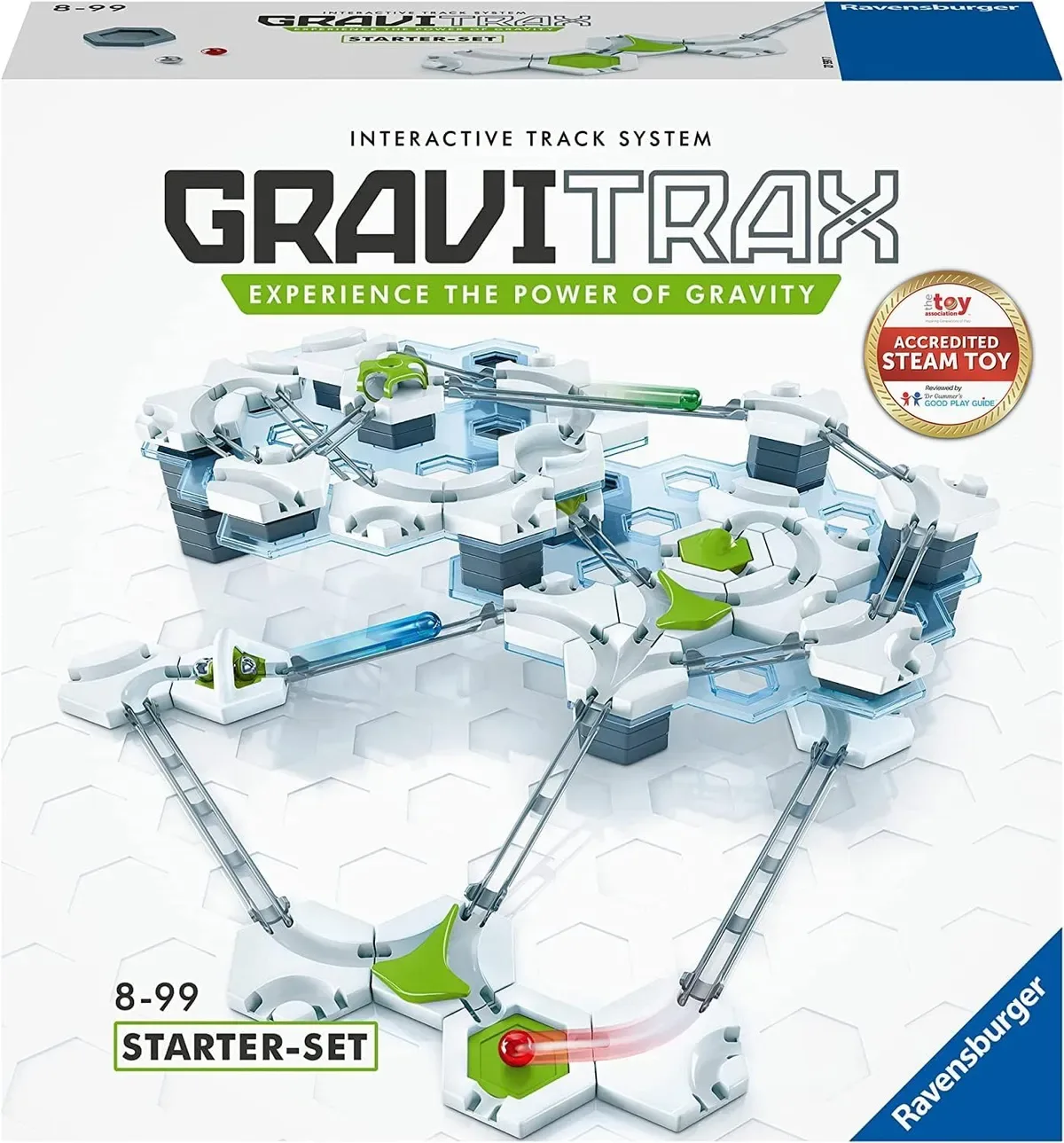
For ages 8 and up, GraviTrax is in a different class. It’s less a “marble run” and more a “kinetic engineering system.” The starter set includes:
- ~120 pieces: track pieces, various height towers, basic action pieces
- 6 marbles
- 10 challenge cards + construction manual
- Basic set of “action” pieces: loop, magnetic cannon, hopper
What makes GraviTrax different from every other marble run on the market:
- Magnetic action cannons — marble hits a magnetic “launcher” and is propelled back across the track
- Loops — fully enclosed loops a marble can traverse if it has enough speed
- Layered-height design — tracks can span multiple heights in 3D space
- Interchangeable pieces — the same pieces support thousands of different tracks
At age 8+, kids can plan complex multi-step tracks, iterate on designs, and engage with genuine engineering problems (“how do I keep the marble moving after it hits the cannon?”). See our full review — Product Rating 9/10, Moderate evidence.
Expansions Worth Knowing
- GraviTrax PRO expansion ($40) — more complex pieces including verticals, splits, and advanced combinations
- GraviTrax Trax Expansion ($15) — more basic track pieces for larger runs
- GraviTrax Lifter Expansion ($25) — motorized elevator that lifts marbles back up
- GraviTrax Magnetic Cannon Expansion ($30) — more of the signature action pieces
Budget guidance: Starter + PRO ($100 combined) is the sweet spot for most 8–12-year-olds. Beyond $100 of expansions, marginal engagement returns typically diminish.
The Age 6–9 Bridge
Between Hape’s upper age (about 7) and GraviTrax’s lower age (about 8), there’s a bridge. GraviTrax is rated 8+ but many motivated 7-year-olds engage with it if they’ve previously done marble runs. Hape’s upper comfort is ~7 but can stretch to 8 for a child who isn’t ready for GraviTrax’s complexity.
If the child is 7: Hape Marble Run is the safer pick. GraviTrax Starter with adult scaffolding works if the kid is engineering-inclined.
If the child is 8: GraviTrax Starter is the right fit for most kids. Hape is below the challenge floor they want.
Alternatives Worth Noting
Quadrilla Wooden Marble Run — $60–$200
High-end wooden marble run system. Different build aesthetic from GraviTrax (traditional wooden towers and rails vs GraviTrax’s plastic-modular). Comparable price range. Heirloom-quality wooden pieces; beautiful on display. Worth considering for a family that prefers wooden aesthetic and doesn’t need GraviTrax’s magnetic cannons.
Magna-Tiles + Ramp Add-On Sets
Magna-Tiles plus accessory ramp/ball sets create improvised marble runs. Less precise than GraviTrax but leverages existing Magna-Tiles investment. Not really a marble run per se — more a Magna-Tiles extension.
Hape Marble Run + GraviTrax Starter Combo
For a household with multiple kids spanning the age-7-vs-age-8 divide: owning both gives each child the age-appropriate fit. Total cost ~$100 for a 2-kid household.
What to Avoid
- Cheap plastic marble runs under $20. Connectors tend to fail within weeks of regular play.
- Marble runs requiring specific marble sizes. Some knockoff products use proprietary marbles; if lost, the run becomes non-functional.
- “Build a marble run” kit marketed to ages 3+ that are actually designed for age 6+. Assembly complexity doesn’t match the age label.
- Lego-brand marble runs. Typically more “LEGO with marbles” than actual marble-run engineering; worth considering only if LEGO is the child’s primary brand interest.
- Motorized marble runs that require app control. See our Screen-Free STEM Kit Audit — the app-dependent marble-run category is small and we haven’t found one we recommend over screen-free alternatives.
The Physics That Marble Runs Teach
At the core, marble runs demonstrate:
- Potential vs kinetic energy — marble at the top has stored energy that converts to motion
- Conservation of energy — marble can only go as far/high as it has energy for
- Friction losses — longer or curvier tracks lose more energy
- Newton’s laws — marble continues in straight line unless acted upon
- Elasticity and momentum — magnetic cannons illustrate elastic collisions (GraviTrax specifically)
For a 10-year-old working through GraviTrax’s more challenging builds, these aren’t abstractions — they’re the concepts the marble physically illustrates.
See our NGSS-by-grade STEM toy map for specific NGSS Performance Expectations GraviTrax supports (4-PS3-1, 4-PS3-2, 4-PS3-4).
The Bottom Line
Ages 4–7: Hape Marble Run at $40. Wooden, age-appropriate, reliable.
Ages 8+: GraviTrax Starter Set at $60. Real engineering system, scales with expansions, multi-year value.
For the engineering-serious 10+: GraviTrax Starter + PRO expansion ($100 combined).
For families spanning ages 5 and 10: Hape for the younger, GraviTrax for the older. Most families benefit from having one marble toy appropriate for each child’s developmental stage.
Every product recommended has been reviewed in depth by our team.